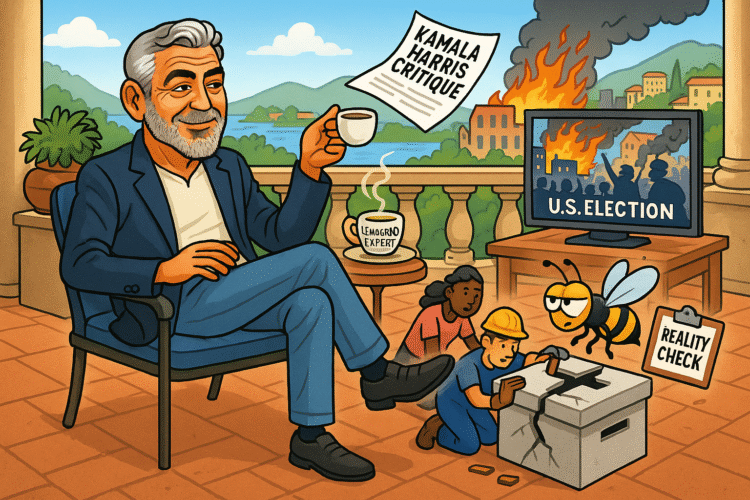
There’s something almost poetic about George Clooney criticizing the Democratic Party from an Italian villa while American democracy keeps coughing up blood in the background. It’s like watching a man deliver a eulogy for a house he helped burn down, except he’s doing it over espresso, wearing a watch that costs more than a precinct’s voter outreach budget.
In a CBS Sunday Morning interview filmed somewhere that looked suspiciously like a museum of good lighting, Clooney decided the moment was ripe to tell America that Democrats had made a terrible mistake nominating Kamala Harris without a competitive primary after Joe Biden withdrew. It wasn’t democratic, he said. It wasn’t fair.
The words hung in the air like fine mist over Lake Como.
Here was a man who, six weeks before the 2024 election, used the pages of The New York Times to publicly demand that Joe Biden drop out “for the good of the country.” A man who helped create the exact vacuum he now blames others for filling too quickly. A man who cracked the dam, then complained about the flood.
Let’s rewind.
In July 2024, after a brutal news cycle and donor panic set off by that Clooney op-ed, Biden stepped aside. It was an unprecedented move. Kamala Harris stepped up, inheriting the nomination, the debt, and the mess—with 107 days left before the election.
That’s 107 days to assemble a national campaign infrastructure, rebrand a ticket, fundraise nearly a billion dollars, and stand toe-to-toe with a convicted felon running the most authoritarian campaign in modern history.
And somehow, Clooney’s take is that she didn’t have enough competition.
It’s like a man crashing your car and then asking why you didn’t take it to the car wash first.
This wasn’t an interview about civic insight. It was an exercise in self-exoneration. Clooney didn’t want to talk about what he did. He wanted to make it sound noble. His op-ed, he said, was about democracy. About the voters’ right to choose.
Except they didn’t get to choose. Because people like him made sure they couldn’t.
By pressuring Biden to drop out that late in the race, donors and insiders like Clooney guaranteed that there would be no primary. There wasn’t time. Ballot deadlines had passed. The logistics were impossible. What remained was a narrow path—Harris, as vice president, stepping in to save the party from implosion.
And she almost did.
Harris didn’t lose because of lack of legitimacy. She lost because democracy doesn’t fit neatly into a 107-day schedule, and because the same pundits and patrons who forced the reset then sat back, clutching pearls about the speed of the recovery.
Clooney’s performance on CBS was measured, sincere, and utterly divorced from reality. He sat there with the calm of a man who’s never had to scramble for rent, explaining that nominating Harris was “unfair to her.”
That’s the line that stuck.
Unfair to her.
Not unfair to the millions of women, young voters, and working-class Americans who had to watch democracy get turned into donor theater. Not unfair to the people Harris inspired or the organizers who worked overtime to build a campaign from the ashes. No, the tragedy, in George’s mind, was procedural.
It’s the political equivalent of a man lamenting the lack of a sommelier during a famine.
Don Winslow, never one to waste characters on subtlety, said what most Democrats were thinking.
“Do you see George Clooney out there helping any Democratic candidates? NOPE.
Do you see George Clooney writing op-eds against Donald Trump or his hateful racist policies? NOPE.
Do you see George Clooney doing anything but tearing down Biden/Harris? NOPE.”
Winslow called him an “insufferable asshole,” which, while inelegant, was refreshingly efficient.
He wasn’t wrong.
Clooney hasn’t used his platform to fight fascism, organize voters, or amplify policy. He hasn’t campaigned for candidates in swing states or hosted fundraisers for down-ballot Democrats. He’s done what celebrities often do when politics gets messy—he’s curated distance.
When the stakes are high, they offer “thoughts.” When democracy sputters, they offer statements. And when they do participate, it’s usually in the least consequential way possible—like narrating a documentary or speaking from a villa about how the people running the firehose aren’t using enough water pressure.
There’s a pattern here. Clooney’s version of civic engagement has always been cinematic. He approaches politics like a film set—believing in well-framed moments, moral clarity, and tidy resolutions. He loves causes that fit in two sentences and end with applause.
But governing isn’t a script. It’s a spreadsheet covered in sweat and compromise. It’s the kind of work that doesn’t make good television.
Kamala Harris learned that lesson in real time. She spent 107 days trying to stabilize a party that had been hollowed out by performative despair. She campaigned on childcare, abortion rights, infrastructure, housing, and democracy itself. She made mistakes. She adjusted. She built something that looked like America, even if it wasn’t enough to win.
Meanwhile, George was sipping espresso and explaining how she should have had a longer audition.
There’s also the unspoken part—the racial and gender subtext that everyone else is too polite to name.
Because the tone of Clooney’s critique isn’t neutral. It’s paternalistic. It’s the sound of a man who believes he’s doing a favor by being disappointed.
When Biden fumbled debates, it was “fatigue.” When Harris faced a stacked deck, it was “unearned.” When men lose, it’s circumstance. When women lose, it’s a referendum.
And when a Black and South Asian woman loses after running the fastest campaign in modern history, elite voices don’t ask what broke the system—they ask whether she was the right person to test it.
That’s not analysis. That’s conditioning.
To be fair, Clooney isn’t malicious. He’s just insulated. He’s part of a class of people who confuse access for understanding. They live so far above consequence that politics becomes an aesthetic preference rather than a civic duty.
For them, democracy is something to be curated, not protected.
They want politics to feel like prestige television: smart, moral, perfectly lit. They crave the illusion of order, even when the world is burning. And so they build narratives where they can still be the heroes—“concerned citizens,” “truth-tellers,” “bridge-builders.”
But sometimes the bridge isn’t between parties. Sometimes it’s between reality and delusion.
The irony is that Clooney has played this role before—literally. In The Ides of March, he directed and starred as a presidential candidate undone by ego, loyalty, and moral shortcuts. It was a sharp critique of idealism corrupted by ambition. The film ends on a note of quiet ruin.
Apparently, he thought it was a documentary.
Because that’s what this looks like: a man so enamored with the image of integrity that he doesn’t realize he’s become the cautionary tale.
Let’s be clear: George Clooney didn’t destroy the Democratic Party. But he did help fracture its morale at a moment when unity was oxygen. His op-ed validated every whisper campaign that Biden was too old, too weak, too vulnerable. It gave permission to the panic.
And now, with the election lost and the consequences visible from space, he’s decided that the problem was “process.”
It’s like watching a firefighter blame the water for getting things wet.
What makes Clooney’s position especially absurd is that the party did do what he said it should. They made a bold move. They trusted the voters. They chose a candidate who reflected the country’s demographic reality and moral center.
And then they watched people like him bail the moment things got complicated.
Clooney’s silence during Harris’s campaign was deafening. He didn’t headline events. He didn’t open his wallet. He didn’t use his name to counter the right-wing propaganda that dominated the airwaves.
But he did find time to talk about how sad it all was.
This is the sickness of elite liberalism: the worship of narrative over action. The need to be seen caring more than to actually do something.
If Clooney wanted to help, he could start by understanding what Kamala Harris actually represents. She’s not a symbol. She’s a working politician who’s fought uphill every step of her career. District attorney who built reentry courts for offenders. Attorney general who stood up to the banks. Senator who grilled power like it was her second language. Vice president who helped steer the country out of a pandemic and into historic infrastructure investment.
That’s not a résumé. It’s a receipt.
And when she finally got her shot to lead, the people who should have had her back were too busy writing elegies for the process.
George Clooney loves to talk about democracy as if it’s an endangered species he funds through a nonprofit. But democracy doesn’t need patrons—it needs participants.
He doesn’t have to run for office. He doesn’t even have to pick up a sign. He could just use his platform to amplify the people who are actually fighting. Instead, he’s turned punditry into therapy.
There’s nothing brave about critiquing a candidate you refused to support. There’s nothing noble about regret when it’s convenient.
The Democratic Party doesn’t need George Clooney’s permission to move forward. It needs him to stop mistaking nostalgia for insight.
In the end, the most revealing part of Clooney’s interview wasn’t what he said—it was where he said it. From Italy.
From a place where politics is an abstraction, where elections are theater, and where you can talk about fairness without ever seeing what hunger looks like up close.
It’s hard to take a sermon about democracy seriously from a man who doesn’t even live under its consequences.
That’s the final absurdity: George Clooney, lecturing America about the meaning of democracy while living abroad like it’s a brand he endorses but doesn’t use.
So here’s the lesson, George. You wanted to play civic conscience, but you ended up auditioning for the role of “well-meaning distraction.” You wanted to spark a reckoning, but all you did was hand the other side a soundbite. You wanted to save democracy, but you forgot to read the script where democracy saves itself by showing up, not sounding clever.
You’re not the villain, George. You’re the subplot.
And while you’re polishing your regret on another marble terrace, the people you second-guessed are still doing the work.
Final Section: Postscript from the Cheap Seats
Every generation gets the activist it deserves. Some chain themselves to trees. Some run for office. And some, apparently, call CBS from their yacht to explain that the party didn’t handle the coup with enough choreography.
Clooney has become the embodiment of a certain liberal vanity—the kind that confuses moral discomfort with moral courage. He’s proof that even the most handsome man in the room can still say something deeply stupid when the mirror becomes his main source of political insight.
He doesn’t need to shut up. He just needs to pick a side.
Because democracy isn’t a movie, and the credits aren’t going to roll before the next election.