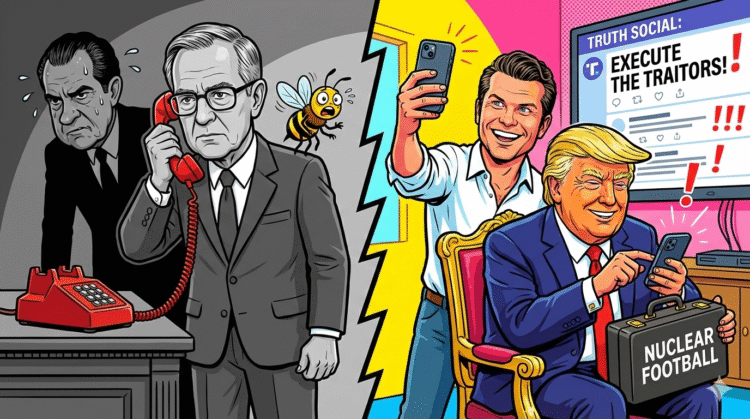
If you want to know the exact moment the American presidency dissolved from a functioning executive branch into a chemically unstable mood ring, you don’t need to look at the nuclear codes or the classified briefings. You just need to look at Truth Social at 3:00 AM, where the Commander-in-Chief is currently debating whether it is more appropriate to arrest six sitting members of Congress or simply execute them for the crime of reading the instruction manual.
As Tom Nichols points out in his Atlantic essay “The President Is Losing Control of Himself,” we have moved past the “authoritarian bluster” phase of the Trump presidency and entered the “explicit death threats in all caps” phase. It is a subtle but important distinction. Bluster is saying you want to lock up your opponents. Escalation is typing “SEDITIOUS BEHAVIOR, punishable by DEATH!” because a group of veterans had the audacity to remind the military that their loyalty belongs to a piece of paper called the Constitution, not to the guy currently throwing ketchup at the wall.
The targets of this digital fatwa—Senators Elissa Slotkin and Mark Kelly, along with Representatives Jason Crow, Maggie Goodlander, Chris Deluzio, and Chrissy Houlahan—are all people who have actually worn the uniform or served in national security. They released a video that was, by any objective standard, a civics lesson. They reminded service members that “just following orders” hasn’t been a valid defense since 1945 and that they have a duty to refuse illegal commands.
To a normal president, this would be a banal statement of fact. To Donald Trump, it was an assassination attempt on his ego.
Nichols correctly situates this outburst in a week of behavior that can only be described as “medically erratic.” The trigger, of course, was the Epstein Files Transparency Act. For months, the administration fought this bill with the desperate energy of a man trying to hide a dead body in a glass house. When the House passed it 427-1 and the Senate approved it by unanimous consent, the dam broke. Trump signed the bill, but he did it while seething, unleashing a string of demands that the legislators who forced his hand be treated as “TRAITORS.”
The psychological unraveling was visible in real-time. In a meeting with Saudi Crown Prince Mohammed bin Salman—a man who knows a thing or two about dealing with troublesome journalists—Trump snapped at ABC’s Mary Bruce, calling her “insubordinate.” Later, he referred to a female reporter asking about the Epstein emails as “piggy.” This is not the behavior of a master strategist playing 4D chess. This is the behavior of a man whose internal monologue has grabbed the steering wheel and is driving the car off a cliff.
The response from the White House press shop has been a masterclass in gaslighting. Press Secretary Karoline Leavitt, whose job is now 90% crime scene cleanup and 10% creative writing, offered a surreal denial that the President actually wants to kill members of Congress. She then immediately pivoted to scolding the lawmakers for supposedly undermining the “chain of command.”
Let’s pause on that. The White House is arguing that reminding soldiers of their constitutional oath is a threat to the chain of command. This implies that the chain of command is contingent on the soldiers not knowing the rules. It suggests that the military’s legitimacy rests on blind obedience to the leader, rather than fidelity to the law. It is a terrifying inversion of the American military ethos, delivered with the straight face of a spokesperson who knows she is defending the indefensible.
Nichols invokes a chilling historical parallel: the 1974 episode in which Defense Secretary James Schlesinger quietly told the Joint Chiefs to route any “unusual” orders from a drunk, unraveling Richard Nixon through him. Schlesinger knew that a president facing impeachment and psychological collapse was a danger to the republic. He created a human firewall to prevent a nuclear launch ordered in a fit of pique.
The problem, as Nichols argues, is that 2025 is a worse version of 1974. Trump is (presumably) sober, but his state of mind is far more volatile. He is vengeful, paranoid, and panicked over the Epstein files and the various investigations closing in on him. And crucially, Defense Secretary Pete Hegseth is no James Schlesinger. Hegseth is a Fox News host turned Pentagon chief who was hired for his loyalty, not his ability to tell the President “no.”
We are left with a terrifying equation: A Commander-in-Chief publicly howling for blood against legislators whose only “crime” was citing the law, a base that has a history of acting on his violent rhetoric, and a defense secretary who is more likely to retweet the death threat than intercept it. The “adults in the room” have all left the building, and the nuclear football is sitting on the desk next to a man who thinks “piggy” is a sick burn.
The Schlesinger Gap
The scariest part of Nichols’s analysis is not what Trump is doing, but what the system is not doing. In 1974, the institutions held because there were people inside them who valued the country more than their careers. Today, the institutions are staffed by people who were hired specifically because they passed a loyalty test to the man, not the Constitution. When Trump calls for the execution of Mark Kelly—an astronaut, for God’s sake—there is no one in the West Wing telling him to put the phone down. There is only Karoline Leavitt, figuring out how to spin “death to traitors” as a bold new policy initiative. We are living in the Schlesinger Gap, the space between the breakdown of executive sanity and the failure of the failsafes. And right now, that gap looks wide enough to swallow the entire republic.