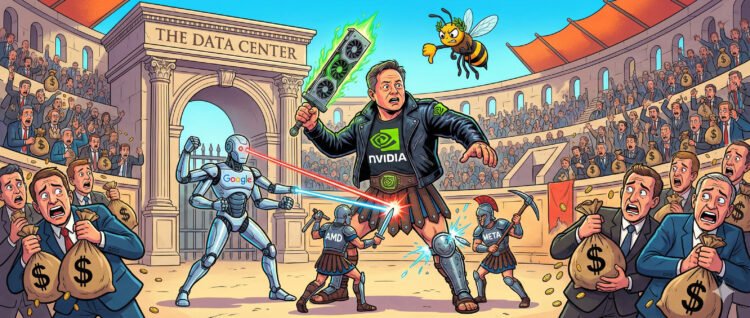
For the last eighteen months, the entire global financial system has effectively been a single, levered bet on Jensen Huang’s leather jacket. The investment thesis was simple enough for a Golden Retriever to execute: buy Nvidia, buy more Nvidia, and then buy calls on Nvidia. It was the “one true trade,” a monolithic belief that the only shovel-seller in the AI gold rush was the company making the H100s. But if you listened closely this week, underneath the roar of another blowout earnings call, you could hear the sound of that monolith cracking.
The “AI trade,” once a singular, unstoppable force, is splintering.
According to reporting from the Wall Street Journal and the frantic whispers of traders who suddenly have to do actual research, the market is rotating. The easy money is gone. We are entering the era of the “alt stack,” where the monopoly is being challenged not by a scrappy startup, but by a four-trillion-dollar search engine that woke up and remembered it also designs chips.
The Google Pivot: From “Search Giant” to “Silicon Dealer”
The catalyst for this vibe shift is Alphabet. After months of being treated like the embarrassing uncle of the AI revolution—the one who hallucinates glue on pizza—Google has surged back into the conversation with the rollout of Gemini and, more importantly, a ruthless push to sell its in-house Tensor Processing Units (TPUs) to the world.
The headline that stopped the scrolling was the revelation that Meta is in talks to shift a significant chunk of its AI training off Nvidia hardware and onto Google’s custom silicon. This is the tech equivalent of the Rebels stealing the Death Star plans. Meta, one of the largest buyers of GPUs on the planet, is openly flirting with the idea that they don’t need to pay the “Nvidia tax” forever.
Google isn’t just selling these chips to itself anymore. It is pitching them to high-frequency trading firms, banks, and rival tech giants. They are effectively saying, “Nice monopoly you have there. It would be a shame if someone offered a cheaper, more efficient alternative that integrates perfectly with the model we just released.”
The “Choppy” Reality of the King
Nvidia, for its part, is still putting up numbers that look like typos. They posted another quarter of revenue that would make a small nation blush. But the stock reaction was telling. It didn’t moon; it wobbled. It turned “choppy.”
This chop is the sound of hedge funds unwinding the most crowded trade in history. It is the sound of AI-focused ETFs frantically rebalancing because they realized they were accidentally 40% exposed to a single ticker symbol. The “GPU Maximalists”—the true believers who think CUDA is a religious text—are suddenly having to argue with the “Alt Stack” heretics who think AMD, Qualcomm, and Google might actually peel off slices of the data center budget.
The narrative has shifted from “Nvidia is the only game in town” to “Nvidia is the best game in town, but have you seen the cover charge?” And in a market priced for perfection, even a hint of competition looks like a disaster.
The Fragility of the Magnificent Seven
Zoom out, and this splintering exposes the terrifying fragility of the broader rally. The S&P 500 has been essentially three trench coats in a trench coat for a year, propped up by seven mega-cap stocks that account for an absurd percentage of the gains. If the AI trade fractures, if the capital starts to rotate out of the leaders and into the challengers, the entire index starts to look shaky.
We are moving from the “rising tide lifts all boats” phase of the mania to the “knife fight in a lifeboat” phase. Wall Street is suddenly being forced to distinguish between companies that are actually shipping profitable AI products (the infrastructure builders) and the companies that are just bolting “AI” onto every press release to pump their stock (everyone else).
The “vibes” era of AI investing is over. The “infrastructure” era has begun. And in this new phase, it isn’t enough to just say you are buying chips. You have to know whose chips, what they cost, and whether the company selling them can actually deliver the intelligence they promised, or if they are just selling you a very expensive autocomplete.
Receipt Time
The market is waking up to the fact that “AI” is not a single ticker symbol. It is a supply chain. And supply chains are messy, competitive, and prone to disruption. Google’s aggressive entry into the merchant silicon market, combined with the looming presence of AMD and Qualcomm, means the margins are going to get squeezed. The “thesis” is no longer simple. It is a complex, multi-front war for the plumbing of the future. And if you are still holding Nvidia and calling it a day, you might want to check the news. The monopoly is over. The competition has arrived.