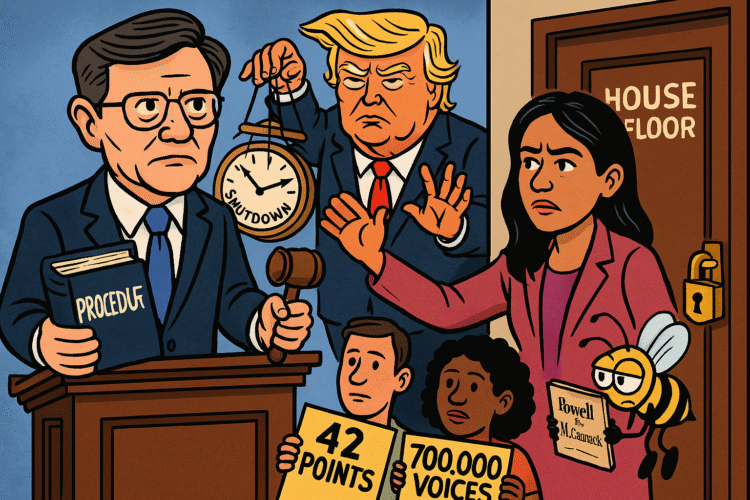
It takes a special kind of cynicism to lose an election by forty-two points and still claim victory through bureaucracy. Enter Speaker Mike Johnson, the man who can make “government by inaction” sound like constitutional originalism.
Adelita Grijalva—daughter of longtime Arizona Representative Raúl Grijalva, former Tucson school board president, and newly elected congresswoman for Arizona’s 7th District—won her September 23 special election in a landslide so decisive that even the math was bipartisan. Forty-two points. Seven hundred thousand Arizonans went to the polls, made their choice, and sent her to Washington.
That was thirty-seven days ago. She still hasn’t been sworn in.
Why? Because the government shut down on October 1, and Speaker Johnson decided that the “lack of operational funding” somehow extends to administering the oath of office. Apparently, the Constitution requires a continuing resolution to open a Bible.
The Manufactured Crisis of Representation
To understand how absurd this is, let’s start with the text that Johnson pretends to love:
Article I, Section 2 of the U.S. Constitution says the House “shall be composed of Members chosen every second Year by the People of the several States.” There’s no “unless Mike Johnson is busy grandstanding during a shutdown” clause.
Section 5 gives the House the power to “judge the Elections, Returns and Qualifications of its own Members.” That doesn’t mean “ignore the results indefinitely.”
And for the record, Powell v. McCormack (1969) already decided this exact issue. In that case, the Supreme Court ruled that the House can’t exclude a duly elected, qualified member who meets the constitutional criteria. Translation: if the people choose you, you get your seat.
But here we are, nearly six weeks later, with the Speaker claiming that procedural housekeeping and “shutdown protocols” prevent swearing her in.
If that logic holds, Congress could literally shut down democracy anytime it wants—no tanks, no coups, just an “administrative delay.”
The “Shutdown” Excuse: A Masterclass in Bad Faith
Johnson’s office insists that “floor actions are limited during the funding lapse.” You’d think they were waiting on a delivery of ceremonial Bibles.
Meanwhile, the House still manages to hold press conferences, issue subpoenas, and conduct selective outrage hearings about “weaponized government.” Apparently, government isn’t too weaponized to disarm democracy.
Behind the scenes, aides admit that the real reason for the hold is political leverage. Seating Grijalva would give Democrats another vote—and her signature is the 218th needed on a discharge petition that could force a floor vote to release the Jeffrey Epstein files.
Yes, the same files that have become a bipartisan embarrassment because they contain the names of donors, lobbyists, and, by some accounts, more than a few familiar faces from the current administration’s social circles.
The logic is simple: no Grijalva, no signature. No signature, no vote. No vote, no exposure.
So the Speaker wrapped a procedural gag around Arizona’s 7th District and called it “order.”
The Lawsuit: Arizona Fights Back
On October 21, Arizona Attorney General Kris Mayes and Grijalva filed suit in federal court in Boston—yes, Boston, because that’s where the judiciary consolidated shutdown-related governance cases.
Their complaint argues two main points:
- Administrative convenience does not override constitutional entitlement. The House has no authority to withhold an oath once an election is certified and the member-elect meets the basic qualifications.
- Indefinite delay violates the Guarantee Clause, which promises every state a republican form of government. A district without a representative for thirty-seven days isn’t republican government—it’s administrative disenfranchisement.
They’re seeking a temporary restraining order (TRO) and an injunction compelling Johnson to administer the oath immediately.
The filing cites Powell v. McCormack as precedent, alongside the Food and Nutrition Act case from the same shutdown cycle, to argue that constitutional guarantees don’t evaporate just because the Speaker declares a “pause.”
The docket has been assigned to Judge Indira Talwani, who also presides over the SNAP litigation in Boston. Legal observers note that the overlap isn’t coincidental: both cases involve the same question—can an executive or legislative officer weaponize procedure to deny rights during a funding lapse?
The Timeline of a Manufactured Absence
September 23: Adelita Grijalva wins the AZ-07 special election by 42 points.
September 28: Arizona certifies the results. Grijalva’s credentials are transmitted to the House Clerk.
October 1: The government shuts down. Speaker Johnson issues a memo suspending “non-essential floor actions.” Swearing in a new member, apparently, is non-essential.
October 4–15: Democrats send multiple letters requesting unanimous consent to administer the oath. Johnson’s office refuses, citing “shutdown limitations.”
October 16: A discharge petition to release the Jeffrey Epstein files reaches 217 signatures—one short of the required 218.
October 21: Grijalva and AG Mayes file suit in federal court. The case is docketed as Grijalva et al. v. Johnson et al.
October 24: Johnson holds a press conference insisting that “procedural integrity” requires waiting for funding to be restored. He does not clarify how the funding lapse affects a 15-second oath.
October 25: Governors and advocacy groups from 25 states release a joint letter calling the delay “an unconstitutional disenfranchisement of 700,000 Arizonans.”
Quantifying the Harm
While Johnson plays hall monitor to democracy, the cost of his obstruction is measurable:
- 37 days without representation for more than 700,000 Arizonans.
- Zero votes cast in the House on their behalf.
- Two committee vacancies (Education and Labor; Oversight) that remain unfilled.
- Thousands of constituent case files stalled, including veterans’ benefits, Social Security claims, and federal grant applications.
- A missed discharge petition signature that could have forced sunlight onto one of the most disturbing unresolved scandals in modern politics.
When asked about the mounting harm, Johnson’s spokesperson replied, “The Speaker is ensuring process integrity.”
When pressed on whether integrity includes ignoring the Constitution, the spokesperson said, “Next question.”
Legal Stakes: Powell, the Guarantee Clause, and the Separation of Powers
If the court grants the TRO, it will reaffirm Powell v. McCormack’s principle that Congress cannot invent new conditions for seating members. The ruling could also extend the Guarantee Clause beyond its usual theoretical role, making it a practical check against procedural disenfranchisement.
On the other hand, if Johnson wins, the implications are chilling. It would mean that during any funding lapse or “floor disruption,” the Speaker could effectively suspend representation for entire districts, indefinitely, without consequence.
It’s the kind of precedent authoritarian lawyers dream of: disenfranchisement by calendar.
The Rhetoric of “Order”
Johnson’s allies claim this is about “respecting institutional rules.” But their idea of order looks a lot like selective chaos.
They cite “shutdown posture” as though democracy requires a mood ring. The truth is simpler: this is procedural hostage-taking, plain and simple.
Arizona voted. The state certified. The House Clerk acknowledged receipt. The only thing missing is the oath—fifteen seconds of ceremony that separates democracy from dictatorship.
Political Calculus: Silence as Strategy
Behind closed doors, Republican strategists admit they’re using Grijalva’s absence as a stress test. If they can block one member from taking the oath, they can block others later under the same pretext.
The next time a Democrat wins a red-leaning special election, expect the same playbook: “We can’t swear them in during a shutdown,” or “We’re reviewing their qualifications,” or “We’re protecting institutional integrity.”
It’s the legislative equivalent of gerrymandering time.
And as usual, the media covers it as a “procedural dispute.”
The Media’s Reflexive Cowardice
Cable anchors love the phrase “both sides claim.” It’s their favorite prophylactic against clarity.
So when Johnson’s office says, “We’re just following process,” reporters dutifully repeat it. When constitutional scholars point out that process doesn’t supersede representation, the chyron reads: Debate Over Oath Timing Intensifies.
It’s not a debate. It’s a theft.
A duly elected official has been barred from serving for over a month, and the press calls it “delay.”
If seven hundred thousand Floridians or Texans were denied representation for thirty-seven days, it would be a constitutional crisis. But because it’s Arizona—and because the party in power benefits—it’s just “process.”
Reactions and Consequences
Democrats are calling it what it is: disenfranchisement. Representative Robert Garcia called it “a grotesque abuse of procedural power.” Senator Mark Kelly described it as “holding Arizona hostage.”
Republicans in Johnson’s circle insist it’s temporary. “We’ll get to it once the government reopens,” said one aide. Asked what reopening has to do with swearing in a member, he said, “Everything is interconnected.”
Voting rights groups warn that the precedent could snowball. If you can delay representation under the guise of “shutdown protocol,” you can delegitimize any election result you dislike by simply running out the clock.
Arizona officials are livid. Governor Katie Hobbs called the delay “anti-democratic sabotage.” Attorney General Mayes, in announcing the lawsuit, said, “When the Constitution says the people shall be represented, it doesn’t include a government funding disclaimer.”
Even some conservatives privately admit discomfort. One former GOP aide told The Bulwark, “If Nancy Pelosi did this, Fox News would be in DEFCON 1.”
The Next Two Weeks: Concrete Checkpoints
- Preliminary Injunction Hearing: Judge Talwani is expected to schedule an emergency hearing within ten days to determine whether Johnson’s delay violates Powell.
- House Floor Maneuvers: Democrats may attempt a privileged resolution to swear in Grijalva, forcing a recorded vote that would put Republicans on record against seating a member-elect.
- Unanimous Consent Attempt: Minority Leader Hakeem Jeffries could again request unanimous consent to administer the oath, daring Johnson to object in public.
- Epstein Discharge Petition: Without Grijalva’s signature, the petition remains one short of triggering a vote. The deadline is approaching fast.
- Inspector General Review: The House IG may be asked to investigate whether “shutdown protocol” memos were legally vetted or purely political.
The Broader Question: Can Democracy Be Procedurally Gutted?
This episode is not about one congressional seat. It’s about the normalization of disenfranchisement as administrative policy.
We are watching a slow-motion coup that doesn’t need tanks—it only needs a gavel, a memo, and a willing media ecosystem that refuses to call it what it is.
When a Speaker can nullify an election by citing “shutdown posture,” the line between democracy and authoritarianism becomes a matter of scheduling.
Seven hundred thousand people cast ballots. They’re now invisible because a man with a Bible and a procedural memo says “not yet.”
Closing Section: The Silence Between Oaths
Every democracy dies in the silence between oaths.
Adelita Grijalva did everything right: ran, won, certified, showed up. Her district did everything right: voted, waited, trusted. The only thing left undone is fifteen seconds of ritual—the part where the government looks its people in the eye and says, “Your voice counts.”
But not yet.
Not until the Speaker finds it convenient. Not until the next round of budget brinkmanship ends. Not until democracy stops being leverage and starts being law again.
The irony, of course, is that this entire saga unfolds under the same Capitol dome where members quote Scripture about justice and liberty before voting to suspend both.
Powell v. McCormack settled this fifty-five years ago. But perhaps the new Congress doesn’t read Supreme Court decisions—only shutdown memos and polling crosstabs.
So the question now isn’t whether Grijalva will be sworn in. She will, eventually. The question is what we normalize in the meantime. Because once a party learns it can erase a district’s voice by simply refusing to administer an oath, elections become optional.
And that, my friends, is not a republic. It’s a hostage negotiation with paperwork.