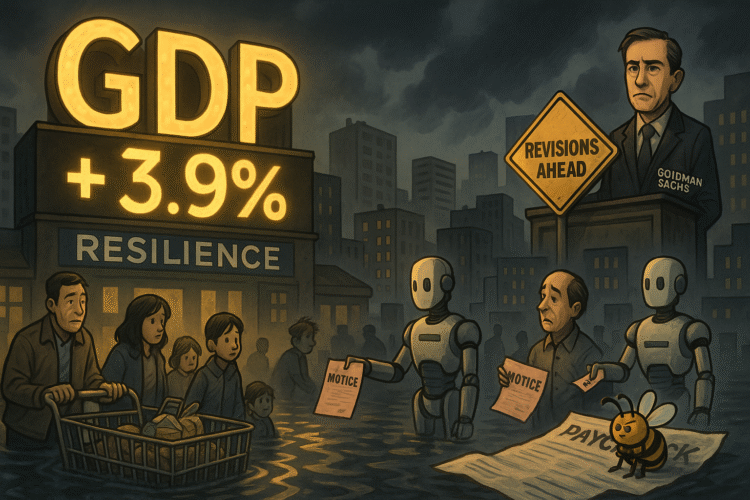
It’s official: America is thriving—on paper. The GDP is glowing like a ring light on a politician’s livestream. The stock market is preening. The White House comms shop is drafting victory tweets about “resilience.” And yet, if you’re an actual human being with a pulse, a rent payment, and a résumé floating in the void, you may have noticed the economic boom feels like an inside joke you weren’t invited to.
That’s because it is.
According to Fortune, Goldman Sachs’ chief economist Jan Hatzius has looked at the numbers and politely screamed into the void: this labor market looks the worst it has outside a recession in fifty years. The data, he warns, is lying—or at least pretending to have better lighting than it does. GDP growth is being flattered by what he calls shutdown-era “data gaps,” inventory restocking, and a brave new frontier of AI-driven “jobless growth.”
Translation: The economy is technically expanding, but people aren’t.
The Shiniest Recession Never Declared
Let’s start with the contradiction everyone’s pretending not to see. The Atlanta Fed’s GDPNow model—America’s favorite crystal ball—flashes an annualized growth rate of about 3.9%. That’s a number you’d expect in a humming, full-employment paradise. Cable news hosts say “resilient” like it’s a word that can pay bills. Politicians beam about “historic expansion.”
But Goldman Sachs is quietly trimming its growth projections. Hatzius and his team say the façade is cracking. Those big GDP numbers? Overstated. Those “strong job gains”? Revised down. Those wage growth headlines? Rewritten after the press cycle ends.
We’re living through what you might call a meme-stock GDP—all hype, no fundamentals. The data looks hot because the system that measures it is still coughing from the shutdown hangover. The Bureau of Labor Statistics, working through pandemic-era blind spots, is trying to count jobs that may not exist anymore and productivity that might just be software hallucinations.
In short, the numbers look fine because the truth is still buffering.
When 3.9% Feels Like Zero
Hatzius isn’t alone in waving the red flag. Economists across the board are muttering the same thing with different accents: Q2 and Q3 growth, hovering around 3.8% and 3.3%, may be inflated. The statistical catch-up—the great data reckoning—hasn’t hit yet.
Why does this matter? Because when you remove inventory padding and statistical glitter, what’s left looks an awful lot like stagnation. Companies restocked after supply-chain droughts, juicing output. Imports slowed thanks to tariffs, which perversely made GDP look stronger by subtracting less from net exports. But actual hiring? Actual paychecks? They’re the ghost notes under the chart.
“Resilience,” in 2025, has become the corporate synonym for “no one’s getting a raise.”
The Low-Hire, Low-Fire Twilight Zone
We’re stuck in a strange limbo economists are calling a “low-hire, low-fire” labor market. Businesses aren’t firing people en masse—that would break the illusion—but they’re sure as hell not hiring either.
You can see it in the job boards: postings vanish midweek, interviews go silent, offers expire without explanation. Companies boast about “efficiency gains” while quietly freezing headcount. “We’re investing in automation,” they say, as if AI is a coworker and not a pink slip generator.
It’s a corporate version of Schrödinger’s labor market: workers are both employed and replaceable, visible in the data but missing from payroll.
AI: The Invisible Layoff
The irony is exquisite. The same “productivity boom” that’s padding GDP growth is also erasing entry-level jobs faster than you can say “prompt engineering.”
Tech companies love to brag about AI like it’s the Messiah. In practice, it’s the intern who steals your job and then asks for feedback on its performance. Young coders, designers, and writers are already discovering that their replacements don’t need health insurance or weekends.
AI displacement doesn’t show up in the unemployment rate right away—it hides in hours worked, freelance droughts, and the eerie quiet of job applications never opened. It’s the algorithmic version of a hiring freeze.
So while the official data says “output is surging,” the reality is that output per worker is rising because there are fewer workers per output. The math works; the morality doesn’t.
The Shutdown Fog
Part of the problem is technical. The federal shutdown chaos earlier this year didn’t just close parks—it scrambled the sensors that measure reality. Government statisticians lost weeks of collection, surveys lagged, and revisions started eating their young.
The result? A fog of uncertainty so thick you could run a G7 economy through it. Every economic indicator now comes with a disclaimer that might as well read “subject to revision, delusion, and political manipulation.”
The shutdown didn’t just pause data—it infected it. Now policymakers are operating off a spreadsheet that might as well be fanfiction.
Tariffs, The Ghost Inflation
Meanwhile, the administration’s tariff spree is inflating prices under the patriotic banner of “fair trade.” Imported goods are pricier, domestic producers quietly raise prices to match, and families stretch grocery budgets that already look like anxiety manifestos.
Tariffs are the magic trick of modern populism: make prices rise, call it strength, then blame the previous administration when the bills arrive.
So yes, the GDP is up. But so is the price of chicken, rent, insulin, and dignity.
The Illusion of Growth
Goldman Sachs’ warning cuts deeper than the headlines admit. A labor market “the worst outside a recession in half a century” means that beneath the spreadsheets and slogans, the social contract is eroding. For decades, economic growth meant at least a little something for everyone: higher pay, more jobs, better prospects.
Now, growth just means the corporate balance sheet got shinier while your workweek got shorter—by force, not choice.
We’re entering the era of jobless growth: the economy expands, the people don’t. GDP becomes an aesthetic, not an outcome.
The Revisions That Ate the Truth
Every few months, the Bureau of Labor Statistics revises its job numbers, and lately, those revisions are reading like apologies. Gains evaporate. Wages shrink. “Robust hiring” turns into “oops, never mind.”
It’s like watching a magician reveal how the trick was done, only to discover the rabbit died months ago.
Media outlets dutifully report the headline numbers, then forget the corrections. By the time the revisions hit, the public’s moved on, the talking points are baked, and the myth of “resilience” endures.
If the truth arrives three months late and no one’s left to tweet about it, did it even happen?
Goldman Sachs: The Cassandra of Capitalism
It’s telling when the world’s most famous investment bank starts sounding like a labor organizer. Hatzius isn’t exactly Che Guevara, but his message carries revolutionary undertones: we’re mistaking noise for progress.
Goldman’s analysts are trimming forecasts for 2025, citing weaker hiring, tariff drag, and fading inventory momentum. They’re essentially telling their clients, “The emperor’s clothes are GDP revisions.”
The irony is painful. The same firm that thrives on market optimism is now warning that the optimism itself is fake news. When the architects of capitalism start sounding like prophets of doom, you know the roof’s starting to creak.
The Political Theater of “Resilience”
Washington, of course, is thrilled with itself. The president points to the GDP figure like a toddler showing off macaroni art. Treasury officials tweet graphs shaped like good vibes. Lawmakers beam from podiums about “record productivity,” as if that phrase will make the price of cereal flinch.
It’s not that they’re lying. It’s that they’ve redefined truth as “what looks good on camera.”
Austerity is compassion. Tariffs are growth. Flat wages are freedom.
The cognitive dissonance is so thick that even the press corps has started to treat “economic strength” as a mood rather than a measurement. We’re living in an age where good feelings are economic policy and discomfort is treason.
The Households Left Behind
For most Americans, the boom feels more like background noise. Paychecks aren’t stretching. Job searches drag on. Side hustles now require side hustles. When Hatzius says the labor market looks worse than any non-recession period in fifty years, he’s describing a reality most households already know in their bones.
The “average” family isn’t living the miracle of GDP growth—they’re living the arithmetic of exhaustion: higher prices, longer commutes, thinner margins, and a growing sense that the future has been repossessed.
Politicians call it “transition.” Economists call it “restructuring.” Regular people call it “hell.”
The AI Aristocracy
The cruelest irony is that the people engineering this jobless expansion will never feel it. The architects of AI automation and tariff economics live in a world of stock options and concierge grocery delivery. To them, “labor market weakness” is an abstraction, not a paycheck.
They speak in metrics: productivity, efficiency, scalability. What they don’t mention is that every decimal point of productivity hides a human being who used to have a job.
The new aristocracy doesn’t need workers—it needs Wi-Fi.
The Meme-Stock GDP
And so we return to the meme economy: GDP as clickbait, productivity as propaganda, growth as branding. The economy has become a performance art piece where the audience starves while the stagehands polish the lights.
We are, as Hatzius implies, living through the economic equivalent of a stock pump—numbers inflated by confidence and delay. When the revisions hit, and they will, the boom will look more like a rounding error.
Until then, expect more press conferences celebrating “record growth” and more grocery aisles where the only thing expanding is disbelief.
Closing Section: The Sound of a Door Closing
The cruelest part of this illusion is its rhythm. Every cycle feels the same: the data glows, the press repeats, the people wait, and then the revisions come in like bad credit scores.
This is what happens when an economy decouples from its citizens. The spreadsheets ascend. The humans vanish.
So yes, America’s GDP is up. The charts look good. The models purr with optimism. But the only boom most people feel is the door closing behind another rejected job application.
We’ve built an economy that calls itself resilient while quietly forgetting who it’s supposed to be resilient for.
When the data finally catches up to reality, it won’t feel like a correction. It’ll feel like déjà vu.
And somewhere in the fluorescent light of a half-stocked supermarket, a family will look at the receipt, then at the headline about “strong growth,” and laugh the way people do when the only thing left to do is keep the joke alive.