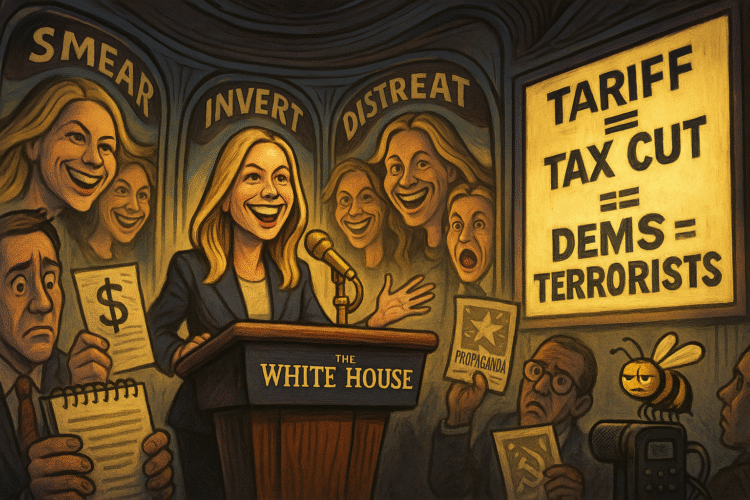
There’s a rhythm to authoritarianism, and Karoline Leavitt has perfect pitch. Every press secretary inherits a tone from the boss they serve, but Leavitt’s isn’t mere mimicry. It’s weaponized performance—an acceleration of Trumpism’s original sin: confusing cruelty for clarity. The job isn’t to inform. It’s to injure with flair, to convert talking points into shrapnel, and to make lying look like leadership.
Her latest example is a case study in how the White House’s propaganda factory now works on instinct. Appearing on Fox News, Leavitt declared that the Democratic Party’s “main constituency” is “Hamas terrorists, illegal aliens, and violent criminals.” Not fringe rhetoric, not a throwaway tweet—this was a televised statement by the official spokesperson for the President of the United States. She has since repeated it like a personal mantra, across prime-time hits and viral clips shared gleefully by right-wing influencers.
The line is designed to dehumanize. Not just Democrats, but anyone who doesn’t worship the throne. Tens of millions of Americans—parents, veterans, teachers, nurses—folded into a smear that equates dissent with treason. It’s the oldest trick in the book: divide the world into patriots and parasites, then act shocked when democracy begins to rot.
The Enemy Within (Apparently Everyone)
Let’s pause on the absurdity of that claim. If the “main constituency” of one of America’s two major parties truly consisted of terrorists, undocumented workers, and violent offenders, the country would look like a post-apocalyptic film. The claim collapses under the weight of arithmetic. But arithmetic isn’t the point—emotion is. Leavitt’s calculus is about conditioning. Repeat the lie often enough and people stop asking whether it’s true; they start asking why it feels true.
In this version of America, disagreement equals danger. Journalism is espionage. Protest is sedition. Refugees become vectors of crime, and empathy itself becomes suspect. When you label millions of your fellow citizens as “terrorists” and “illegals,” you’re not debating policy—you’re pre-clearing the ground for persecution. The rhetoric writes the warrant.
That’s the chilling logic behind the smile: say something outrageous, laugh it off as “straight talk,” and let the base absorb the dehumanization as common sense.
Tariffs Are “Tax Cuts,” and Other Fairy Tales
Leavitt’s podium performance has turned economic policy into improv theater. Asked about Trump’s tariff barrage—which economists warn will cost U.S. households about $2,400 annually—she called the tariffs a “tax cut for Americans.” It’s an inversion so perfect it belongs in a physics textbook.
Here’s what actually happens: tariffs are taxes on imports. Companies pass those costs to consumers. Prices rise. Wages lag. Inflation stretches paychecks thinner than ever. The administration insists this is “strategic pain,” as though a grocery bill is a military campaign.
When fact-checkers called the claim false, Leavitt didn’t correct it; she doubled down. “The president is standing up for American workers,” she said, while those same workers paid more for eggs, tires, and stoves. It’s rhetorical algebra designed to make suffering sound like sovereignty.
Her second economic invention came just days later: she assured reporters that Trump’s new tax-and-spending package “does not add to the deficit.” The Congressional Budget Office disagrees. So do basic numbers. The plan adds trillions.
But here’s the pattern: invert the truth, attach a flag to it, and dare anyone to challenge it without looking “anti-American.” Each press briefing is a stress test for reality. How much distortion can the public absorb before words like “fact” and “lie” lose meaning?
The Condom Conspiracy That Wasn’t
No propaganda cycle is complete without a bit of sexual panic. Enter Leavitt’s viral whopper: that the United States was funding “condoms in Gaza.” It’s the kind of claim that feels scandalous enough to be true—because it’s designed to. The allegation spread across right-wing media ecosystems like gossip at a revival meeting: “Your tax dollars, funding birth control for terrorists!”
Reuters fact-checked it. No evidence. No condoms. No program. Nothing but fumes. But the truth lagged behind the outrage, as it always does. By the time the correction landed, the claim had already done its job—flooded the zone, changed the subject, kept the outrage economy humming.
This is rumor laundering: seed a lurid claim, rely on its virality to outrun correction, and dare the press to keep up. Even when disproved, the residue remains. People remember the headline, not the footnote. And for an administration that governs through emotional manipulation, that’s victory enough.
The Budapest Blunder
Leavitt’s contempt for accountability isn’t limited to falsehoods—it’s built into her posture. When a journalist asked her why a Trump–Putin meeting was being scheduled in Budapest (a location that makes geopolitical analysts twitch, given the Budapest Memorandum’s history and Hungary’s pro-Kremlin tilt), she didn’t answer. She taunted.
The press secretary—paid by taxpayers—responded to a basic diplomatic question with a screenshot of their inquiry and a mocking caption: “So obsessed with Trump you’re emailing from brunch!”
It was pure middle-school energy, the kind of sneer you’d expect from a student council campaign, not a White House podium. But it wasn’t just immaturity—it was a signal. In this communications shop, mockery is message discipline. Questions are not obstacles to overcome but enemies to humiliate.
The tactic serves two purposes: it intimidates reporters and entertains the base. It turns governance into sport and press freedom into a punchline. It also reveals the deeper instinct at work here: disdain for scrutiny, contempt for consequence, and a fundamental misunderstanding of what a democracy requires to function.
Channeling the Boss, Amplifying the Rot
From her first briefing, Leavitt promised to “channel the president directly.” That wasn’t a metaphor. It was a surrender. The press secretary, traditionally a conduit between power and the public, has become an amplifier—one that blares the boss’s resentments at full volume.
Trump doesn’t need messaging discipline; he needs emotional reinforcement. And that’s what Leavitt provides. Her role is to weaponize his id, translate impulse into policy gloss, and turn incoherence into conviction. She is not an advisor; she’s an echo chamber.
When Trump blurts that tariffs are freedom or that protest equals treason, Leavitt’s job isn’t to clarify—it’s to consecrate. The strategy is simple: feed the base an endless buffet of outrage, distraction, and flattery until reality itself feels elitist.
The Lie Factory’s Assembly Line
If you step back and view these episodes as a series, a pattern emerges—one familiar to anyone who’s studied propaganda: smear, invert, distract, repeat.
- Smear: Label opponents as enemies. The “Hamas, illegals, criminals” line isn’t an accident—it’s a framework. By branding an entire party as subhuman, the administration sets moral pretext for future crackdowns.
- Invert: Call taxes “cuts,” call debt “surplus,” call cruelty “protection.” The inversion destabilizes truth itself.
- Distract: Drop a shocking rumor (condoms, migrants, secret foreign deals) and let it dominate the news cycle.
- Repeat: Mock those who seek accountability, and reframe any pushback as persecution.
It’s a formula built for the attention economy, where outrage is currency and facts are speed bumps. The White House communications office doesn’t correct falsehoods because the falsehood is the point. It’s a weapon, not an error.
The Psychological Toll of Perma-Theater
What’s chilling isn’t just the dishonesty—it’s the glee. Watch Leavitt closely at the podium. The smirk after each dodge. The rehearsed faux-shock at “liberal media bias.” The gleeful sound bites meant to go viral before the question’s even finished.
Every interaction becomes a stage for dominance. And dominance, not dialogue, is the end goal.
This is what authoritarian communication looks like in a democracy: performative power. It doesn’t seek to persuade—it seeks to exhaust. The lies aren’t meant to be believed; they’re meant to blur the edges of the real until exhaustion replaces outrage. When truth feels like just another opinion, the liar wins.
From Words to Warrants
But the consequences extend far beyond semantics. When you normalize slander, you pave the way for suppression. The “Democrats are terrorists” narrative isn’t rhetorical excess—it’s ideological scaffolding for repression.
If tens of millions of Americans are framed as enemies of the state, it justifies surveillance, protest crackdowns, even selective prosecution. The First Amendment becomes negotiable. Civil liberties become collateral.
Already, “No Kings” protesters have faced federal intimidation for peaceful assembly. Already, journalists critical of the administration are branded as foreign agents. The rhetoric isn’t isolated; it’s preparatory. It softens the public for the idea that some citizens are more equal than others.
That’s how democracies decay: not in one dramatic coup, but through a slow corrosion of empathy and language.
The Weaponization of Absurdity
Leavitt’s genius—if we can call it that—is the deliberate absurdity of her statements. They’re too ridiculous to take seriously, yet too dangerous to ignore. It’s a deliberate trap. Critics waste energy debunking lies that were never meant to survive scrutiny.
By the time a correction lands, the next outrage has already taken flight. The audience learns to stop caring about truth altogether. That’s how authoritarian humor works—it turns disbelief into fatigue.
This White House doesn’t suppress the press through censorship. It drowns it in noise.
When the Joke Stops Being Funny
Leavitt’s defenders insist she’s just “fighting back” against biased media. But the pattern tells another story. She’s not waging a culture war—she’s waging a credibility war. Her goal isn’t to win arguments; it’s to make arguments impossible.
When truth becomes a team sport, lies become patriotic. And once that switch flips, anything goes.
In that environment, propaganda isn’t just tolerated—it’s aspirational. Reporters become foils, institutions become enemies, and cruelty becomes the language of competence.
Measure Power by Its Relationship to Truth
The Leavitt doctrine is simple: control the story, and you control the stakes. But power should be measured not by what it says about the truth—but by what it does to the truth.
In a healthy democracy, the press secretary’s job is to explain the administration’s decisions. In this one, it’s to obscure them behind smears and sound bites. The result is governance by insult, accountability by emoji, diplomacy by meme.
The words “official statement” no longer signify authority—they signify threat. And when words lose meaning, democracy loses oxygen.
Closing Section: The Method, and the Cost
So what’s the pattern? Smear, invert, distract, repeat. It’s the four-step program of every autocrat, dressed up in press briefings and Fox chyron glow.
First, create the enemy. Second, invert morality so cruelty looks righteous. Third, flood the field with nonsense until outrage numbs. Fourth, laugh about it.
That’s the machine Leavitt operates—a ministry of make-believe whose product isn’t policy but perception.
And here’s the price: each lie, each taunt, each weaponized rumor corrodes the collective capacity to discern reality from theater. Each insult aimed at “illegals” or “terrorists” lands on real people who live, work, and pay taxes in the country their government now paints as their enemy.
When a government stops caring whether its statements are true, what it’s really saying is that truth no longer matters. And when truth stops mattering, power becomes the only thing that does.
So the next time you see Karoline Leavitt sneer her way through another briefing, remember: the smirk is the message. The lie is the leash. And the rest of us are living inside the punchline.