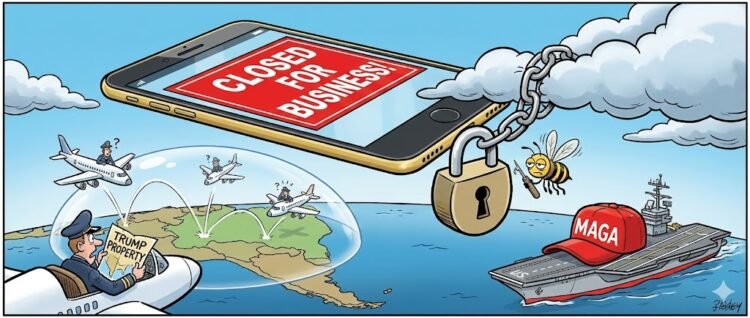
The airspace above a sovereign nation is usually governed by a complex web of treaties, international conventions, and the boring, reliable physics of radar and air traffic control. But in the year 2025, the laws of aerodynamics and the Chicago Convention on International Civil Aviation have been superseded by a more potent force: the Caps Lock key on Donald Trump’s phone.
On a Tuesday that will surely go down in the annals of diplomatic history as “The Day We Forgot How Maps Work,” the President of the United States logged onto Truth Social and issued a proclamation that effectively privatized the stratosphere over South America. “To all Airlines, Pilots, Drug Dealers, and Human Traffickers,” the post began, grouping Delta pilots and cartel sicarios into the same convenient mailing list, “please consider THE AIRSPACE ABOVE AND SURROUNDING VENEZUELA TO BE CLOSED IN ITS ENTIRETY.”
With that sentence, typed presumably between holes nine and ten, the concept of national sovereignty was officially downgraded from a “legal right” to a “polite suggestion.”
We are witnessing a brazen exercise in imperial overreach disguised as drug-war bravado. The pronouncement was not issued by the Federal Aviation Administration after months of interagency review. It was not the result of a UN Security Council resolution. It was a tweet (or a “truth,” in the parlance of the platform) that functioned as a unilateral annexation of the sky. It signals that this is less a formal legal move and more of a televised flex, part propaganda, part war advertisement, and entirely unconcerned with the fact that Venezuela actually owns the air above Venezuela.
The result was immediate, chaotic, and predictable. The government in Caracas denounced the statement as a “colonialist threat” and “illegal aggression,” phrases that sound hyperbolic until you realize that a foreign power just claimed ownership of their clouds. International airlines, which generally prefer their fuselages to remain un-perforated by missiles, immediately canceled flights. They didn’t do this because they respect the legal authority of a Truth Social post; they did it because the FAA followed up with warnings about heightened military activity and GPS interference.
This is the new diplomacy: The President screams into the void, and the bureaucracy scrambles to make the scream reality.
The Caribbean Parking Lot
The closure warning comes on the heels of a sweeping U.S. military buildup in the Caribbean that would make the Spanish Armada look like a regatta. Carrier strike groups are prowling the waters. F-35s have been deployed to Puerto Rico, presumably to protect us from the imminent threat of Venezuelan gliders. Naval patrols are conducting repeated maritime strikes on vessels accused of drug trafficking, operations that have already killed dozens of people without so much as a trial or a press release.
This is all happening under the rubric of “anti-narcotics operations,” the classic catch-all excuse for American interventionism. If you want to invade a country in the 21st century, you don’t say you’re fighting communism; you say you’re fighting fentanyl. It’s the perfect casus belli because nobody likes drugs, and drugs can’t sign a peace treaty.
But let’s be honest about what we are looking at. This isn’t a drug bust. It is a siege. The blockade of the airspace is the precursory curtain call before a possible land-based intervention to topple the government of Nicolás Maduro. It is the softening of the target. It is the moment in the movie where the villain locks the doors of the theater before setting it on fire.
The absurdity lies in the method. We are enforcing a no-fly zone not through air superiority, but through social media superiority. The President didn’t order the Air Force to shoot down planes; he just told everyone that the sky was closed, and because he is the man with the nuclear codes, everyone has to act as if he isn’t bluffing. It is a bluff backed by the GDP of the United States, which makes it a very expensive bluff indeed.
The “Drug Dealer” Loophole
The brilliance of the “Drug Dealers and Human Traffickers” framing is that it effectively depoliticizes the aggression. By addressing the warning to criminals, Trump creates a permission structure for his base to cheer for what is essentially an act of war. Who could object to closing the sky to drug dealers? Only a drug dealer would object!
It ignores the inconvenient fact that the sky is also used by commercial airliners, humanitarian aid flights, and birds. It ignores the fact that declaring a blockade against a sovereign nation is, under international law, an act of war. But in the MAGA worldview, international law is just another “woke” constraint on American greatness. Why should a piece of paper signed in 1944 stop us from doing what we want?
The Venezuelan authorities, for their part, have responded by revoking the landing rights of carriers they accuse of collaborating with “U.S.-driven state terrorism.” This creates a hermetically sealed box around the country. If you can’t fly in, and you can’t fly out, you are trapped. The people of Venezuela, already suffering under sanctions and mismanagement, are now the hostages in a geopolitical staring contest between a dictator in Caracas and a wannabe dictator in Washington.
The Slippery Slope of the “Tweet-Decree”
The broader pattern should alarm anyone who values sovereignty, oversight, or consistent legal standards. Because this “closure” is not backed by a treaty. It is not backed by a congressional declaration. It isn’t even backed by a formal Pentagon operation notice. It is framed as an all-caps ultimatum aimed at “bad hombres” but broadcast to the world as a de facto blockade.
What we must explore is not only the chaos and confusion any open-ended blockade can cause—disrupted flights, economic consequences, brinkmanship in diplomacy—but the slippery precedent. If airspace can be declared closed by a post, then international law becomes a suggestion. Aggression becomes a brand statement.
Imagine if China decided to declare the airspace over Taiwan closed via a Weibo post. Imagine if Russia declared the airspace over Poland closed via Telegram. We would call it madness. We would call it a violation of the rules-based order. But when we do it, we call it “strong leadership.” We call it “fighting the cartels.”
This is the normalization of extrajudicial-style pressure as “national security.” We are watching the spectacle of power turned theatrical. The Situation Room has been replaced by the Studio. The generals have been replaced by the social media managers. And the war is being declared not after a solemn debate in the Senate, but during a commercial break.
The Narcissism of Small Differences
The irony is that Trump and Maduro are not so different. They both believe that the state is an extension of their ego. They both believe that enemies are to be crushed, not debated. They both view the law as a tool for their friends and a weapon against their foes.
The conflict between them is not a clash of civilizations. It is a clash of mirrors.
Trump looks at Venezuela and sees a “failed state” that needs to be disciplined. He sees a resource-rich country that is “disrespecting” us. He sees a problem that can be solved with enough force and enough volume.
Maduro looks at the U.S. and sees an “imperialist aggressor” that validates his own paranoia. He needs the U.S. threat to justify his own repression. Trump’s tweets are the best propaganda Maduro could ask for. They allow him to wrap himself in the flag and claim that he is the defender of the nation against the Yankee invaders.
They are perfect dance partners, locked in a tango of escalation that serves both of their domestic political needs while immiserating the people caught in the middle.
The Absence of Adults
Where are the adults? Where are the institutionalists? Where are the people in the Pentagon and the State Department whose job it is to say, “Mr. President, you can’t just close a country’s sky because you’re mad at them”?
They are gone. They have been purged. They have been replaced by loyalists like Pete Hegseth and Kash Patel, men who view the President’s whims as commands from God. The guardrails have been removed and sold for scrap. The “adults in the room” are now the people cheering on the chaos.
We are left with a foreign policy that is entirely reactive, entirely personal, and entirely dangerous. We are risking a regional war for a headline. We are engaging in brinkmanship with a nuclear-armed world for a “like” count.
The chaos is the point. The confusion is the goal. By keeping everyone off balance, by making the rules up as he goes along, Trump maintains the illusion of total control. He is the only one who knows what is happening because he is the only one making it up.
The Future of the “Closed Sky”
As we watch the F-35s circle Puerto Rico and the aircraft carriers steam toward the horizon, we have to ask ourselves: what comes next? Does the blockade become a bombardment? Does the “anti-narcotics” operation become an invasion?
Or does it just fizzle out when the President gets bored and finds a new target?
That is the terrifying thing about government by tweet. It is ephemeral. It is fickle. The sky over Venezuela might be closed today, but it might be open tomorrow if Maduro says something nice about Trump on TV. The fate of millions of people hangs on the mood swings of one man.
This is not strength. This is instability disguised as power. It is the geopolitical equivalent of a toddler throwing toys out of the crib. It is loud, it is messy, and it demands attention. But it doesn’t build anything. It doesn’t solve anything. It just leaves a mess for someone else to clean up.
So, consider the airspace closed. Consider the law suspended. Consider the absurdity the new normal. And remember, the next time you look up at the sky, that it doesn’t belong to the birds or the clouds or the nations of the world. It belongs to the account with the most followers.