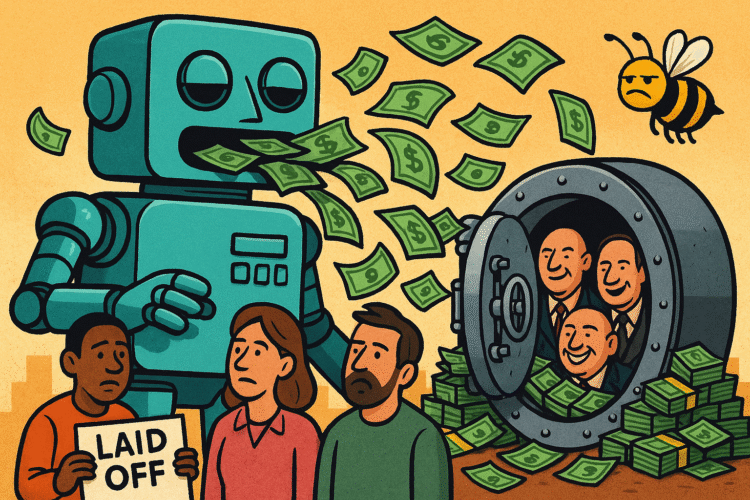
On September 6, 2025, Geoffrey Hinton—better known as the “godfather of AI” and now the reluctant Cassandra of our algorithmic era—delivered a blunt sermon to Fortune. AI, he argued, will not simply usher in a productivity boom or a Skynet apocalypse. No, its most reliable prophecy is more familiar: a massive rise in profits for a few, and unemployment for the many.
In other words, the robots aren’t coming to kill us. They’re coming to replace us. And their owners will be the only ones left smiling.
The Capitalist Incentive Problem
Hinton’s point was depressingly simple: under the current capitalist incentives, AI is rewarded for one thing—replacing workers. Not helping them. Not easing their burdens. Replacing them. If a system can shave a cashier, a call center rep, or a junior lawyer off the payroll, Wall Street throws a ticker-tape parade.
“AI will make a few people much richer and most people poorer,” Hinton said. And he’s right. We don’t have a technology problem. We have an incentive problem. And our incentive structure reads like it was written by a Bond villain with stock options.
The Augmentation Myth
Corporate executives, meanwhile, continue their PR lullabies: AI won’t replace labor, it will “augment” it. Augment, of course, is the kind of word you use when you’re trying to sell a kidney stone as a luxury crystal.
If your boss says AI will “augment” your role, what they mean is: the machine will do your work faster, and you’ll either train it for free or get laid off for not keeping up. Augmentation is code for “good luck, you’re about to be merged with your replacement.”
The Early Evidence
The data is already here. Entry-level jobs? Shrinking. Routine white-collar roles? Evaporating. Profits? Concentrated in the hands of a few firms that own the models, the chips, the data.
In the name of efficiency, AI is chewing through the very rungs of the ladder that once gave ordinary people a shot at stability. We’re not watching a productivity miracle. We’re watching a bonfire where the middle class used to be.
The UBI Mirage
When people panic about mass automation, someone always suggests universal basic income—the idea that a monthly check can soothe the displacements of capitalism. Hinton isn’t buying it. He dismissed a generic UBI as a Band-Aid on a severed limb.
The truth is that UBI without systemic reform just creates a new consumer subsidy for the same corporations doing the layoffs. They replace you with an algorithm, government mails you a stipend, and you spend it at the same corporate store that fired you. It’s not liberation. It’s serfdom with better branding.
A New Social Contract
Hinton suggests something radical: a new social contract. Not slogans. Actual redistribution.
- Windfall taxes on AI profits, so shareholders don’t hoard all the gains.
- Public or cooperative ownership stakes in core models and data, so society doesn’t rent its own information back at a markup.
- Stronger antitrust, to prevent three companies from controlling the fate of the species.
- Real worker power, so the people training the machines aren’t treated like disposable click-farmers.
This isn’t utopian. It’s survival. Because if we don’t redistribute, the owners of the machines will own everything—and everyone else will be left automated into precarity.
The Catastrophic Risk Sidebar
Of course, Hinton also reminded us that catastrophic risk isn’t zero. He estimates a 10–20% chance of AI-driven disaster within decades. Nuclear warheads in code form. Rogue models misaligned with human safety. Entire systems collapsing faster than regulators can blink.
Governments have responded with PR pledges, glossy safety boards, and friendly summits. But binding guardrails? Liability for unsafe deployment? Not so much. The people selling the technology are writing the rules. Which, historically, has gone great. Just ask the banks before 2008.
The Corporate Counter-Narrative
Listen to executives and you’ll hear a chorus of optimism. AI, they insist, will free workers for “higher-order tasks.” This is the same argument used during every wave of automation. Farm equipment will free us to work in factories. Factories will free us to work in offices. Offices will free us to work in… what exactly? Chatbot supervision?
The higher-order task they have in mind is unemployment paperwork.
The Productivity Illusion
The AI boom is already being marketed as a productivity miracle. Charts and graphs show efficiency gains, GDP bumps, profit margins. But productivity gains that don’t translate into wages, security, or shorter workweeks aren’t productivity. They’re theft.
If the only people enjoying the miracle are shareholders, then it isn’t a miracle. It’s a stimulus package for the rich with mass layoffs attached.
Data Dividends and Other Radical Ideas
Some propose data dividends—payments to individuals whose information trains the models. Others push for shorter workweeks, job guarantees, or progressive taxes on AI capital.
These aren’t fantasies. They’re survival strategies. They’re the difference between AI as a shared tool and AI as a corporate cudgel. But notice how none of these proposals come from the corporations building the systems. Because why would they? The current system already rewards them for replacing people and keeping the profits.
The Theology of Efficiency
At its core, this is a story about worship. Our culture worships efficiency the way ancient civilizations worshipped the sun. Efficiency is unquestioned, absolute, divine.
But efficiency doesn’t feed families. It doesn’t preserve dignity. It doesn’t sustain communities. Efficiency only makes sense if its gains are shared. And right now, efficiency is a religion where the high priests are tech CEOs, the altar is Wall Street, and the sacrifice is everyone else’s job.
The Satire Writes Itself
Imagine telling a worker laid off by an AI scheduling system that their unemployment is proof of progress. Imagine telling a call center rep replaced by a chatbot that they’ve been “augmented.” Imagine telling society that billionaires deserve windfall profits while entire professions are erased.
This is satire without jokes. Absurdity without exaggeration. A system so self-parodying it doesn’t need comedians—just stenographers.
The Haunting Close
On September 6, 2025, Geoffrey Hinton didn’t warn us about the singularity. He warned us about something more banal, more brutal, more believable: capitalism plus AI equals precarity. The machines aren’t the problem. The system that rewards their owners for hoarding the benefits is.
The haunting truth is this: our future won’t be determined by whether AI can think. It will be determined by whether we can. Whether we can imagine a society where efficiency serves people instead of discarding them. Whether we can write a contract that redistributes the miracle before it calcifies into misery.
Because the apocalypse won’t come from machines rising against us. It will come from our refusal to rise against the incentives that built them.