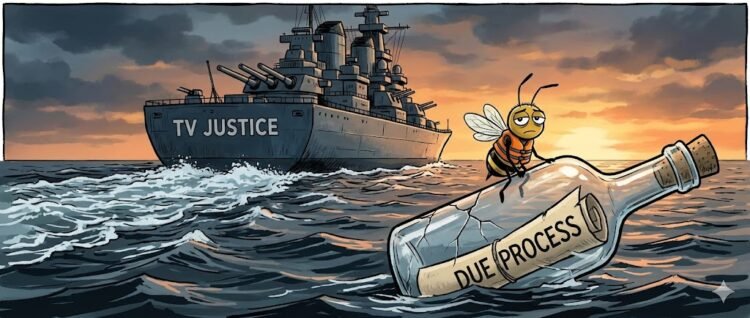
When the Department of Defense decides that “interdiction” is just a fancy word for “snuff film.”
The United States Navy has a long and storied tradition of rescuing sailors in distress. It is one of those ancient maritime codes, like not whistling on the bridge or avoiding bananas on a boat, that separates professional mariners from pirates. But under the stewardship of Defense Secretary Pete Hegseth—a man whose qualification for the job appears to be that he owns a lot of tactical vests and once threw an axe on live television—that tradition has been updated. The new standing order seems to be: “If they’re wet, they’re still a threat.”
In early December, reporting surfaced that alleges Hegseth didn’t just authorize a September 2 strike on a suspected drug boat in the Caribbean; he essentially cheered for the sequel. The operation, overseen by Navy Admiral Frank “Mitch” Bradley, was a kinetic masterclass in overkill. After the initial strike left the boat a burning ruin and eleven people dead, survivors were spotted in the water. In a normal world, this is where the “search and rescue” phase begins. In Hegseth’s world, this is where you reload.
According to reports that have caused bipartisan heads to explode on Capitol Hill, a second strike was ordered to finish the job. Two survivors, likely clinging to debris and wondering why the sky hated them, were vaporized. The administration’s defense of this “double tap” is that it was a “counter-narcotics necessity,” a phrase that suggests the survivors were about to swim the remaining thousand miles to Miami with kilos of cocaine clamped between their teeth.
The “Narco-Combatant” Loophole
The legal gymnastics required to justify this are truly Olympic-level. To make this legal, the administration has to classify drug smugglers not as criminals, but as “narco-combatants.” This is a linguistic magic trick. A criminal has rights. A criminal gets an attorney. A criminal gets a trial. A “combatant,” however, gets a Hellfire missile.
By slapping a war-on-terror label on a law enforcement problem, the administration has created a free-fire zone in the Caribbean. They have decided that the Fourth Amendment stops at the water’s edge, and the Laws of War are more like “Guidelines of War” that can be ignored if the enemy is selling fentanyl.
Legal scholars and former military prosecutors are currently screaming into the void, pointing out that deliberately targeting shipwrecked survivors is a textbook war crime. It is a violation of the Geneva Conventions so clear that even a first-year law student could spot it. But Hegseth and his team are banking on a different kind of law: the law of selective accountability.
They know that if they frame this as “protecting the homeland,” a significant chunk of the electorate will not care if the methods would make a bond villain blush. They are betting that the “tough on crime” rhetoric is loud enough to drown out the splash of the bodies hitting the water.
The Domestic Disconnect
The irony, of course, is how we treat the same crime depending on the zip code. If you are caught selling drugs in Ohio, you are arrested. You are indicted. You go to trial. We have an entire infrastructure of courts and prisons designed to deal with you. We do not, generally speaking, call in an airstrike on your house.
But if you are on a boat south of Key West, you are apparently an existential threat to the Republic who must be liquidated with extreme prejudice. This “political logic of selective accountability” creates a bizarre two-tiered system of justice. Domestic drug dealers get due process; foreign drug traffickers get a closed-casket funeral (if there’s anything left to bury).
It raises the question: At what point does the “war on drugs” stop being a metaphor and start being a literal war where we execute the enemy on sight? And if we are at war, why haven’t we declared it? Why is this being run like a black ops program instead of a military campaign?
The Pardon as Policy
The administration’s hinted solution to the pesky problem of war crimes is perhaps the most cynical part of the whole affair: blanket pardons. There are whispers that the White House is preparing to immunize U.S. personnel involved in these strikes, effectively telling the military, “Do what you have to do; we’ll fix the paperwork later.”
This turns the pardon power into a policy tool. It signals to the troops that the Uniform Code of Military Justice is optional, provided you are killing the “right” people. It destroys the chain of command’s ability to enforce discipline. If the President has already signaled that he will pardon the shooters, why would any commander hesitate to pull the trigger?
It creates a moral hazard of epic proportions. It encourages the kind of cowboy behavior that leads to atrocities, knowing that the Sheriff is not only looking the other way but is actively handing out “Get Out of Jail Free” cards.
The View from NATO
Our allies are watching this with a mixture of horror and exhaustion. NATO diplomats, who spend their days trying to uphold the “rules-based international order,” are now having to explain why the leader of the free world is sanctioning the execution of shipwreck survivors. It makes the job of arguing against Russian or Chinese aggression significantly harder when the United States is treating the Caribbean like a video game.
The damage to U.S. credibility on the laws of armed conflict is total. You cannot lecture other nations on human rights while you are running a maritime assassination program. You cannot claim to be the good guys when you are double-tapping the wounded.
The Accountability Theater
So now we enter the phase of “procedural checkpoints.” We will have the classified briefings where admirals squirm in their seats. We will have the demands for full footage, which will inevitably be “lost” or “corrupted.” We might even see an Inspector General’s report in two years that uses the word “troubling” fourteen times.
But the political logic is already set. Hegseth has framed himself as the warrior fighting the bureaucracy. He will wear the congressional outrage as a badge of honor. He will go on television and say that the “swamp” wants to protect drug dealers while he wants to protect your children.
And the debate over “narco-combatant” rhetoric will rage on, displacing the actual work of solving the drug crisis. Because bombing a boat is easy. It looks good on TV. Fixing the demand for drugs, securing the ports, and addressing addiction? That’s hard. And Pete Hegseth doesn’t do hard. He does loud.
Receipt Time
The bill for this “kinetic diplomacy” will not be paid by the people ordering the strikes. It will be paid by the service members who have to live with what they did. It will be paid by the loss of our moral standing. And it will be paid by the rule of law, which is being slowly, methodically dismantled to make way for a policy of violence that feels good but solves nothing. The cost of a Hellfire missile is about $150,000. The cost of our soul? Apparently, it’s negotiable.