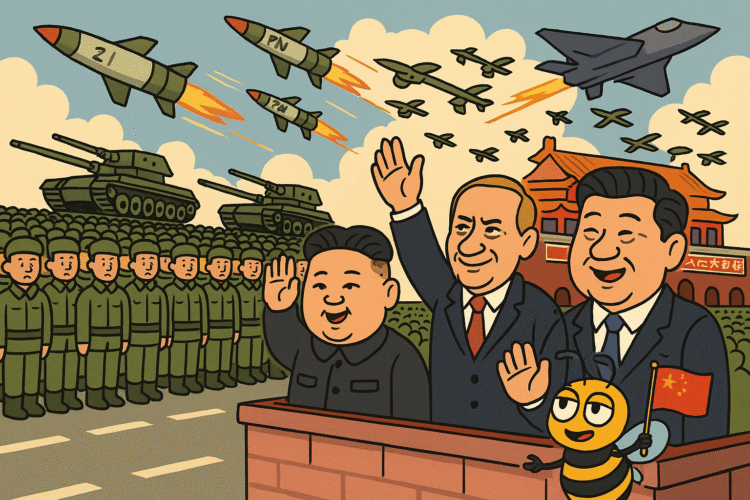
On September 3, 2025, Beijing decided history was too important to leave to textbooks—or perhaps too fragile. The 80th anniversary of Japan’s WWII surrender was reimagined as a Victory Day military parade so vast it made even the most overproduced Marvel finale look subtle. The setting: Tiananmen Square. The guest list: Xi Jinping, flanked like a Bond villain by Vladimir Putin and Kim Jong Un. The mood: less memorial, more flex.
This was not remembrance. This was spectacle as statecraft. A 70-minute procession of hypersonic missiles, stealth flyovers, swarming drones, anti-drone systems, and nuclear hardware rolled past foreign leaders who nodded like tourists at a Cirque du Soleil show, pretending not to notice the ticket price was measured in billions of yuan the economy doesn’t really have.
The Script of the Strongman
Xi’s speech was vintage performance art: solemn, theatrical, threaded with warnings that the world faces a stark choice between “peace or war.” Which is a bold line to deliver while standing in front of hypersonic missile launchers. The contradiction was the point. The show wasn’t about peace, and it certainly wasn’t about history. It was about rewriting the cast list.
In Xi’s version, China and Russia emerge as co-victors of WWII, while American aid is minimized to a footnote. This is the “memory war” strategy: edit the past until the present looks inevitable. It’s less historiography than Photoshop. Stalin and Chiang Kai-shek blurred out, Uncle Sam faded to the background, leaving Beijing and Moscow as the heroes of their own parade.
The Foreign Guest Section
Over twenty foreign leaders attended, each seated with the composure of people who know they will end up in the background of propaganda posters. Putin, smiling through the cracks of sanctions. Kim Jong Un, radiating joy at finally being treated like an equal-sized chess piece. Leaders from Central Asia and the SCO orbit, nodding in approval while calculating how many loans their attendance might secure.
Noticeably absent: most Western leaders, who politely RSVP’d “regret” while privately sighing in relief that they didn’t have to clap for missiles. Taiwan officials, watching from afar, dismissed the whole spectacle as propaganda cosplay. They noted the “eye-watering price tag” and asked how many ghost cities could have been revitalized with that budget. Beijing, of course, ignored them.
The Hardware Show
No parade is complete without its toys. And Beijing brought the full arsenal:
- Hypersonic missiles so sleek they looked CGI-rendered.
- Stealth flyovers with the grace of synchronized swimmers but the budget of NASA.
- Drone swarms buzzing in tight formations, followed by anti-drone systems just in case.
- Nuclear-triad hardware rolling past in broad daylight, because subtlety is for weak economies.
For seventy minutes, the message was hammered: “Look at our toys. Look at our might. Forget our GDP numbers, ignore our youth unemployment, don’t mind the real estate implosion—just watch the missiles.”
It was equal parts roaring confidence and nervous overcompensation. A power declaring itself inevitable while betraying the insecurity of needing to remind everyone it’s still here.
The Trump Cameo
No geopolitical event is complete without a cameo from America’s loudest retiree-in-chief. President Trump (still campaigning by meme) chimed in on Truth Social with a note to Xi: his “warmest regards” to pass to Putin and Kim “as you conspire against the United States.”
The phrasing was pure Trump: half grievance, half greeting card. It read less like foreign policy and more like a cranky uncle sending postcards from Mar-a-Lago. Yet even this interjection underscored the surrealism of the moment. Beijing stages hypersonic missiles. Trump responds with sarcasm and capitalization. Both sides feed the theater. Both sides perform.
Propaganda as Pageant
The pageant capped a week of “memory war” messaging. State media downplayed American Lend-Lease aid, the Flying Tigers, and the billions in supplies that kept China afloat. Instead, documentaries highlighted Chinese resilience, Russian sacrifice, and an iron bond between Beijing and Moscow forged in shared victory.
The irony, of course, is that memory wars aren’t about memory. They’re about manufacturing consent. History is pliable clay, reshaped to justify present alliances. Yesterday’s alliances are erased. Tomorrow’s are foreshadowed. Today’s parade becomes the connective tissue of an invented past.
The SCO Backdrop
The timing was deliberate. The parade served as a prelude to the Shanghai Cooperation Organization summit, where Beijing hopes to deepen ties with Moscow, Pyongyang, and every state nervous about U.S. hegemony but hungry for loans.
The imagery of Xi flanked by Putin and Kim wasn’t accidental. It was a staged tableau: three leaders, united in defiance, framed as heirs to wartime victory. Never mind that one of them runs a gas station economy, and another rules a country that can’t reliably keep the lights on. The optics matter more than the GDPs.
The Empty Chairs
The absence of Western leaders spoke as loudly as the presence of missiles. Europe, caught between needing Chinese trade and fearing Chinese power, stayed home. Washington dismissed the parade as “theatrics,” but behind closed doors, strategists parsed every missile angle, every drone formation, every handshake between Putin and Xi.
Absence doesn’t mean disinterest. It means plausible deniability. It means “we’re not clapping, but we’re watching.”
The Price Tag of Spectacle
The cost of the parade was astronomical, a fact not lost on citizens facing economic strain. Factories are slowing. Youth unemployment numbers have mysteriously disappeared from official reports. Real estate bubbles wobble. And yet, billions were spent to roll missiles past a crowd for seventy minutes.
This is the paradox of authoritarian spectacle: strength projected outward, fragility ignored inward. The louder the roar, the more fragile the foundations. The more dazzling the missiles, the more anxious the economy.
Confidence or Overcompensation?
So what was the parade? Roaring confidence, or nervous overcompensation? Both. The missiles gleamed, but the desperation leaked. The alliances looked firm, but the cracks were visible. The parade shouted inevitability while whispering insecurity.
It was statecraft in daylight, designed to reassure the world and frighten it simultaneously. It was theater for domestic audiences, reassurance for nervous allies, intimidation for adversaries, and a subtle plea: “Believe we are strong, even if you know we are struggling.”
By the end of the seventy minutes, the missiles rolled back into their hangars, the drones landed, the leaders waved. The square emptied. State media replayed the footage on loop, branding it history.
But here is the haunting truth: parades end. The economy doesn’t. Alliances wobble. Memory wars fade under the weight of real wars. Spectacle can dazzle, but it cannot feed. The roar of missiles echoes, but it cannot erase fragility.
On September 3, 2025, Beijing staged strength in broad daylight. But strength staged is never strength secure. And sometimes the loudest parade is just the quietest confession.