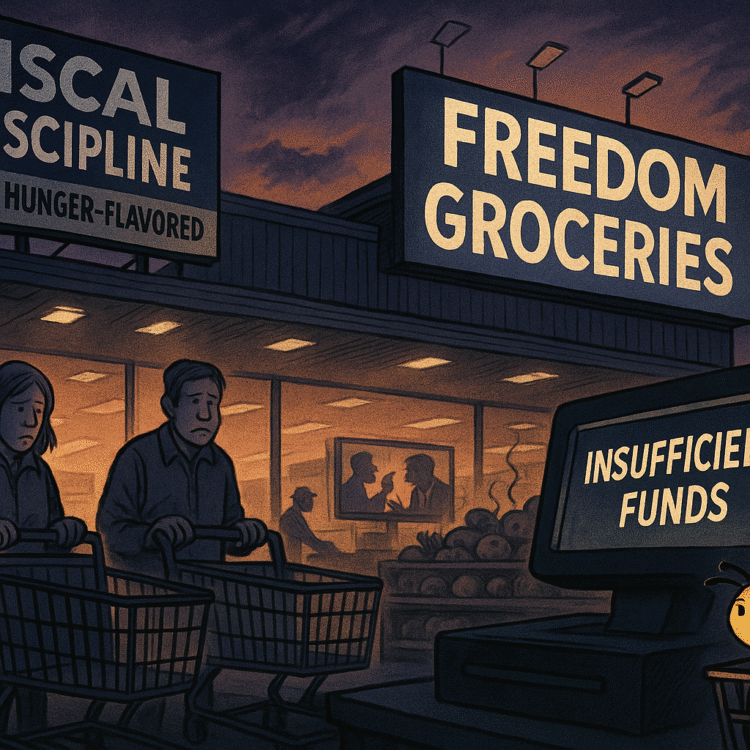
There’s a moment every fall when America pretends to care about food. Usually it arrives in the form of syrupy commercials: laughing families in sweaters, grocery carts brimming with abundance, the phrase “holiday spirit” hovering over a table that looks sponsored by a butter manufacturer. This year, that tableau feels like parody. Because as the government shutdown drags into November, there’s a decent chance 42 million Americans won’t have food at all—at least not the kind purchased with money.
SNAP, the Supplemental Nutrition Assistance Program, is about to run out of cash. Not metaphorically. Literally. The U.S. Department of Agriculture has already warned states that there isn’t enough money to fund a full November cycle. October benefits went out only because contingency funds kept the lights on for a few extra weeks, a fiscal sleight of hand that now feels like optimism with a side of denial. California, Oregon, Illinois, Missouri, and a dozen other states are sounding alarms louder than their empty balance sheets.
But Washington, as usual, is too busy congratulating itself for performing gridlock in a democracy.
A Government Starves Itself, Then the People
The numbers are obscene in their banality: 42 million people—children, seniors, veterans, single parents, retail workers, and nursing aides—depend on SNAP to eat. In California alone, Governor Gavin Newsom warned that millions enrolled in CalFresh face a “funding cliff.” Oregon’s human-services department told 750,000 residents that November benefits might not arrive at all. Illinois estimates nearly 2 million people could lose aid before Thanksgiving if Congress doesn’t reopen the government by month’s end.
Even Missouri, a state that practically gets hives at the word “safety net,” posted that it would keep processing paperwork but “will not issue November benefits until further notice.” Translation: we’re still pretending this is temporary, but you should probably start rationing.
And in Washington, Agriculture Secretary Brooke Rollins—smiling with the serene fatalism of someone who’s never waited for an EBT reload—offered the understatement of the year: “We’re going to run out of money.”
That’s not a statement of fact; it’s an epitaph.
Shutdown as Performance Art
The official cause is bureaucratic: the Antideficiency Act, which bars federal agencies from spending money not appropriated by Congress. The political cause is pettier: the ongoing shutdown, that ritual of hostage-taking where lawmakers turn basic governance into a stunt show. The operational posture is a tangle of acronyms and expired authorizations—FNS funding lapsed, carryover balances gone, contingency reserves exhausted.
But the cultural cause? Vibes-based budgeting.
The administration that calls tariffs “tax cuts” and deficits “patriotism” has decided hunger is a moral corrective. The rhetoric goes like this: real Americans don’t depend on government aid; they bootstrap. Never mind that the majority of SNAP recipients work—often full time—or that seniors and children make up most of the rest. This is governance as sermon: starve the poor, then quote scripture about discipline.
From Washington to the Checkout Aisle
The consequences of shutdown arithmetic aren’t theoretical. They show up in grocery aisles, in food pantries, in the quiet despair of someone staring at a balance that reads $0.00. When 42 million people lose purchasing power, retailers lose revenue. When retailers lose revenue, they raise prices. When prices rise, families downgrade calories. It’s a national chain reaction—an economic Rube Goldberg machine powered by cruelty and denial.
Grocery chains are already warning of cascading demand as food banks brace for a flood they cannot absorb. The last time this happened—during the 2019 shutdown—SNAP recipients received early issuances that had to stretch nearly two months. Food pantries saw a 40% surge. This time, there may be no early issuance at all, just a cliff.
Imagine Thanksgiving week at your local store: turkeys unsold, aisles quieter, shelves of instant noodles empty. Somewhere, a Treasury staffer will tweet a graph proving “consumer confidence remains stable.”
The Policy Gymnastics of Pretending Not to Care
Technically, this is a “temporary interruption.” But that phrase hides a hierarchy: which lives get to be paused and which don’t. When the Pentagon faces a shutdown, it’s a national security crisis. When hungry kids do, it’s a “budget impasse.”
Advocates have been screaming this script for weeks. Anti-hunger organizations warned that the October payouts were a mirage—money borrowed from next month’s misery. They reminded lawmakers that SNAP isn’t discretionary spending; it’s the last line between survival and starvation. But moral urgency, unlike interest rates, doesn’t compound in Washington.
Meanwhile, the same administration that can’t fund food managed to eliminate SNAP-Ed, the nutrition education program that taught recipients how to stretch benefits and cook healthy meals. It’s like cutting someone’s lifeboat, then congratulating yourself for saving weight.
The Bureaucratic Hunger Games
This is how empire collapses in slow motion—not with fire, but with memos. State agencies from Sacramento to Springfield are now issuing polite apocalypse notices: “Please prepare accordingly.” “Contingency measures under review.” “Future benefits uncertain.”
Every statement reads like a tragedy written by HR. Missouri’s Department of Social Services promised to “continue processing eligibility paperwork,” which is like reassuring passengers that the ticketing counter remains open while the plane plummets.
The USDA, asked whether it could guarantee November payments, offered a masterclass in doublespeak: “We are assessing available funding options.” Translation: none.
The Economics of Starvation
SNAP isn’t charity. It’s stimulus. Every dollar spent on food stamps generates roughly $1.50 in economic activity. When benefits vanish, that multiplier collapses. The poorest households spend every cent they receive, feeding both themselves and the local economy.
Cut that flow, and the damage ripples outward—through grocery stores, trucking routes, and distribution centers. The people who bag the groceries and drive the pallets lose hours. Rural grocers shutter. Urban pantries overflow. Hunger becomes an invisible tax on dignity.
And yet, somewhere in Washington, a fiscal hawk will go on television to brag that “wasteful spending” has been reduced. They will not mention that the “waste” in question is breakfast.
From SNAP to Slapstick
The absurdity borders on biblical. Lawmakers who sermonize about “family values” are starving actual families. Governors who decry “big government” are now begging for federal intervention. The same political bloc that demanded work requirements for food aid is engineering a shutdown that leaves the working poor unpaid and unfed.
It’s government by paradox: make policy failure look intentional, then campaign against it.
Already, the rhetorical justifications are blooming like mold on expired bread. “Temporary hardship.” “Necessary discipline.” “Encouraging self-reliance.” This is the language of moral outsourcing—transforming hunger into a virtue.
California, Oregon, Illinois: The Front Lines of Famine Management
California’s CalFresh system, one of the largest in the country, is bracing for chaos. Governor Newsom said millions could lose benefits by November, and he’s not exaggerating. Oregon’s Department of Human Services told three-quarters of a million residents to “plan for disruptions.” Illinois is warning nearly two million households that they might not see funds before Thanksgiving.
None of these statements come with solutions, only condolences. Food banks are mobilizing, volunteers scrambling, state treasuries quietly calculating how long they can front money without federal reimbursement. It’s a logistical version of “thoughts and prayers.”
If you zoom out, the geography of hunger now maps neatly onto the geography of governance failure. The same states that export food are about to import starvation.
The Sound of Empty Cards
There’s a unique humiliation in seeing your EBT card decline. The machine doesn’t care about policy nuance. It doesn’t know about the Antideficiency Act or carryover balances. It just beeps.
That beep will echo across checkout lanes next month. It will land in the ears of parents trying to buy cereal, of seniors buying bread, of workers grabbing dinner after a shift. It will land in the silence that follows, when a cashier glances away and the customer pretends not to notice.
That moment—private, small, humiliating—is the real face of shutdown politics. It’s not the sound of debate; it’s the sound of abandonment.
America the Contradiction
The richest nation on earth can fund a fighter jet that costs $80 million but cannot guarantee lunch for a child. It can subsidize corn exports and oil exploration but balks at subsidizing hunger prevention. It can invent trillion-dollar coins and quantum encryption systems but can’t load $200 onto an EBT card.
The contradiction isn’t financial—it’s moral. Hunger in America is not an accident; it’s a design choice. A country that treats compassion as debt will always find new ways to default.
The Rhetoric of Responsibility
When the hunger reports start rolling in, expect the usual chorus of paternalism. You’ll hear about “personal responsibility,” about “fiscal restraint,” about “tough choices.” The same lawmakers who write off billions in corporate subsidies will suddenly rediscover arithmetic when the subject is groceries.
They’ll say people should “budget better,” as if you can stretch nothing into something. They’ll frame starvation as a motivational tool. They’ll call it discipline while posting Thanksgiving photos of golden turkeys and champagne.
Austerity, after all, is the most bipartisan religion in Washington. Both parties tithe in suffering.
Food Banks: The New Federal Government
As the official safety net frays, food banks are becoming the de facto Department of Agriculture. The difference? They run on donations and exhaustion. Warehouse managers are begging for shelf-stable goods, volunteers are sleeping on-site, and the lines are already forming.
One Oregon organizer put it best: “We can’t replace $200 million in missing benefits with goodwill.” But that’s the national strategy—replace policy with charity, structure with sentiment.
Meanwhile, grocery chains will quietly adjust inventory. The rich will still buy organic cranberries; the poor will ration canned beans. The country will call that “freedom.”
Austerity as Entertainment
There’s something surreal about watching politicians tweet through a hunger crisis. You can almost hear the giddy detachment: “We’re standing firm for fiscal sanity!” It’s the kind of phrase that reads well on cable crawls and ages like milk in history books.
Each sound bite is another sermon from the Church of Market Grace, where suffering is proof of virtue and empathy is inflationary. They’ll say hunger builds character, but they’ll never say whose.
Closing Section: The Empire of Empty Shelves
The warning lights are already flashing. Benefits won’t load. Food banks can’t compensate. Governors are pleading. The Secretary of Agriculture is shrugging.
And somewhere in Washington, the architects of this famine-by-committee are debating whether to call it a “shutdown” or a “pause.” The semantics are irrelevant. Hunger doesn’t wait for procedural votes.
What happens when a government treats its people like a bargaining chip? You get an empire of empty shelves. You get grocery aisles where patriotism costs $4.99 a pound. You get a country that measures its greatness not by what it feeds but by what it withholds.
The United States will survive this shutdown, as it always does, by rediscovering empathy just long enough to forget it again. But the lesson remains: when politics becomes theater, someone always goes hungry in the audience.
And this November, the standing ovation will come from the well-fed.