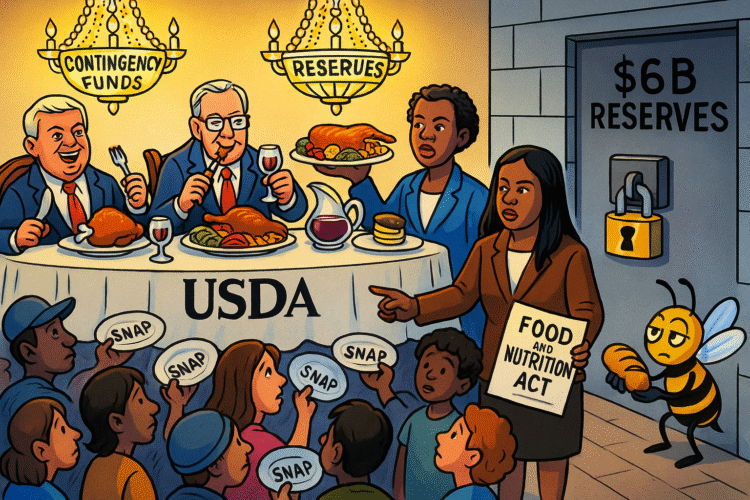
When the Trump administration announced it was freezing Supplemental Nutrition Assistance Program (SNAP) benefits for more than forty-one million Americans during the shutdown, the official explanation was simple: fiscal responsibility. The unofficial one was simpler: cruelty is the point, and hunger is a feature, not a bug.
Now, twenty-five Democratic-led states and Washington, D.C., are suing to stop it. The coalition—fronted by New York Attorney General Letitia James and Massachusetts Attorney General Andrea Joy Campbell—has filed suit against USDA Secretary Brooke Rollins, arguing that the department’s refusal to use five to six billion dollars in contingency funds violates the Food and Nutrition Act of 2008 and the Administrative Procedure Act.
Translation: the law says you have to feed people, not audition for the role of Ebenezer Scrooge with a security clearance.
The case, filed in federal court in Boston and assigned to Judge Indira Talwani, may be the most literal test yet of whether one cabinet department can legally manufacture mass hunger while sitting on billions in reserves. It’s not just about food stamps—it’s about the boundaries of power, the purpose of government, and the quiet war between fiscal “discipline” and human survival.
The Setup: The Hunger Games (Shutdown Version)
For decades, SNAP—commonly called food stamps—has operated without interruption through wars, recessions, and political tantrums. When funding lapses, the USDA has contingency reserves. Those reserves exist for one reason: so forty million Americans don’t wake up one morning and find that their grocery cards don’t work.
This time, however, the administration decided to innovate. USDA Secretary Brooke Rollins, a former White House policy advisor turned austerity evangelist, announced that SNAP payments would stop unless Congress passed new appropriations. In other words: no funding, no food.
Her department claimed its hands were tied. The reserves, they said, could only supplement existing appropriations, not replace them. That might sound like legal prudence—until you read the Food and Nutrition Act, which explicitly guarantees benefits to all eligible households regardless of funding hiccups.
For half a century, the USDA interpreted that law to mean “feed people first, sort out paperwork later.” Now, under the Trump model, it means “starve them first, cite budgetary restraint later.”
The Lawsuit: Feeding the Law
The plaintiffs’ complaint reads like a civics textbook written by a public defender on three hours of sleep. It lays out that the USDA has both the authority and the obligation to use contingency funds during a lapse. Those funds, roughly five to six billion dollars, exist precisely to prevent this kind of crisis.
By refusing to use them, the states argue, the department violated two key statutes:
- The Food and Nutrition Act of 2008, which guarantees eligible households access to SNAP.
- The Administrative Procedure Act, which prohibits arbitrary and capricious agency action.
The legal posture is straightforward: if you have the money and the mandate, you can’t just decide to starve forty million people because your boss wants leverage in a budget fight.
The USDA’s defense, by contrast, sounds like a bureaucratic riddle: “We’re not allowed to spend contingency money until we have appropriations to supplement.” Which is like saying you can’t use your fire extinguisher until the house is fully engulfed.
The Money Trail: Five Billion in the Basement
The USDA sits on roughly six billion dollars in SNAP contingency reserves. Normally, those funds keep benefits flowing when Congress forgets to do its job. Every administration since the program began has used them as a buffer.
But this White House has decided that being the first in history to miss a monthly issuance is a badge of honor. According to budget officials, “discipline” means withholding the funds to make a political point.
Meanwhile, state agencies have been scrambling to prepare for a potential SNAP cliff—the first time in U.S. history when families might actually miss their benefits.
Retailers are panicking about lost sales. Hospitals warn that food insecurity will spike ER visits. School districts say children who rely on free breakfast programs will suffer next. Anti-hunger groups are watching the slow-motion disaster unfold with the resigned horror of people who have seen this play before.
The Fallout: When Bureaucracy Meets Real Life
SNAP doesn’t just feed families—it props up entire economies. Every dollar in benefits generates about $1.50 in local economic activity. In many small towns, it’s the difference between a grocery store staying open and shutting down.
Cutting SNAP isn’t just cruel; it’s economically self-destructive. But cruelty wrapped in fiscal jargon has a long shelf life in Washington.
The ripple effect would reach beyond SNAP. Nearly seven million participants in the Women, Infants, and Children (WIC) program could lose access next if the USDA extends its “discipline” doctrine to other nutrition programs.
As one state administrator put it, “You can’t tell a two-year-old to wait for appropriations.”
The Timeline: From Notice to Lawsuit
The drama unfolded in record time.
- Day 1: USDA issues a suspension notice warning that SNAP benefits may not go out next month.
- Day 3: Governors and state officials hold emergency calls to assess damage.
- Day 5: Attorneys general draft a multistate complaint.
- Day 6: Lawsuit filed in federal court in Boston.
- Day 8: Judge Indira Talwani schedules an expedited hearing on the request for a temporary restraining order.
Meanwhile, behind the scenes, Electronic Benefit Transfer (EBT) processors are on standby. Retailers are reprogramming systems for potential outages. Food banks brace for a surge in demand.
It’s a coordination nightmare wrapped in a moral crisis, created entirely by choice.
The Administration’s Argument: Hunger as “Discipline”
The White House has blamed Senate Democrats for the shutdown, claiming they refused to pass a “clean funding bill.” But withholding SNAP isn’t a matter of legislative gridlock—it’s an executive decision.
Administration officials call it fiscal discipline. They argue that contingency funds are “not a substitute for appropriations.” It’s a tidy way of saying “we could fix this, but we’d rather not.”
In Trump’s America, starving the poor isn’t a failure of governance; it’s a show of strength.
The Legal Stakes: Who Owns the Safety Net
This case isn’t just about SNAP. It’s about whether a single cabinet secretary can unilaterally redefine how government safety nets work. If USDA wins, it creates a precedent: that executive departments can withhold essential benefits during a shutdown, even with money in reserve.
That’s not fiscal restraint. That’s weaponized administration.
The oversight stakes are massive. Congress designed SNAP as a mandatory spending program precisely so it couldn’t be used as a political hostage. If that firewall collapses, the entire social contract is negotiable.
The Plaintiffs’ Core Argument
Letitia James and Andrea Campbell aren’t mincing words. Their filings read like a mix of legal reasoning and moral indictment. They argue that the Food and Nutrition Act’s language is clear: the USDA “shall” issue benefits to all eligible households.
“Shall” isn’t a suggestion. It’s a command.
The Administrative Procedure Act, meanwhile, requires that agencies follow their own rules and justify any deviation. By refusing to use contingency funds for the first time in history, the USDA is doing the opposite. It’s arbitrary, capricious, and politically motivated.
The plaintiffs want an immediate injunction forcing USDA to release the funds. If they win, millions will eat. If they lose, millions won’t. It’s that simple.
The Politics of Hunger
Republicans call the lawsuit performative. They say it’s about optics, not policy. But optics matter when you’re talking about forty million people choosing between rent and groceries.
Governors across blue states are already issuing emergency declarations. Anti-hunger groups have mobilized. The nonprofit Feeding America estimates that demand at food banks could spike by forty percent within a week of missed payments.
The administration’s allies, meanwhile, are calling it “a moment of accountability.” Translation: hunger is a teaching tool.
This is the new conservative morality—fiscal hawkishness that punishes the poor for existing while the rich feast on tax breaks.
The Separation-of-Powers Subtext
Congress created SNAP. Congress funds SNAP. But now, the executive branch wants veto power over whether that funding actually reaches people.
If USDA can refuse to issue benefits despite having money in reserve, what stops any agency from doing the same? Social Security next? Veterans’ benefits? Medicare reimbursements?
It’s not just about food stamps—it’s about constitutional balance. The lawsuit may determine whether presidents can turn policy disagreements into economic weapons.
The Bureaucratic Absurdity
The USDA’s position rests on a single premise: contingency reserves can “supplement” but not “replace” appropriations. The plaintiffs counter that this reading defies both logic and precedent. Every administration, Democrat and Republican alike, has used contingency funds to bridge gaps during shutdowns.
The USDA’s new position would make the reserves useless. A safety net you can’t use when you need it isn’t a safety net—it’s a museum exhibit.
The Broader Costs
Beyond legal briefs and political talking points lies the real cost: human suffering.
Single parents will find grocery cards declined. Seniors who depend on SNAP will skip meals. Children relying on school breakfasts will arrive hungry and leave hungrier.
Hunger has a ripple effect. It erodes health, education, and stability. It turns survival into a full-time job.
And the cruelest part? It’s avoidable. The money exists. The infrastructure exists. The will does not.
The Reactions
Democratic governors call it “governmental malpractice.” Anti-hunger groups label it “state-sanctioned starvation.” Economists warn of a cascading effect across supply chains.
Conservative pundits, on the other hand, call it “tough love.” They say it’s time for “personal responsibility,” as though malnutrition builds character.
Meanwhile, the White House insists everything is under control. Which, in this administration, is usually when you should panic.
Closing Section: The Politics of the Plate
In the end, this isn’t about fiscal policy or administrative law. It’s about who counts. It’s about whether feeding people is a duty or a favor.
For all its complexity, the lawsuit distills into one question: should an American cabinet secretary have the power to starve forty million people during a shutdown while sitting on billions in reserves?
If the answer is yes, the precedent will outlive this administration.
It will mean that every future government can use hunger as leverage, poverty as punishment, and food as politics. It will mean that safety nets aren’t guaranteed—they’re conditional.
For now, the case sits before a federal judge in Boston. But outside the courtroom, the real verdict is already visible in every grocery aisle, every food pantry, every kitchen where families stretch dinners into breakfasts.
History will remember what we did when hunger became optional.
And if this government decides that “optional” is acceptable, it won’t be the first to learn that starvation is not a sustainable political strategy.