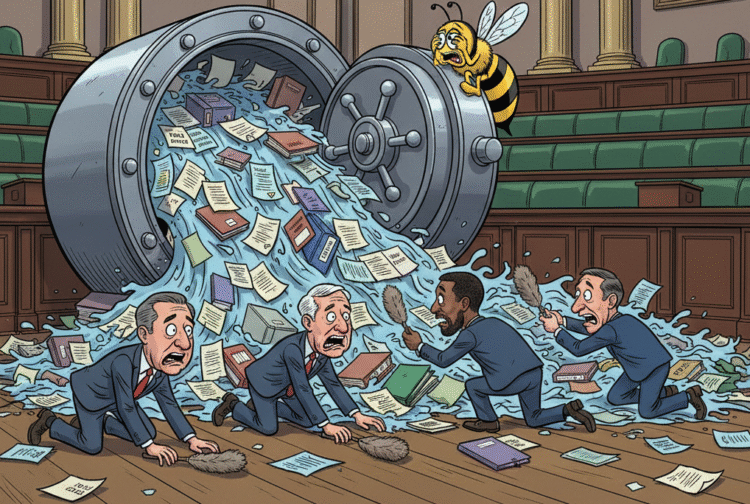
The spectacle of Washington operating at speed, with overwhelming bipartisan agreement, is generally reserved for declaring war or giving tax breaks to billionaires. But this week, the gears of Congress ground forward with unnerving velocity to pass the Epstein Files Transparency Act. After months of calculated stonewalling from the usual suspects in Trump-world, the House of Representatives delivered a verdict that was less about justice and more about self-preservation, passing the measure with an astonishing 427-1 vote under suspension of the rules. The lone vote against, from Louisiana Republican Clay Higgins, only highlighted the political impossibility of opposing a document release that has become a lightning rod for the public’s deep, corrosive distrust of elite impunity. Five members wisely chose to simply stay home.
Within hours of the House vote, the Senate performed its own act of procedural whiplash, agreeing by unanimous consent to pass the exact same bill without amendments the moment it is formally transmitted. The entire legislative process, which typically moves at the speed of institutional molasses, suddenly sprinted toward the President’s desk. This legislative stampede means the bill is now heading straight to Donald Trump, who spent weeks dismissing the entire furor as a “hoax” and insisting that his Pam Bondi-led Department of Justice review already “looked at everything.” He has since reversed course, offering a performative vow to sign the bill. The sheer speed and unity of this passage reveals a deeply cynical calculation: Congress is rushing to force the documentation into the public sphere to inoculate itself against the coming political fallout, offloading the accountability onto the Justice Department’s technical process.
The live blogs covering the day captured a political scene of dizzying, exhausting contradiction. On one side, Speaker Mike Johnson and Judiciary Chair Jim Jordan, two figures usually preoccupied with the performance of constitutional zeal, were reduced to vaguely fretting about “privacy” and “due process.” This sudden, delicate concern for legal nuance, deployed only when facing the consequences of their allies’ past actions, was received with the surgical skepticism it deserved. It was difficult to take seriously their legalistic handwringing when the files pertain to a case where the justice system itself was famously compromised, allowing a powerful man to escape a proper reckoning.
On the other side of the aisle, there was a brief, disorienting display of cross-partisan cooperation. The bipartisan co-sponsors, Thomas Massie and Ro Khanna, celebrated the vote alongside survivor advocates like Annie Farmer and Haley Robson. Dozens of rank-and-file members from both sides hailed the vote as a long-overdue, essential step toward transparency. This unity was, however, paper-thin. Democrats and survivors’ groups immediately pressed the obvious, inconvenient questions: If the files hold “nothing to hide,” as Trump has insisted, why did he refuse to simply order the release himself months ago? And why is Ghislaine Maxwell, Epstein’s accomplice, reportedly enjoying alleged VIP treatment in a Texas prison, an obvious suggestion that the protection of the powerful continues even after a conviction?
The central, haunting question remains accountability. Outside groups are not simply asking for documents; they are demanding assurances that the powerful Americans implicated in the files will face “the same consequences” that UK figures, most notably Prince Andrew, have been forced to grapple with. The files are not just a collection of sordid details; they represent a detailed, institutional map of elite predation, a web connecting financiers, politicians, and intelligence figures to a vast sex trafficking network. The public is not only seeking the names, but also the consequences that should accompany them. The low-stakes vote was easy; the actual application of law will be the true test.
With the bill landing at the White House, the next steps are fraught with institutional tension. The DOJ, still led by Attorney General Pam Bondi, now has the clock ticking, forced to process tens of thousands of emails, memos, witness statements, and evidence on a fixed timetable. The act compels the department to publish all unclassified investigative materials in a searchable format, allowing only limited, narrowly defined redactions to protect victims and ongoing cases. The DOJ will be operating under an intense, unprecedented public and media microscope.
The document dump itself will be less a single event and more a protracted, multi-dimensional crisis. Law enforcement and civil liberties experts are already engaged in a heated, public debate over the precise balance required—how to maintain the privacy and dignity of the victims while ensuring maximum accountability for the high-powered clientele. Every redaction, every delayed email, will be scrutinized by a media and public already convinced of a deep-state cover-up. The process itself is now a referendum on whether the U.S. justice system is capable of imposing consequences on its wealthiest and most connected citizens.
The stakes are enormous. This massive document release could reshape reputations overnight, ending careers, and opening doors to civil and potentially criminal liability. It will severely test the credibility of the entire political establishment and, most acutely, whether Trump’s promise that “we have nothing to hide” is remotely true. The files represent the chance for a long-delayed, painful reckoning with how the U.S. justice system handled one of the most notorious sex trafficking networks in modern history—a system that, by most accounts, offered Epstein far more latitude and protection than it offered his victims. The 427-1 vote was a sign of political fear, not conviction. The real courage will be in the cleanup.
Fine Print for Grownups
The greatest illusion of the bill’s passage is that it represents an end to the story. In reality, it is merely the opening of the first drawer. The documents themselves do not enforce the law; they merely provide the roadmap. What follows the release will not be a sudden, purifying wave of justice, but a protracted, messy period where the power of the implicated figures will be tested against the weight of public evidence. The true measure of American justice will not be found in the overwhelming vote of a panicking Congress, but in the slow, grinding work of prosecutors and regulators who must decide if the names on the list are still too powerful to touch. The public has been handed the receipts, but only the institutions can decide whether to cash the check.