Flags for Some, Not for Others
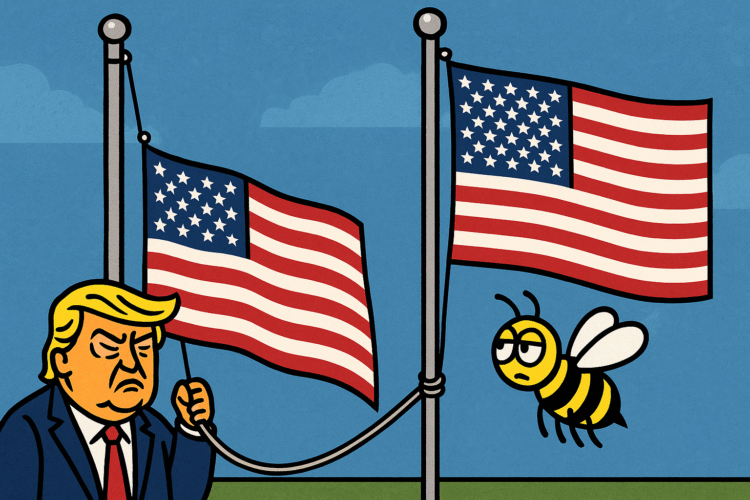
There is nothing quite as American as fighting about flags. We argue about who can kneel before them, who can burn them, whether rainbows belong on them, and now—who gets the honor of lowering them.
President Donald Trump ordered U.S. flags lowered nationwide for Charlie Kirk. A right-wing commentator killed in Utah, transformed in death into a symbol. Proclamation signed, flags at half-mast, solemn music, somber press statements.
But when Minnesota House Speaker Melissa Hortman and her husband, Mark, were assassinated in June? Silence. No proclamation. No flags. No calls. No ritual. Pressed on it months later, Trump said he was “not familiar” with the killing. Then he said he “would have” lowered flags if Governor Tim Walz had asked. This from the same man who had dismissed calling Walz at the time as a “waste of time.”
It’s a master class in selective empathy. Some tragedies get draped in ritual. Others get shoved offstage.
The Political Funeral Industrial Complex
Lowering the flag is supposed to be neutral. A gesture of national grief. It doesn’t bring anyone back. It doesn’t solve anything. But it’s supposed to be universal—an act of solidarity that says “this life mattered.”
Under Trump, it’s a weapon. Lowering the flag becomes endorsement. Refusing becomes punishment. It’s the weaponization of ritual, where grief itself is split down party lines.
When Kirk was assassinated, flags dropped instantly. When Hortman and her husband were murdered, flags didn’t move an inch. The difference wasn’t tragedy. It was politics.
The Excuse Factory
Allies rushed in with excuses. Protocols. Technicalities. Maybe the governor didn’t file the right paperwork. Maybe the dog ate the proclamation. Maybe Trump just didn’t hear about it, despite the national news cycle, the vigils, the bipartisan outcry.
But Trump himself gave away the game. First, he claimed ignorance. Then he admitted he knew—he just didn’t bother. Because grief, like infrastructure or voting rights, only counts if it flatters him.
Pride Flags as Collateral
The Kirk proclamation created a second controversy when officials lowered Pride and trans flags at LGBTQ landmarks. A gesture meant to honor a right-wing martyr suddenly muted queer visibility. It was grief layered over erasure.
Lowering the flag is supposed to unify. Instead, it divided. A gesture meant to symbolize mourning for one man became a reminder of exclusion for millions.
The Ritual Economy
This is how the presidency works now. Rituals are not neutral. They are transactional. Mourning is a resource. Condolences are investments. Silence is sanction.
To lower a flag for Kirk is to canonize him as a figure of national importance. To ignore Hortman is to deny that her life mattered beyond Minnesota. The signal is clear: Republican deaths get ritualized. Democratic deaths get rationalized.
Whose Grief Counts?
The deeper question is chilling: whose grief counts? Who gets the imprimatur of national mourning, and who gets brushed aside?
If the answer is partisan, then the flag itself is no longer national. It’s factional. Half-mast doesn’t mean unity anymore. It means, “our side lost someone, and you’re required to perform grief for them.”
That’s not ritual. That’s enforcement.
Empathy as Weapon
This isn’t new. Trump has long practiced selective empathy. He praised some COVID deaths while dismissing others. He offered condolences to police families while ignoring victims of police violence. He mourned soldiers who fit his narrative while calling others “losers” and “suckers.”
Now the weaponization extends to flags. Empathy itself becomes a cudgel: wielded for friends, withheld for enemies.
The Theater of Grief
It’s easy to forget that lowering flags doesn’t cost anything. It doesn’t require congressional approval. It doesn’t drain the budget. It’s just symbolism.
And that’s why it matters so much. Because if you can’t even extend free symbolism universally, it proves the point: this isn’t about mourning. It’s about message discipline.
When asked why flags weren’t lowered for Hortman, Trump didn’t even bother to pretend there was a principle. He just pivoted: “I wasn’t familiar. Would have, if Walz asked.” Translation: “I didn’t care, and I still don’t.”
The Minnesota Contrast
In Minnesota, the contrast was glaring. Crowds gathered for vigils. Leaders across the aisle called it an attack on democracy. Communities grieved.
And yet the federal silence echoed louder than any candlelight. The president’s refusal to even make a phone call became its own act of violence. It said: your loss is not our loss. Your grief is provincial, not national.
The Kirk Contrast
For Kirk, the full ritual rolled out. Proclamation. Media saturation. Trump and Vance both turned his memorial into a political cudgel, blaming the left, vowing retribution, threatening nonprofits. It wasn’t just mourning. It was mobilization.
This is the double standard: Democrats get ignored in death. Republicans get canonized, weaponized, and merchandised.
Flags as Polling Data
Lowering a flag used to mean something spiritual. Now it’s polling data in cloth form. Will this gesture please the base? Will it enrage the opposition? Does it align with the campaign narrative? If yes, lower the flag. If no, let it fly.
It’s not about grief. It’s about optics.
Rituals and Reality
The bigger problem is what this does to national rituals. If even grief is partisan, then nothing is sacred. Not funerals. Not memorials. Not flags.
The president’s job isn’t just policy. It’s ritual. It’s the symbolic role of national mourner, the one who represents the whole. Trump refuses that job. He represents only his half.
The result? A country that no longer agrees on whose deaths deserve recognition.
The Season of Polarization
The timing couldn’t be worse. The country is already aflame with polarization. Investigations, assassinations, raids, protests. Every event turns into a culture-war weapon.
Now even grief is drafted into the fight. The symbolism of the flag—a supposed refuge from partisan spin—is reduced to another partisan signal.
We are left with a season of mourning that feels less like shared grief and more like branding.
The Smell Test
Here’s the real smell test: if Melissa Hortman had been a Republican, would the flags have dropped? Of course they would have. They would have dropped instantly, and Trump would have staged a rally on the ashes.
If Kirk had been a Democrat, would the flags have dropped? No. Trump would have shrugged, said he wasn’t familiar, and called it a waste of time.
The principle isn’t principle. It’s partisanship. And everyone knows it.
Ritual as Ruin
Rituals are fragile. They only work if everyone believes in them. Once they’re politicized, they break.
Lowering the flag no longer means “we mourn together.” It means “we mourn selectively.” And once that’s clear, the ritual is ruined.
Summary: Mourning as Messaging
Trump’s decision to lower flags nationwide for Charlie Kirk but not for Minnesota House Speaker Melissa Hortman and her husband revealed the presidency’s new approach to grief: ritual as weapon. Pressed for answers, Trump claimed ignorance, then blamed protocol, despite having refused to even call Gov. Tim Walz at the time. The contrast exposed selective empathy—Republican deaths canonized with proclamations, Democratic deaths dismissed as distractions. The symbolism extended further when Pride and trans flags were lowered alongside U.S. flags, turning mourning into erasure. In a season of polarization, the flag itself has become a partisan tool. Mourning is no longer universal. It’s messaging. And when empathy is deployed only for allies, the rituals that once unified us become just another fracture.