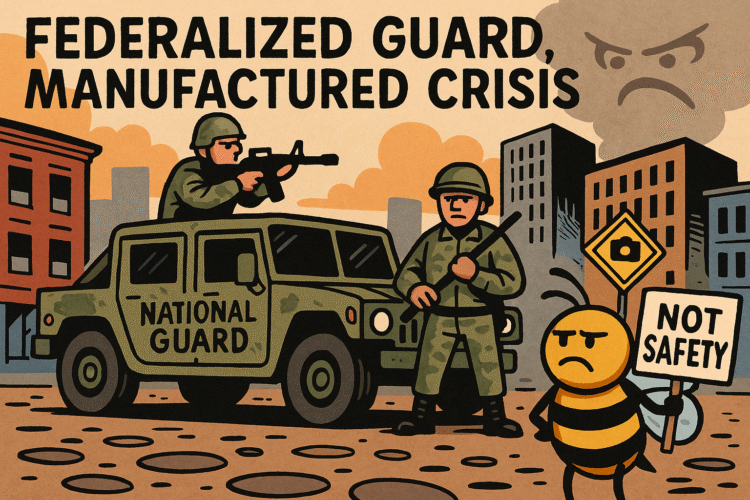
The White House confirmed that the president authorized federalization of three hundred Illinois National Guard troops to “protect federal officers and assets” in Chicago. Governor J.B. Pritzker answered with fury, saying he had been handed a manufactured performance disguised as an ultimatum: activate the Guard himself or watch Washington seize control. The move followed a week of escalating shows of force—Border Patrol boats on the Chicago River, agents detaining pedestrians along the Magnificent Mile, apartment raids in South Shore, and a Brighton Park incident where a U.S. citizen was shot after federal agents said their vehicles were boxed in and rammed.
This is not protection. It is projection.
From River Patrols to Federal Command
It began with boats that did not belong. Border Patrol craft prowled the Chicago River, rifles mounted, uniforms stiff, the kind of militarized theater that turns a city into a spectacle. Then came the foot patrols, agents sweeping Michigan Avenue, River North, side streets where shoppers once felt anonymous. People were stopped, questioned, detained. Some were undocumented, some were not. “Operation Midway Blitz” became the bureaucratic brand for this visibility campaign, but the point was not law enforcement. It was to show who controls the sidewalks.
By the time protests erupted against these tactics, federal pressure had already hardened. Pritzker described it bluntly: Washington told him to deploy the Guard on state orders or accept that the Guard would be federalized without him. He denounced the stunt as a performance, not a necessity. A White House spokeswoman confirmed the three hundred Guardsmen were now under federal command. DHS Secretary Kristi Noem justified the request as “force protection,” a phrase that stretches to cover almost anything once boots are on the ground.
The Law Bent into Shape
This is the legal theater that follows every show of force. The Posse Comitatus Act, that fragile wall between military and domestic law enforcement, forbids soldiers from policing civilians. The administration insists the Guard is not policing at all, merely protecting federal personnel. Yet the line vanishes when Guard troops stand shoulder-to-shoulder with Border Patrol agents conducting stops on public streets. Protection becomes participation.
The debate over Title 10 and Title 32 authority only deepens the fog. Under Title 32, Guard units remain under state control even when federally funded. Under Title 10, they shift to active-duty authority. In this case, the administration engineered a hybrid posture—Guard troops wearing federal orders while officials claim they are not engaged in policing, only perimeter security. The Insurrection Act lurks as the ultimate bypass, but invoking it outright would trigger a political backlash. So instead, the government sneaks its way into near-military control without the word “insurrection” ever leaving the teleprompter.
Then comes the most chilling admission. A Border Patrol commander said agents consider “how they look” when deciding whom to stop. Appearance is not probable cause. It is a return to phrenology with better uniforms. It is a constitutional injury masquerading as discretion. That single phrase is the blueprint of racialized policing, the codification of suspicion as identity.
Boots, Bridges, and Checkpoints
The question is not just who holds the orders, but where the troops stand.
Guard staging will anchor around federal buildings, the courthouses and loading docks where agencies claim vulnerability. Bridges across the Chicago River are likely checkpoints. ICE facilities, especially Broadview, become fortified zones. Troops may man perimeters, provide logistics, control access points, or stand as human backdrops for television cameras.
Even if official missions are limited to “protection,” the visual effect is unmistakable. When the Guard occupies bridges and federal plazas, Chicagoans are no longer moving through their city—they are passing through checkpoints in a federalized zone.
Operation Midway Blitz has already tallied dozens of arrests. Most involve undocumented residents, but U.S. citizens have been detained too. One was shot and wounded in Brighton Park after agents claimed their vehicles were boxed in. Every additional arrest adds to the sense of dragnet rather than due process.
The Ripple Through Daily Life
Chicago thrives on crowds. Its economy is not just built on finance and shipping but on conferences, conventions, restaurants, theaters, holiday traffic. Tourists do not book hotels to stroll past armored agents. They cancel. They reroute. The Magnificent Mile with a visible military presence becomes a corridor of hesitation. Restaurants lose covers, retailers lose customers, hotels lose bookings. Q4 projections turn downward not because of inflation or weather but because the streets look like staging grounds.
Residents face the deeper cost. Wrongful detentions of citizens and legal residents are no longer a hypothetical—they are a pattern waiting to emerge. Each mistaken identity chips away at trust in institutions. Families lose time, wages, safety. Civil rights lawsuits pile up, but the legal process cannot undo the daily humiliation of being stopped for looking the wrong way in the wrong place.
Rules of engagement blur when Guard troops stand beside Border Patrol. What counts as protest? What counts as resistance? Does a chant become a threat? Will shields and gas be authorized against unarmed demonstrators? The difference between “securing federal assets” and “suppressing dissent” is erased in the smoke of a flash-bang.
Demands for Transparency
Illinois and Chicago leaders know the playbook. They are demanding stop logs, warrant lists, booking data, daily tallies of who is detained and why. They are pressing for disclosure of any internal directives that codify appearance-based stops. They are asking for transparency not as theater but as survival. Without it, the federal narrative—that this is about safety—becomes unfalsifiable.
Transparency is the minimum standard if the administration wants credibility. The refusal to provide it signals the obvious: this is not safety, it is control.
The Narrative Mask
Every regime seeks its euphemism. Here the word is “protection.” The Guard is not occupying Chicago, we are told, but protecting federal officers. Border Patrol is not stopping residents based on race, they are ensuring compliance. ICE raids are not neighborhood incursions, they are targeted operations.
But residents feel the opposite. They know that protection is a synonym for dominance when it arrives uninvited. They see the militarized optics, the agents at riverwalks, the rifles on boats, the checkpoints across bridges. They understand that a federalized Guard means the city itself has been told: sovereignty is no longer yours to wield.
A Larger Experiment
This is not an isolated episode. Chicago now joins a list of cities—Portland, Los Angeles, Washington, Memphis—where federal muscle was flexed not to solve crisis but to stage dominance. Each deployment is a rehearsal for broader authority. Each unchallenged incursion becomes precedent for the next.
The administration frames dissent as obstruction. It labels protestors as agitators, mayors as weak, governors as complicit. In that narrative, militarized presence is not extraordinary; it is the natural antidote to civic resistance.
The danger is clear. If cities normalize Guard deployments and Border Patrol sweeps, the practice becomes expectation. What begins as an emergency becomes routine. What looks like a crackdown becomes a template.
Closing Observation
Chicago has been told to submit or resist. Federal authority has been draped over its bridges and poured into its rivers. The Guard now belongs to Washington, not Springfield. The question is not whether this is constitutional—it is whether it becomes permanent.
Militarized enforcement justified by protection is not a response to crisis. It is the crisis. It redefines what it means to walk a street, to carry a passport, to live as a citizen rather than a suspect.
The city’s future now depends on whether it insists on oversight, transparency, and sovereignty, or whether it adapts to life under permanent spectacle.
Either way, the curtain has risen. And Chicago has been cast as both stage and script.