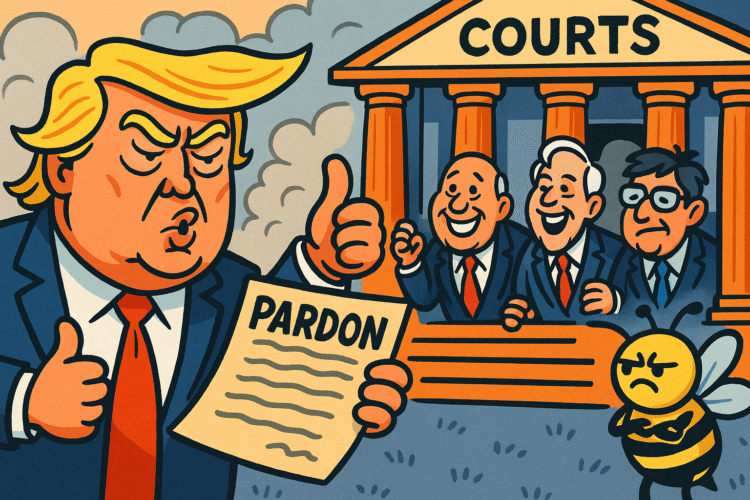
The news broke like a dropped stack of subpoenas. President Donald Trump issued sweeping federal pardons to Rudy Giuliani, John Eastman, Mark Meadows, Christina Bobb, Boris Epshteyn, and dozens of false electors whose signatures still appear on documents that prosecutors occasionally hold up with tongs. Pardon attorney Ed Martin delivered the announcement with the weary timbre of a man who understands that he has not been hired to practice law so much as to perform cleanup after a political carnival. The White House called it healing, a word deployed with all the sincerity of a con man offering a bandage to someone he just pushed down the stairs. The rest of the country responded with a mix of confusion, outrage, analysis, and the kind of legal commentary usually reserved for true crime podcasts.
The challenge whenever Trump does anything is to translate spectacle into law. The pardon power under Article II is sweeping, but it is not supernatural. It can wipe away federal criminal exposure for both charged and uncharged conduct up to the date the pardon is issued. It cannot touch state prosecutions, civil liability, bar discipline, future crimes, or the long memory of a federal judge who has read every page of every indictment and would still like answers. It also carries the Burdick admission problem, a century old legal consequence that means accepting a pardon is treated as an admission of guilt sufficient to strip away the Fifth Amendment privilege against self incrimination. In plain English, every single person pardoned today just became a subpoena magnet. They can still lie, which would be perjury, or commit new crimes, which is their specialty, but they cannot refuse to speak about anything that falls within the scope of the pardon. It is the legal equivalent of removing the batteries from every smoke alarm in their own house.
The statutes hovering over this roster of recipients could fill a law library table. Conspiracy against the United States under section 371. Obstruction of an official proceeding under section 1512. Conspiracy to interfere with voting rights under section 241. False statements. Document tampering. Contempt. The list is long and not curated for elegance. Pardons wipe away the federal criminal exposure but do nothing to change the facts, which exist on paper, on video, in emails, in text logs, and occasionally in PowerPoints that no rational human should have created. The paper trail remains. The receipts remain. And prosecutors remain eager to ask questions that now must be answered.
Anyone who has watched these cases unfold understands the chain of consequences that follows a pardon. The Office of the Pardon Attorney issues the warrants. Those warrants move to the Department of Justice. DOJ must file motions to dismiss indictments or vacate convictions. Judges review the paperwork, complete with the raised eyebrows and pointed footnotes of jurists who have grown deeply weary of living inside a political thriller without royalties. Nothing about this chain protects the recipients from the ongoing state cases in Georgia, Arizona, Michigan, Nevada, and Wisconsin. Those continue untouched. State sovereignty is not erased by a federal signature.
Civil suits are already being drafted by election workers and officials targeted by the elector scheme. Bar authorities are accelerating disciplinary actions against Giuliani and Eastman, because professional responsibility rules are their own jurisdiction and do not evaporate because a president wants to tidy up the political landscape. Congressional committees are preparing subpoena lists at a pace that suggests interns have been given unlimited caffeine. Watchdogs are calling it self dealing. Conservative commentators are declaring victory. And lawyers across the spectrum are explaining that this is the legal equivalent of popping champagne while someone quietly measures you for a witness chair under oath.
The people at the center of this story will soon discover that a pardon trades one form of danger for another. Before today, they could plead the Fifth. They could refuse to testify in federal investigations, congressional hearings, or grand juries. They could hide behind privilege and hope the clock ran out. Now they cannot. The Supreme Court’s precedent is clear. A person who has no federal criminal exposure cannot refuse to answer questions about that exposure. They can no longer say they fear prosecution for the acts covered by the pardon. The privilege evaporates. The subpoena remains. Perjury risk increases. And the temptation to lie increases with it, because these are not people known for consistent honesty.
The White House insists this is a step toward unity. Congress insists this is an admission of guilt. Prosecutors insist this is an opportunity. State attorneys general insist their work continues. And the public is left to wonder whether the pardon power has become a tool for obstructing accountability or a boomerang that returns to the thrower with surprising force. The timing matters. Trials are ongoing. Sentencing hearings are pending. Grand jury work continues. The sequence of events may become relevant evidence in itself.
There is a simple truth that every constitutional lawyer knows: a pardon cannot erase facts. It cannot erase acts. It cannot erase consequences outside the federal system. And it cannot erase the sworn testimony that will now be required. A pardon is not a shield for the future. It is not armor. It is not an invisibility cloak. It is an administrative action that ends federal criminal jeopardy but opens the door to everything else. This includes congressional oversight, civil litigation, and state prosecution, all of which move on timelines unaffected by presidential preferences.
The White House may have believed it was helping allies. Instead it may have created the largest compelled witness pool in modern political history. Giuliani will be asked about electors, memos, strategy sessions, funding streams, and the internal communications that federal prosecutors have already hinted at. Eastman will be asked about his memos, his emails, his calls, and the precise chain of events he helped orchestrate. Meadows will face questions about the pressure campaign, the coordination with state officials, and the conversations inside the Oval Office. Bobb will be asked about documents and statements. Epshteyn will be asked about his role as a central coordinator. False electors will be asked who recruited them, who drafted the certificates, who mailed them, who paid for their activities, and who ordered the effort.
The next seventy two hours will determine the difference between vibes and law. The pardon warrants must be released publicly. Their scope must be read carefully. The Department of Justice will file motions and status updates in federal dockets that judges will scrutinize with the forensic attention of seasoned investigators. Congress will begin scheduling subpoenas timed precisely to take advantage of the now eliminated Fifth Amendment privilege. State attorneys general will issue statements clarifying their ongoing work. Civil suits will be filed. Bar courts will update dockets for disbarment proceedings. And every newly pardoned individual will have to decide whether to cooperate honestly or add new crimes to a record the President just tried to wipe clean.
The press has a responsibility to say plainly what has happened. A pardon removes federal jeopardy. It does not remove the underlying facts or the public record. It does not rescue defendants from state cases. It does not shield them from civil actions. It does not block bar courts. And it does not free them from subpoenas. It erases criminal exposure while eliminating the Fifth Amendment. That is not a get out of jail free card. It is a forced march into testimony.
The President tried to close the book. Instead he opened a new chapter, one in which a cast of former co conspirators must now sit under oath, answer questions, and decide whether to tell the truth or add fresh crimes to a story that refuses to end.