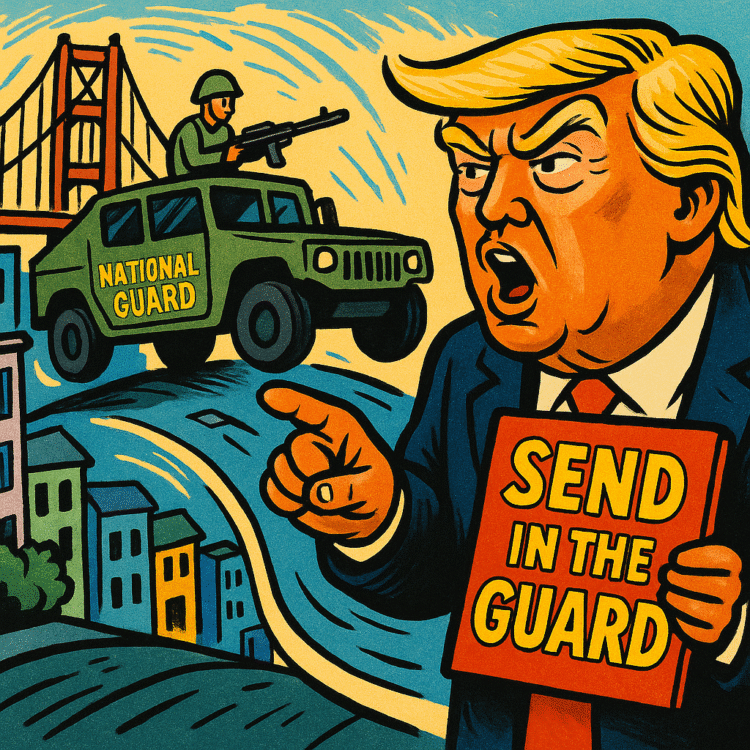
There are few things more American than a trial balloon floated before breakfast and litigated by lunch. This week’s episode comes courtesy of President Donald Trump, who told reporters he is “considering” sending National Guard troops into San Francisco. The comment, equal parts threat and theater, landed with the kind of bureaucratic thud that rattles through cable news for forty-eight hours before dissolving into the ether of the next scandal.
The city’s response was swift. Mayor Daniel Lurie said federal intervention was unnecessary, pointing to data that shows violent and property crime trending downward from early-year peaks. District Attorney Brooke Jenkins and Sheriff Paul Miyamoto echoed him, touting new hires and local partnerships. Meanwhile, in the alternate universe of Silicon Valley, tech moguls lined up to audition as armchair generals. Marc Benioff called for a deployment, Elon Musk cheered him on, and the rest of us remembered why billionaires should never be allowed near public safety policy.
A City Under Siege—In Theory Only
It’s worth pausing on what’s actually happening here. San Francisco is not, contrary to Twitter hysteria, a war zone. The city is messy, expensive, and struggling with homelessness—yes—but it’s also one of the safest major metros in America when measured by violent crime per capita. The problem isn’t lawlessness. It’s the gap between perception and policy, between Fox News B-roll and FBI data.
That gap is where Trump thrives. By framing San Francisco as a failed state, he can posture as the strongman who restores order to chaos, even when the chaos exists primarily in campaign ads. The genius of the strategy lies in its vagueness: he doesn’t have to send troops to reap the political benefit of threatening to.
Federalism on Fire
Legally, this is a rerun we’ve seen before. Deploying National Guard troops without state consent sits on shaky constitutional ground. The Posse Comitatus Act limits federal forces from performing domestic law enforcement unless Congress says otherwise. The Insurrection Act offers a loophole, but only when there’s an actual rebellion or an obstruction of law so severe that local authorities can’t function.
California Governor Gavin Newsom made clear he’ll handle his own state. “We don’t need a federal babysitter,” his office said, in language that managed to be both diplomatic and devastating. The Ninth Circuit has already set limits on similar deployments, and judges in Illinois and Oregon have recently blocked parallel attempts. Yet the administration keeps testing the boundaries, perhaps because the fight itself is the point.
The Billionaires Who Cried Apocalypse
Enter the tech barons. Benioff, ever the spiritual capitalist, initially called for National Guard deployment before quietly backpedaling when it started to sound less like civic engagement and more like martial law. Elon Musk, meanwhile, labeled the city a “drug zombie apocalypse,” as if he’d just discovered adjectives. The irony of two billionaires demanding government boots on the ground while underpaying contract workers wasn’t lost on anyone.
Their argument boils down to optics: if the city looks unsafe, the market loses confidence. It’s the same logic that’s been hollowing out American cities for decades—polish the surface, ignore the structure. Deploying troops for a press conference isn’t governance. It’s set design.
The White House Word Games
The administration’s line is that “local officials requested federal assistance,” a claim notable for its lack of named officials. The phrasing is deliberate. It suggests legitimacy while providing plausible deniability. It’s the political equivalent of saying, “Sources tell me people are saying.”
Behind the scenes, lawyers are already drafting the inevitable court filings. A single executive order would trigger a sprint of temporary restraining orders, appeals, and injunctions. By the time the Supreme Court could weigh in, the photo op would be over and the troops—if they ever left the barracks—would be back home.
The Business of Fear
This is not about safety. It’s about narrative control. A visible military presence satisfies the emotional needs of voters who equate order with force. It allows politicians to declare victory without solving a problem. It’s far easier to blame “the streets” than to invest in treatment beds, housing, and social services.
Every administration eventually finds its scapegoat city. For Nixon, it was Washington. For Reagan, it was Berkeley. For Trump, it’s San Francisco—a city that embodies everything his base loves to hate: liberal, queer, multicultural, tech-saturated, and defiant. Sending troops is not about fixing it. It’s about punishing it.
The Legal Tangle
Even if Trump signs the order, the legal structure collapses on contact with reality. Federalized troops can protect federal property but can’t police local streets. Any attempt to do so would violate constitutional boundaries and invite lawsuits faster than an Amazon drone delivery. The Illinois and Oregon rulings have already established precedent that federal intervention without credible evidence of rebellion is unlawful.
The courts aren’t buying “public disorder” as a blank check. Judges now demand credible data, not vibes. Unfortunately for Trump, San Francisco’s actual data shows improvement—less crime, better enforcement, more accountability. Facts, once again, have the audacity to contradict the campaign message.
A City That Refuses to Play Along
San Francisco’s leadership, whatever its flaws, knows how to play the long game. Mayor Lurie’s calm response turned what could have been a confrontation into a civics lesson. District Attorney Jenkins rolled out numbers on prosecution rates and crime reductions. Sheriff Miyamoto highlighted recruitment gains and fentanyl seizures. It was a masterclass in bureaucratic judo—using dull competence to neutralize political theater.
Even within the business community, cracks appeared. Benioff’s soft-pedal came just as Dreamforce, Salesforce’s flagship conference, returned to the city. Nothing ruins a corporate keynote faster than footage of Humvees rolling down Market Street. Meanwhile, small business owners voiced a simpler concern: that deploying troops would scare away customers faster than any news segment about shoplifting ever could.
The Courtroom Economy
The inevitable next chapter will unfold in courtrooms. Civil rights groups will argue that the deployment violates both the Tenth Amendment and the Posse Comitatus Act. City attorneys will seek emergency injunctions. The administration will appeal, framing resistance as defiance. And through it all, Trump will stand at a podium somewhere, declaring that he tried to bring “law and order” but was stopped by “radical judges.”
This is the performance art of modern governance: provoke, litigate, lose, repeat. Each defeat becomes proof of persecution, each ruling a rallying cry. The goal isn’t to win legally—it’s to win narratively.
The Economics of Escalation
Behind the legal drama lies a more mundane truth: federal deployments cost money. Every soldier on patrol is one less dollar for housing or healthcare. The cost of this theater will be borne by taxpayers who get neither safety nor solutions in return.
It’s worth remembering that the National Guard exists to assist states, not humiliate them. Its members are neighbors, not props. Turning them into a backdrop for political messaging corrodes the public trust that underpins civil service.
When Optics Outrun Reality
The paradox of Trump’s political style is that he understands the media better than the policy he’s weaponizing. He knows that images of troops—real or imagined—dominate headlines. The moment the word “deployment” leaves his lips, the story metastasizes. He doesn’t need soldiers in San Francisco; he needs cameras in San Francisco. The troops are a prop in the oldest trick of strongman politics: equating visibility with power.
But optics have a half-life. The spectacle fades. What remains are the policies that never got written, the programs that never got funded, and the public that grows more cynical with every round of performative governance.
The Precedent Problem
The danger of normalization cannot be overstated. Each “trial balloon” lowers the bar for what counts as acceptable. When federal troops in cities become a recurring headline instead of a constitutional crisis, democracy starts to look like a suggestion. The Insurrection Act, designed for existential threats, risks becoming a campaign tool.
And once the precedent is set, it won’t matter who sits in the Oval Office. Power rarely reverses itself. Every administration inherits the shortcuts of the last.
The Choice Ahead
In the coming days, we’ll see the same split-screen America that defines our era. On one side: White House officials spinning the move as “proactive leadership.” On the other: California leaders insisting on the rule of law. The rest of us will be caught in the middle, watching as the machinery of government grinds through another round of symbolic combat.
The question, as always, is what kind of country we want to be. One that treats cities as laboratories for federal overreach—or one that still believes in local self-governance, even when the politics are inconvenient.
The Long Shadow of the Photo Op
If history is any guide, no troops will march down Market Street. What will march instead is the narrative—the image of a president “considering action,” a city “on the brink,” and a nation supposedly rescued by force. By the time courts dismantle the fiction, the spectacle will have served its purpose. The photo op will have replaced the policy.
That’s the tragedy of our current politics: the people in charge mistake visibility for leadership and power for progress. San Francisco doesn’t need soldiers. It needs sanity, patience, and the unglamorous work of solving hard problems. But that doesn’t make for good television.
In the end, the real battlefield isn’t the city—it’s the story. And if democracy still matters, the story must remain ours to tell.