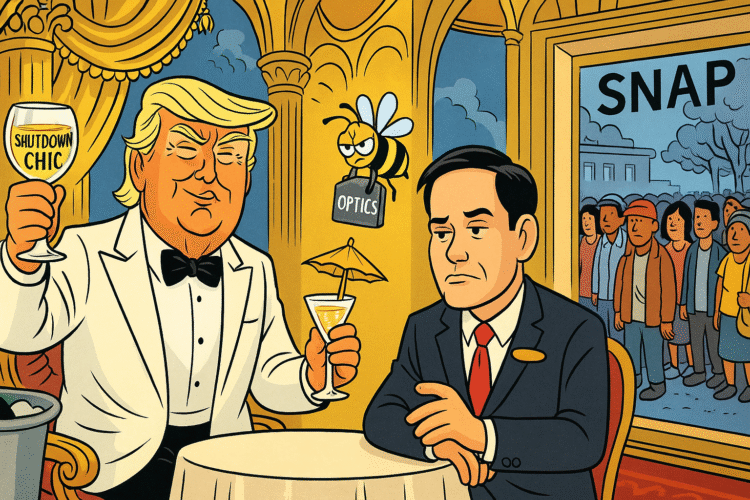
Every generation gets the Gatsby it deserves. In the 1920s, it was Jay. In 2025, it’s Donald. One spent his fortune chasing a dream across the bay. The other rented out an entire country and called it Mar-a-Lago.
This week’s masquerade ball at the Winter White House wasn’t just a Halloween party—it was performance art. While 42 million Americans were told to brace for a shutdown that would cut off food assistance, President Donald Trump was clinking champagne flutes with Secretary of State Marco Rubio under chandeliers shaped like dollar signs. The theme? The Great Gatsby. Because when people are starving, why not go full Fitzgerald.
1. The Party at the End of the Republic
The guest list was as subtle as the décor: donors, cabinet members, and a smattering of influencers in sequined flapper dresses purchased from the kind of online stores that also sell “Back the Blue” lawn signs. Trump arrived in a white tuxedo jacket that gleamed like a gold-leaf indictment, his hair lacquered into the hue of late-stage self-confidence.
“Tonight we celebrate prosperity,” he declared, gesturing toward a bar lined with champagne fountains. At his side sat Marco Rubio, playing Nick Carraway to Trump’s self-anointed Gatsby, a man too polite—or too ambitious—to point out that the Jazz Age ended in a crash.
Outside, reporters were escorted off the property. Inside, the jazz band played “Ain’t We Got Fun,” and the waiters carried shrimp towers taller than most Floridian moral compasses.
At roughly the same time, in Washington, the Department of Agriculture was preparing to inform forty-two million SNAP recipients that benefits might stop the next day.
There is something poetic about serving caviar while cutting food aid. It’s not just hypocrisy—it’s choreography.
2. The Timeline of Tastelessness
Let’s map the week as it happened, because the absurdity needs timestamps to be fully appreciated.
- October 31, 8:00 PM: Mar-a-Lago opens its gates for “The Great Gatsby Halloween Gala.” Guests are encouraged to dress “Roaring Twenties chic.” One aide reportedly comes as “Fiscal Responsibility” and leaves at nine.
- October 31, 9:00 PM: The press pool is escorted out. White House aides explain that “the president’s private celebration is not official business.” Neither is empathy.
- November 1, 9:00 AM: The U.S. Department of Agriculture releases internal notices warning states to prepare for a “temporary lapse” in food aid due to the government shutdown.
- November 1, Noon: Anti-hunger groups file emergency lawsuits in Massachusetts and Rhode Island federal courts, arguing that the administration’s refusal to use contingency reserves violates both the Food and Nutrition Act and the Administrative Procedure Act.
- November 1, 5:00 PM: Judge Indira Talwani in Massachusetts issues a temporary restraining order requiring USDA to tap roughly $5 billion in contingency funds.
- November 1, 7:30 PM: Judge John McConnell in Rhode Island echoes the ruling, ordering the same compliance within 48 hours.
- November 1, 8:00 PM: Trump posts on Truth Social: “Fake news saying people won’t eat. Very unfair! We’re doing big things for Christians and hard workers. Nobody loves food more than me.”
By Saturday morning, lawyers were combing through emergency filings while partygoers were nursing hangovers under gold-plated ceilings.
3. Law by Champagne Light
The irony is architectural. The very laws Trump’s team pretended not to know were designed to prevent exactly this kind of spectacle.
The Food and Nutrition Act makes SNAP an entitlement, not a discretionary favor. Congress funds it; the USDA administers it; the president cannot withhold it on a whim.
The Administrative Procedure Act bars arbitrary and capricious actions. Telling 42 million people “sorry, the check’s in the political mail” while hosting a Roaring Twenties cosplay marathon? That’s the dictionary definition of arbitrary.
And then there’s the Antideficiency Act, which forbids agencies from spending money not appropriated by Congress. It doesn’t allow starvation as a workaround.
So when USDA lawyers told the courts they were “legally uncertain” about how to fund SNAP during a shutdown, the judges didn’t hesitate. They ordered them to use the contingency reserves—somewhere between $5 and $6 billion—already sitting idle.
In other words, the judiciary had to step in and remind the executive branch that feeding people is not a partisan luxury.
4. The Optics of Excess
Governors and senators reacted like parents walking in on teenagers hosting an illicit house party.
“Forty-two million Americans are wondering if they can buy groceries, and the president’s dressed like Jay Gatsby?” said Michigan’s governor. “It’s not just bad optics—it’s a moral aneurysm.”
A senator from Vermont called the soirée “a costume party at Versailles,” while a conservative from Utah, perhaps weary of defending the indefensible, told reporters: “Sometimes you can’t out-PR reality.”
The White House, never missing a chance to confuse satire for strategy, defended the event. “The president celebrates American prosperity,” said Press Secretary Karoline Leavitt. “He believes every American deserves to party like it’s 1929.”
For once, they might be telling the truth.
5. The Jazz Age Redux
If the 1920s were about excess before collapse, the 2020s are about collapse as performance art. Fitzgerald wrote about parties that masked rot; Trump lives it as policy.
At Mar-a-Lago, chandeliers flickered above tables shaped like dollar signs while the band played “Puttin’ on the Ritz.” Outside, EBT users were checking apps that read “Pending.”
In the Jazz Age, Gatsby stared across the bay at a green light symbolizing a dream he’d never reach. In this version, Trump stares across a golf course at his own reflection, wondering why the poor keep asking for seconds.
The irony of the theme wasn’t lost on anyone who still reads history. Gatsby’s world ended in debt, fraud, and the illusion of eternal wealth. America’s current sequel seems determined to skip to the final chapter.
6. The Legal Mechanics of Hunger
The court rulings that interrupted the weekend’s hangover came down hard and fast.
Both Judge Talwani and Judge McConnell emphasized that SNAP isn’t optional. Under the Food and Nutrition Act, the federal government must provide benefits as long as funds exist. The contingency reserve exists precisely for emergencies like shutdowns.
By refusing to use it, USDA violated the Administrative Procedure Act, acting “arbitrarily and capriciously.” In judicial language, that’s the polite way to say “you made it up.”
The judges ordered immediate compliance and Monday filings confirming disbursement. They also warned that failure to obey could trigger contempt proceedings.
So while the party staff at Mar-a-Lago were sweeping up confetti, DOJ lawyers were drafting memos explaining how to “legally fund” food aid—an Orwellian phrase that deserves its own monument in the Museum of Euphemism.
7. Breadlines and Bubbles
The contrast between champagne and breadlines is not new. What’s new is the self-awareness gap.
Trump’s defenders insist the president “deserves relaxation after hard work.” Hard work, in this case, apparently means holding the economy hostage, alienating allies, and treating law like a buffet—take what you want, leave the rest.
Meanwhile, SNAP recipients are living in the quiet terror of running out of groceries before the courts finish their paperwork. EBT processors are scrambling to implement the judges’ orders, ensuring the funds move before the weekend ends.
For 42 million people, that’s the difference between eating and not eating. For Trump, it’s a scheduling inconvenience between costume changes.
8. The Press Lockout
The press ban from the Halloween party wasn’t just vanity—it was insurance. Trump knows that cameras love contradiction, and nothing screams contradiction like a man dressed as Gatsby while the government he runs starves the poor.
Reporters were told that “private festivities are not for public consumption,” which is precisely the point. The administration is allergic to daylight. The less America sees, the easier it is to sell decadence as strength.
But leaks are inevitable. Photos surfaced on social media showing gold confetti falling over guests chanting “USA!” while a violinist played “Rhapsody in Blue.” The captions wrote themselves: “Let them drink Dom Perignon.”
9. The Consequences of Mockery
The administration’s tone-deaf spectacle has unified an unlikely coalition. Governors from both parties demanded clarity on SNAP disbursements. Anti-hunger nonprofits flooded federal hotlines with questions. Even moderate Republicans expressed disbelief that anyone thought the optics were survivable.
The president’s response was to double down. “The fake news hates when Americans celebrate,” he posted. “We’re bringing back class, beauty, and real wealth.”
In a way, he’s right. Nothing says “class” like starving the poor and calling it fiscal discipline.
10. The Irony of the Theme
Let’s linger on the theme, because it’s the rare political metaphor that explains itself.
In The Great Gatsby, opulence hides emptiness. The parties are masks for moral rot. Wealth becomes theater, and empathy dies backstage. The characters drink, dance, and self-destruct under the illusion that money can buy meaning.
Now imagine that energy in the White House. Trump isn’t playing Gatsby—he’s playing the house band at Gatsby’s funeral. His costume is wealth, his performance is nostalgia, and his audience is a country too exhausted to clap.
The 1920s ended with a crash because the system was built on illusion. We’re watching the same movie with color correction.
11. Monday Morning Reality
The next checkpoints are bureaucratic but vital:
- Compliance filings: USDA must prove by Monday that it has tapped contingency reserves.
- EBT logistics: Processors must distribute benefits before cards go dark.
- Appeals: The administration can challenge the injunctions, but doing so risks open revolt from states already rationing aid.
If the system holds, grocery shelves stay stocked. If not, expect euphemisms like “temporary disbursement gap” and “administrative pause” to enter the news cycle—phrases designed to make hunger sound like a software update.
12. The Soundtrack to Decline
There’s a quote from Fitzgerald that feels made for this moment: “They were careless people, Tom and Daisy—they smashed up things and creatures and then retreated back into their money or their vast carelessness.”
Replace Tom and Daisy with Donald and Melania, and the sentence needs no edits.
Carelessness is not an accident—it’s a governing philosophy. It’s the belief that consequences are for other people, that empathy is weakness, and that history is a stage for self-promotion.
Trump’s Gatsby party wasn’t a lapse in judgment. It was the thesis statement of his presidency: indulgence as identity, cruelty as pageantry.
13. What the Party Meant
The real tragedy isn’t the hypocrisy—it’s the normalcy. We’ve reached a point where the image of a president feasting under chandeliers while food aid collapses feels merely “on brand.”
That’s how decadence works. It stops shocking you. It becomes wallpaper.
But make no mistake: this is the country’s mirror moment. A leader who dresses as Gatsby while 42 million Americans wonder how to eat has turned governance into a morality play. The costume is the policy.
14. The Epilogue
By the weekend’s end, the court orders forced the government to release the funds. Grocery benefits were restored—at least temporarily. The judges saved the program, not the soul of the administration.
Mar-a-Lago’s ballroom is quiet again, its marble floors scrubbed of spilled champagne. But the metaphor lingers. The band played on while the empire dined, and the next shutdown, like the next party, is already being planned.
In Fitzgerald’s world, Gatsby believed in the green light, the orgastic future that receded before him. In ours, Trump believes in the golden one—the glare of self-worship that blinds everyone else.
And somewhere out there, forty-two million Americans swipe their EBT cards and pray that the light turns green.