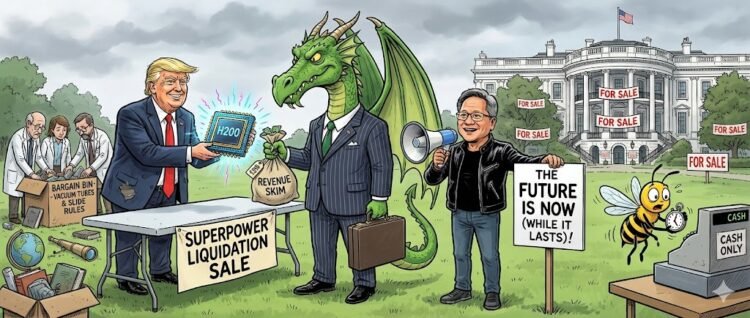
The United States has decided that the best way to win the arms race of the twenty-first century is to act as the premium supplier for the opposing team.
If you have been paying attention to the frantic, breathless security briefings coming out of Washington for the last three years, you know the script. We are in an existential struggle. We are locked in a “Chip War.” We are told, with the gravity usually reserved for nuclear standoffs, that advanced compute is the oxygen of modern warfare and that denying China access to the highest echelons of silicon is the only thing keeping the liberal world order from collapsing into a digital authoritarian nightmare. We have banned the chips. We have sanctioned the fabs. We have twisted the arms of the Dutch and the Japanese to stop selling the machines that make the chips. We have drawn a line in the sand made of semiconductor nanometers and sworn that they shall not pass.
But that was before Jensen Huang put on his leather jacket and walked into the Oval Office.
In a reversal that would make a whiplash lawyer sue for damages, the White House has freshly minted a decision to let Nvidia sell its high-powered H200 AI chips to China. This is not a leak. This is not a rumor. This is the new policy. The supposedly ironclad national security restrictions that barred the export of the H100, the H200, and even the down-tuned H20 series have been melted into soft clay. The administration has approved sales to “vetted commercial customers,” a phrase that does a lot of heavy lifting while actually carrying zero weight. And in a detail that is almost too perfect in its cynicism, the government is reportedly taking a revenue skim off the top. We are not just allowing the proliferation of the technology we fear most; we are charging a commission on it.
The logic, if you can call it that, seems to be that if Nvidia doesn’t sell these chips, they will lose money. Specifically, Nvidia warned earlier this year that export bans could cost it at least 5.5 billion dollars in lost sales, lost market share, and unsellable inventory. And in the Trumpian worldview, losing 5.5 billion dollars is a far greater tragedy than losing the technological edge in the defining conflict of the century. The national security hawks at the Commerce Department and the Defense Department are reportedly screaming into their pillows, but their screams are muffled by the sound of the cash register ringing.
The Absurdity of the “Vetted Customer”
The administration insists that these chips will only go to “approved” buyers. They want us to believe that there is a velvet rope in the Chinese tech sector. They want us to believe that we can ship the most powerful computational engines in human history to a “commercial” entity in Shenzhen and ensure that they stay there, used only for innocuous tasks like optimizing food delivery routes or generating cat videos.
This requires a level of magical thinking that borders on the hallucinogenic. Chips are not buildings. They are small, portable, and incredibly valuable squares of silicon. They migrate. They resell. They resurface. They float through gray channels faster than a TikTok trend. We have already seen this movie. The United States has repeatedly documented Chinese state-affiliated labs, including those linked to the military and nuclear weapons programs, using U.S. silicon long after it was supposed to be blocked. They buy it through shell companies. They buy it through Hong Kong. They buy it through intermediaries in third countries who mark it up and ship it north.
The idea that we can safeguard our technological edge by turning export compliance into a customer loyalty program is laughable. We are essentially giving China a rewards card. “Swipe here for the H200, and if you promise not to use it for hypersonic missile simulation, we will give you a discount on the next batch.” It ignores the fundamental reality of the Chinese economy, which operates under a doctrine of civil-military fusion. In China, there is no hard line between a “commercial customer” and the state. If the People’s Liberation Army wants the compute power sitting in a Tencent server farm, they get the compute power. The law requires it. The system demands it. To pretend otherwise is not strategy. It is willful blindness purchased for the low price of a quarterly earnings beat.
The Oxygen of Modern Warfare
Let us remember what these chips actually do. The H200 is not just a faster way to run Excel. It is the engine of the frontier. It enables the training of giant language models that can write code, analyze intelligence, and generate disinformation at scale. It powers the genomic redesign simulations that could lead to new bioweapons or new cures, depending on who is holding the mouse. It runs the fluid dynamic simulations necessary for hypersonic testing. It drives the industrial automation that allows a factory to churn out drones without human intervention.
For years, officials have told us that every chip, every transistor, every scrap of compute could decide the future of national power. They told us that the “AI arms race” was real and that losing it was not an option. And now, they are handing the other side the jet fuel. They are handing them the engine. They are handing them a fresh set of carbon fiber wings and wishing them good luck on the flight.
The hypocrisy is breathtaking. Politicians stand on podiums and claim that U.S. supremacy depends on locking down compute. They pass bills to fund domestic chip production. They restrict academic exchanges. They treat the export of technology as a grave matter of state. Yet the moment a titan like Nvidia says the bans hurt profits, Washington pivots from national security sermonizing to concierge service for Big Tech. The “iron curtain” of export controls turns out to be a beaded curtain that you can walk right through if you are rich enough.
The Domestic Starvation Strategy
While we are busy acting as the quartermaster for our primary rival, take a look at what is happening at home. American firms, universities, and startups are struggling. They are fighting for allocation. They are dealing with compute shortages. They are paying inflated GPU prices that make it impossible to compete. Research budgets at American universities are being throttled because they cannot afford the hardware necessary to stay on the cutting edge.
We are starving our own innovation ecosystem while feeding our competitor’s. We are telling the PhD student at MIT that they have to wait in line for GPU time, while we expedite a shipment to a “commercial partner” in Beijing. It is a policy of self-sabotage that creates a bizarre inverted reality. The American tax code and the American export policy are effectively subsidizing the advancement of Chinese AI capabilities while putting up hurdles for American ones.
This links directly to the pattern of transactional national security that defines the current era. Rules are rigid until someone wealthy enough shakes the tree. Then, suddenly, everything becomes “flexible.” Everything becomes “strategic.” Everything becomes a “win-win,” even if the win for the corporation is a loss for the country. The strategic calculus has been replaced by the deal calculus. If the check clears, the policy shifts.
The Genie and the Bottle
The strategic consequences of this decision are not reversible. This is not like a tariff that can be lifted or a treaty that can be unsigned. Once the hardware is shipped, it is gone. Once the H200s are in China, they will be used to train models. Those models will exist forever. The insights gained from those models will exist forever.
By strengthening China’s access to advanced chips, we are widening Beijing’s ability to map biological pathways. We are supercharging their industrial robotics. We are advancing their military command systems. We are helping them solve the very problems that our export controls were designed to make unsolvable. We are removing the friction.
And we are doing it at the exact moment when the competition is intensifying. We are blurring the distinction between commercial and military use at a time when that distinction is the only thing keeping the peace. We are weakening U.S. deterrence. If China knows that it can always buy the latest hardware from us, regardless of the rhetoric, they have no reason to fear our technological containment. They know that our greed is stronger than our resolve.
It erodes our negotiating position. How do we ask our allies to stop selling to China when we are doing it ourselves? How do we tell the Netherlands to restrict ASML lithography machines when we are shipping the finished product? We look like hypocrites. We look like opportunists. We look like a superpower that has decided to hold a liquidation sale in the middle of a siege.
The Skim
The detail about the government taking a “revenue skim” is the cherry on top of this toxic sundae. It transforms the United States government from a regulator into a beneficiary. It gives the Treasury a direct financial incentive to approve more sales. It aligns the interests of the state with the interests of the exporter, rather than the interests of national security.
It is a form of state-sponsored racketeering. “Nice chip shipment you have there. Be a shame if it got stuck in customs. Give us a cut and we’ll call it a ‘vetted commercial transaction’.” It degrades the dignity of the office. It turns foreign policy into a side hustle.
This is the ultimate expression of the “business of America is business” philosophy, taken to its logical, suicidal extreme. We are selling the rope, but at least we are charging a premium for it.
The Question of Victory
We have to ask ourselves a cutting question. How can the United States claim to be locked in an existential AI contest while playing quartermaster for its primary rival? How can we claim that we must win the race for the future while we are handing over the very compute engines that define twenty-first-century power?
It suggests that the “race” is a lie. Or at least, the people in charge don’t believe in it. They believe in the quarterly report. They believe in the stock price. They believe that the market is the only god that matters, and that national security is just a story we tell to justify the defense budget.
If the race is real, if AI really is the technology that will determine the fate of nations, then what we are doing is madness. We are selling our rivals the shoes, the track, and the stopwatch. We are handing them the water bottle at the mile marker. We are wishing them good luck on the podium.
And when they cross the finish line ahead of us, powered by the chips we sold them, trained on the models we enabled, we will have nobody to blame but ourselves. We will look at the 5.5 billion dollars we saved Nvidia, and we will wonder if it was worth the price of the century.
The H200 is a marvel of engineering. It is a testament to American ingenuity. It is a masterpiece of design. And it is about to become the engine of Chinese dominance, courtesy of a meeting in the Oval Office and a leather jacket.
Receipt Time
The invoice for this transaction is going to be long and painful. We are trading long-term security for short-term profit. We are trading leverage for liquidity. The receipt shows a credit for “Nvidia Shareholder Value” and a massive, uncalculated debit for “Future Strategic Dominance.” The tax on the sale might fill a pothole or two, but it won’t fill the gap in our defenses. We are selling the future to pay for the present, and the exchange rate is terrible. The customers are vetted, the chips are crated, and the check is in the mail. But the real cost hasn’t even begun to register.