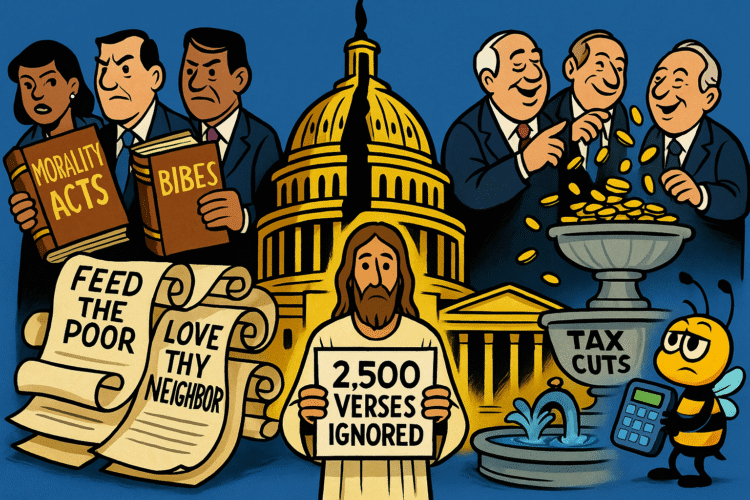
There is a curious arithmetic in American Christianity, a kind of divine math that turns compassion into socialism, wealth into righteousness, and selective literacy into law. It goes something like this: when it comes to who sleeps with whom, suddenly the Bible is binding federal code, the Supreme Court is a Sunday school, and the Department of Justice is a megachurch security team enforcing Leviticus at gunpoint. But when it comes to what Jesus actually wouldn’t shut up about—feeding the hungry, healing the sick, forgiving debts, and calling rich people camels trying to pole-vault through needles—well, that’s “not the government’s job.”
Convenient, isn’t it?
We live in a country where entire political platforms are built on cherry-picking six verses about sex and ignoring two thousand five hundred about wealth and mercy. It’s like editing Les Misérables to keep only the part where Javert lectures people about curfews.
The Holy Hierarchy of Sins
Let’s break down the new national theology. According to today’s self-appointed moral majority, the gravest sin in America is not avarice, violence, or bearing false witness about an election. It’s consenting adults being happy in a way that makes a state senator uncomfortable.
These are the same lawmakers who can quote Paul’s letters on “unnatural relations” with the fluency of an English professor—but go strangely mute when asked to recall Matthew 25:35-36, where Jesus lists the actual criteria for divine judgment:
“For I was hungry and you gave me food,
I was thirsty and you gave me drink,
I was a stranger and you welcomed me,
I was naked and you clothed me,
I was sick and you visited me,
I was in prison and you came to me.”
A list like that would tank in any GOP primary debate. Imagine the horror: a Messiah who identifies with prisoners, immigrants, and the uninsured. No wonder so many American Christians prefer the Book of Job Creators.
The Gospel of Limited Government (Except for You)
The new conservative faith isn’t Christianity so much as Christiantaxonomy: a neat filing system where every moral commandment is sorted by fiscal convenience.
- Love your neighbor → “Only if they pass a background check.”
- Heal the sick → “Let the free market handle that.”
- Feed the poor → “That’s what GoFundMe is for.”
- Welcome the stranger → “Build a wall and quote Romans 13.”
You see, it’s not that they’ve abandoned religion—it’s that they’ve outsourced it. Jesus is no longer Lord; He’s a consultant for zoning restrictions.
They’ll tell you that the Bible prohibits government welfare because charity must be “voluntary.” But so must grace, and that never stopped them from making the state the handmaiden of their purity crusades. Evidently, coercion is fine when it’s your bedroom being policed, just not your billion-dollar hedge fund.
Thou Shalt Not Redistribute
It’s astonishing how the same people who think God hand-picked them for exceptionalism also think He’s powerless to act through collective institutions. “Government can’t show love,” they say, as if FEMA was supposed to hug you instead of send a check.
Yet somehow government can show judgment. It can restrict bodies, criminalize gender, weaponize schools, and make preachers of politicians who haven’t cracked a Bible since their last campaign commercial.
The argument always goes like this: “Jesus told individuals to care for the poor, not the government.” Ah, yes, because the word polis—from which we get “politics”—means “everyone except people in government.”
But here’s a little civics-meets-theology refresher: in a democracy, the government is us. We are Caesar, every tax cycle. We are the moral agents deciding whether our collective power reflects the Sermon on the Mount or the Sermon on the Stock Market.
The Beatitudes, Revised for 2025
Blessed are the poor in spirit, for they will be lectured about personal responsibility.
Blessed are those who mourn, for they’ll be told to stop making everything political.
Blessed are the meek, for they will inherit stagnant wages and a GoFundMe for insulin.
Blessed are those who hunger and thirst for righteousness, for they will be fed empty slogans and fried chicken at the prayer breakfast.
Blessed are the merciful, for they’ll be accused of coddling criminals.
Blessed are the pure in heart, for they shall see their tax rate lowered.
Blessed are the peacemakers, for they will be branded unpatriotic.
Blessed are those who are persecuted for righteousness’ sake, for they will trend on Truth Social until someone else becomes the victim of the week.
Mammon’s Favorite Lobbyists
Let’s talk numbers. The Bible references money over 2,000 times. The word “love” appears roughly 700. The word “sex”? Maybe 30, depending on translation and how prudish your grandmother’s King James was.
So if we were to legislate proportionally, Congress would spend most of its time taxing luxury yachts and banning predatory lending. Instead, it’s out here auditing pronouns.
The politicians shouting about “Christian values” tend to interpret Render unto Caesar as Render unto Donors. Their theology of wealth makes Midas look modest. They treat tax cuts as sacraments and hedge fund managers as apostles.
They call this fiscal responsibility, but it’s really spiritual triage: prioritizing the salvation of markets over the salvation of people.
The Prosperity Gospel Meets the Poverty Line
The prosperity gospel—a theology so morally hollow it could echo—promised that wealth was a sign of divine favor. Trump repackaged it into politics.
Now we have preachers blessing private jets and senators quoting parables to defend capital gains. “God wants you to prosper,” they say, as if He moonlights as a venture capitalist.
Meanwhile, the average SNAP recipient lives on roughly $6 a day. Jesus multiplied loaves and fishes; Congress multiplies excuses.
It’s worth asking: if poverty were truly a moral failure, why did Christ keep feeding people instead of scolding them? If wealth were truly virtue, why did He keep warning that it would damn you?
The gap between pulpit and policy isn’t ideological—it’s theological. We’ve mistaken self-interest for stewardship and baptized greed as destiny.
The Sermon on the Tax Return
Picture this: Jesus returns to modern America. He walks into a congressional hearing on “faith-based initiatives.” A senator greets Him:
“Lord, we’re working hard to ban drag queens. Any thoughts?”
Christ pauses, glances at the budget chart, and says, “Where are your widows and orphans?”
“Oh, we defunded that.”
“What about your hospitals?”
“Privatized.”
“Your strangers at the border?”
“Detained.”
“And your poor?”
“Lazy freeloaders, Lord.”
He leaves quietly. The committee issues a statement: The Savior failed to show sufficient respect for American values.
A Tale of Two Testaments
The First Testament says to leave gleanings for the poor, cancel debts every seven years, and welcome the foreigner as family. The Second doubles down on all of it and adds: “Sell your possessions and give to the poor.”
But in American politics, the Testaments have been merged into a single, self-serving commandment: Thou shalt own the libs.
Somehow, the God who turned water into wine is now cast as a prohibitionist. The refugee who fled Herod’s violence is now invoked to justify border crackdowns. The man who healed the sick for free is now the mascot of private insurance.
We’ve turned a revolutionary into a real estate brand.
The Two Kingdoms of American Hypocrisy
It’s a strange dual citizenship, this Christian nationalism. In one kingdom, the Bible is a cudgel to bludgeon queer kids, women, and immigrants. In the other, it’s a dusty prop ignored whenever money enters the chat.
This is how you end up with governors quoting Scripture while gutting Medicaid, or pastors railing against abortion while endorsing policies that guarantee infant poverty.
They don’t want the state to be godless; they want it to be their god.
When Jesus Became a Culture War
You can tell how thoroughly we’ve politicized Christ by watching the choreography of outrage. The same people who think feeding the hungry is “enabling dependency” will tearfully post about how persecuted they are when Starbucks releases a cup that isn’t sufficiently nativity-themed.
They’re not defending faith—they’re defending monopoly. They’ve mistaken cultural dominance for moral legitimacy.
Every generation of empire finds a way to domesticate its prophets. Rome crucified Jesus. America markets Him.
How We Built a Theocracy of Hypocrisy
Theocratic hypocrisy isn’t an accident; it’s infrastructure. It’s built into the lobbying firms, the donor networks, the think tanks that write “religious freedom” bills so broad they could absolve a hospital from treating a gay patient.
It’s the megachurch with a $20 million sound system that preaches “self-reliance.” It’s the Christian college that fires a teacher for teaching empathy but hires a PR firm to manage donor perception.
And it’s the congressman who quotes Corinthians while taking oil money from a regime that bans Christianity.
The Real Bible Ban
We keep hearing about the “war on religion.” But if anyone’s banning the Bible, it’s the people legislating against everything it says.
Try reading the Beatitudes at a city council meeting. Say “Blessed are the poor” out loud, and half the chamber will look for a tax credit. Say “Woe to you who are rich,” and watch the campaign donations evaporate.
The irony is perfect: they want to hang the Ten Commandments in schools, but not the one about coveting. They’ll quote “Thou shalt not kill” while cutting food stamps that prevent starvation.
This isn’t Christianity. It’s cosplay with better branding.
The Kingdom of Heaven, LLC
We have somehow managed to privatize salvation. Grace is now a subscription model. Churches are businesses, sermons are marketing copy, and faith has been focus-grouped to death.
Instead of “love your neighbor,” we have “serve your base.” Instead of “turn the other cheek,” we have “own the opposition.” Instead of “the last shall be first,” we have “the rich shall have tax shelters.”
The moral calculus is simple: if it costs money, it’s socialism; if it hurts someone else, it’s freedom.
What Jesus Actually Said About Politics
Let’s go straight to the source.
Jesus didn’t say “build walls.” He said “invite them in.”
He didn’t say “cut Medicaid.” He said “heal them.”
He didn’t say “drill, baby, drill.” He said “consider the lilies.”
He didn’t say “protect your assets.” He said “sell your possessions.”
He didn’t say “punish sinners.” He said “let the one without sin cast the first stone.”
He didn’t say “make the government small.” He said “make the kingdom of heaven near.”
Every word He said about power was a warning, not a policy brief. But we’ve turned His warnings into slogans, and His compassion into collateral damage.
The Market as Messiah
The unspoken religion of the American right isn’t Christianity—it’s capitalism with a cross stapled to it. The market will provide, they say, even as it devours. It’s not faith in God; it’s faith in quarterly returns.
When Jesus overturned the money changers’ tables, He was condemning exploitation in the temple. If He did that today, Fox News would call Him “anti-business,” Congress would subpoena Him, and some televangelist would launch a GoFundMe for the broken furniture.
Meanwhile, actual hunger and homelessness—those things He told us to fix—are dismissed as personal failures or local issues. Apparently, salvation stops at the city limit.
The Miracle of Moral Amnesia
The miracle isn’t that Jesus rose from the dead. It’s that His followers managed to kill His message and resurrect their wealth in its place.
When empathy costs money, it’s socialism. When cruelty earns votes, it’s conviction. When charity becomes policy, it’s “unsustainable.”
The prophets warned about this. Isaiah called out those who “join house to house and field to field until there is no room left.” Amos condemned those who “trample on the heads of the poor.” None of them would survive a modern congressional hearing. They’d be dismissed as radicals who “hate America.”
And the People Said, “Not My Problem”
This is the logic of our time: legislating morality for bodies while deregulating morality for wallets. The cross is no longer a symbol of sacrifice; it’s a branding opportunity.
We are the richest Christian nation in history, yet one medical emergency can bankrupt a family. We’re told to pray for the poor, not pay for them. We’re told to give from our hearts, not our budgets.
Every empire claims divine approval until the mirror cracks.
The Gospel of the Other Hand
Jesus had a lot to say about the right hand not knowing what the left hand is doing. America took that literally. One hand writes checks to the defense industry; the other signs laws against compassion. One hand prays; the other picks pockets.
We pretend not to see it because the hypocrisy flatters us. It allows us to be cruel without guilt, pious without cost, and patriotic without reflection.
But the math doesn’t work. You can’t govern a nation on six verses about sex and ignore two thousand about justice. You can’t call yourself pro-life while legislating starvation. You can’t worship both Christ and capital, no matter how gilded your church lobby is.
The real test of faith isn’t how loudly you police sin. It’s how quietly you practice mercy.
And when history asks who we were—the nation that built laws around love or fear—our answer will depend on whether anyone still remembers that the Gospel’s first word was never ban. It was bless.