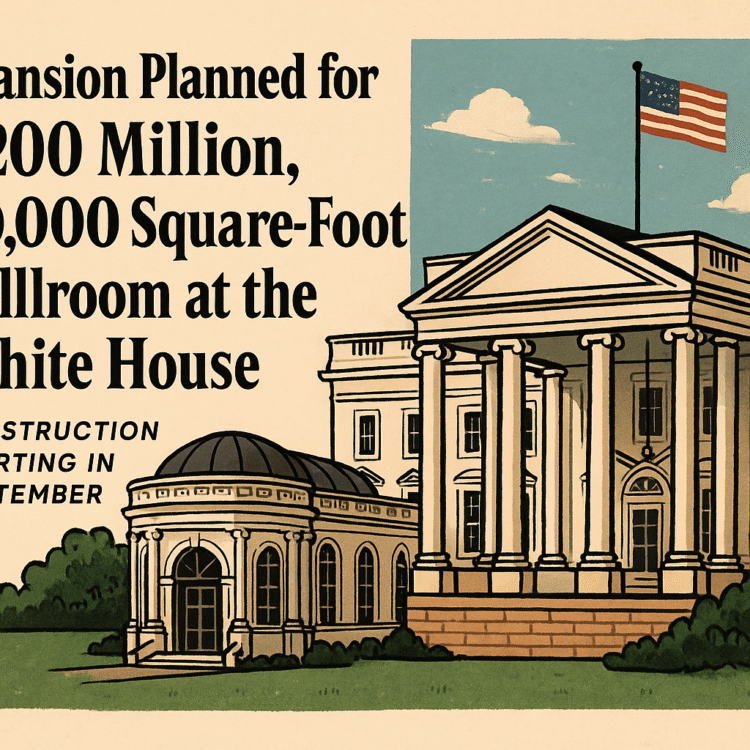
It was the kind of announcement that arrived with all the subtlety of a gold-plated wrecking ball: Former President Donald Trump, against the backdrop of campaign chants and crystal chandeliers, declared that the White House—America’s most sacred secular shrine—will soon be getting a 90,000-square-foot ballroom. Because apparently, what the executive branch lacked most wasn’t decorum, accountability, or stability—it was square footage.
Funded entirely by private donors with a collective net worth somewhere between “God-tier” and “definitely under indictment,” the $200 million expansion will begin construction this September. The ballroom, capable of seating 650 guests (or, if needed, one very important man and his reflection mirrored in 649 gold-framed portraits), will be the largest addition to the White House since Truman’s balcony—and the first with a rumored retractable disco ball.
This, according to the press release, is a noble effort to “address longstanding needs for diplomatic and state functions.” Because when global leaders converge to discuss war, famine, and climate collapse, what they really need is better acoustics for the string quartet and a private champagne bar with Swarovski taps.
Let’s be clear: the White House isn’t exactly a fixer-upper. It already houses multiple dining rooms, a reception hall, the East Room for formal occasions, and a Rose Garden that has hosted more press briefings than roses. But those venues, critics say, lack the gravitas necessary for today’s geo-political influencer class—leaders who demand diplomacy served on bone china under twelve-tier chandeliers, with the occasional pyrotechnic display during dessert.
According to unnamed aides close to the design, the ballroom will feature neoclassical columns, imported marble, 24-karat fixtures, and enough velvet to smother a small village. The centerpiece? A custom ceiling mural titled Triumph of Liberty (and Also the Guy Who Built This Ballroom), rumored to depict Trump in full toga, flanked by eagles and gilded iPhones.
But make no mistake—this is about patriotism. Elegance. Gravitas. And acoustics. And seating capacity. And presumably, the ability to banish the press to a windowless vestibule while foreign dignitaries waltz beneath a golden frieze of Mar-a-Lago’s greatest hits.
Still, some have raised questions. Is a $200 million ballroom truly necessary when the nation is lurching toward a possible government shutdown, infrastructure collapse, and existential heatwave? Will this become the first presidential ballroom to have its own loyalty oath? And can we expect future tours of the White House to include a velvet rope, a DJ booth, and a very stern reminder that the Champagne Room is invitation-only?
White House historians, typically reserved, have begun whispering concerns: about precedent, about symbolism, about whether John Adams would’ve commissioned a hand-painted fresco titled The Art of the Deal. Meanwhile, constitutional scholars are furiously thumbing through the Federalist Papers in search of any clause that mentions dance floors, donor-funded extensions, or private mezzanines with bottle service.
Yet perhaps the most pressing question isn’t about cost, legality, or optics. It’s this: Who gets to dance? And more importantly, who gets to decide who dances?
Because architecture, especially in Washington, is never just about space. It’s about power. Influence. Who’s invited. And who’s locked out while the music plays.
So as construction crews prepare to pour the foundation for what may soon be known as the “People’s Ballroom,” America is once again asked to consider its priorities: Do we measure progress in policy, in principle, or in party size?
One thing’s certain: when the ribbon is cut, and the chandeliers flicker on, someone will raise a glass to American greatness. Just don’t ask who paid for the ice sculpture shaped like a bald eagle doing the moonwalk.
Final Thought:
If diplomacy is the art of knowing when to hold your tongue and when to pass the canapés, this ballroom ensures we’ll do both under six stories of marble and metaphor. Because nothing says “land of the free” like a velvet rope and a donor list.