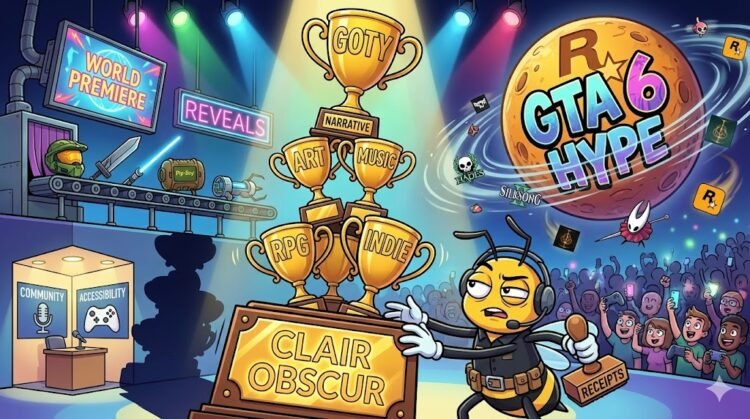
Eight trophies, one gravitational center, and an industry that briefly convinced itself this was destiny rather than appetite.
The Game Awards 2025 unfolded like a formal ceremony that accidentally wandered into a single studio’s victory party and then politely decided not to leave. Clair Obscur: Expedition 33 did not simply win big. It became the room. By the end of the night, Sandfall Interactive’s breakout RPG had collected eight major awards plus Best Performance for Jennifer English as Maelle, effectively turning the show into a guided tour of one game’s trophy shelf. Game of the Year, Best RPG, Best Independent Game, Best Game Direction, Best Narrative, Best Art Direction, Best Score and Music, Best Debut Indie, and a performance win that made the sweep feel complete rather than merely aggressive.
At a certain point, applause stops being about surprise and starts being about acceptance. The audience settles into the idea that this is how the night works now. One game has momentum, and momentum becomes a story that explains itself. By the fifth trophy, the question is no longer “why this game” but “why not.” That’s how award gravity functions. It feels fair because it feels inevitable.
Clair Obscur earned that inevitability by aligning with everything the industry currently wants to praise about itself. It is visually confident, narratively ambitious, musically assertive, and structurally bold. It looks handcrafted in an era obsessed with scale. It signals taste. And taste, at the moment, is the most valuable currency an award show can trade in.
A Snapshot of the Industry’s Current Fixations
Once you step out from under Clair Obscur’s shadow, the rest of the winners sketch a clear picture of where the medium thinks its strengths live right now.
ARC Raiders taking Best Multiplayer speaks to a preference for shared experiences that feel communal rather than extractive. The category no longer rewards raw concurrency alone. It rewards cohesion, tone, and the sense that players are inhabiting a space together instead of being herded through a funnel.
Hades II winning Best Action continues a pattern where speed and precision matter, but style and personality matter just as much. Action is no longer just about reflexes. It is about rhythm, voice, and how good the game feels about itself while punishing you.
Hollow Knight: Silksong winning Best Action and Adventure landed less like a competitive win and more like a collective nod. Its long wait has turned it into a shared cultural patience test, and the award functioned as confirmation that anticipation itself has value when it is attached to trust.
Mario Kart World winning Best Sports and Racing reminded everyone that polish, clarity, and joy still count. No amount of cinematic grit has managed to dethrone the appeal of clean mechanics, readable chaos, and fun that does not need justification.
Final Fantasy Tactics: The Ivalice Chronicles winning Best Sim and Strategy reinforced the genre’s quiet endurance. Strategy players do not need spectacle. They need systems that respect their intelligence and stories that reward attention.
Umamusume: Pretty Derby winning Best Mobile continued the tradition of mobile games being acknowledged briefly before the conversation returns to pretending they are a side hobby rather than one of the largest pillars of the industry.
Donkey Kong Bananza winning Best Family felt like a necessary counterweight. A reminder that approachability is not the enemy of quality and that broad appeal does not mean shallow design.
The Midnight Walk winning Best VR and AR fit the pattern of VR recognition at award shows. There is always a moment of reverence, a nod to innovation, and then a quiet understanding that the category remains adjacent rather than central.
Fatal Fury: City of the Wolves winning Best Fighting underscored the genre’s resilience. Fighting games do not chase trends. They refine, reintroduce, and persist.
Baldur’s Gate 3 winning Best Community Support was almost ceremonial. Few games have been so visibly shaped by an ongoing relationship with their players, and the award felt less like recognition and more like documentation.
Battlefield 6 winning Best Audio Design was predictable in the way physics is predictable. Explosions, collapse, and scale remain that franchise’s core language.
No Man’s Sky winning Best Ongoing Game continued its long-running redemption narrative, proof that persistence and sustained support can eventually overwrite a troubled launch.
Wuthering Waves winning Player’s Voice offered a glimpse into audience taste that does not always align with juries. It was a reminder that popularity and prestige operate on parallel tracks that intersect only occasionally.
Girls Make Games winning Game Changer and South of Midnight winning Games for Impact filled the show’s conscience slots, the categories that signal values alongside spectacle.
The Last of Us Season 2 winning Best Adaptation reinforced the idea that games crossing into other media are still treated as validation moments, even when the original medium no longer needs permission.
DOOM: The Dark Ages winning Innovation and Accessibility demonstrated how accessibility has become part of design excellence rather than an afterthought.
Grand Theft Auto 6 winning Most Anticipated Game was procedural. Some things at The Game Awards function more like calendar confirmations than competitions.
MoistCr1tikal winning Content Creator of the Year, Counter-Strike 2 winning Best Esports Game, Chovy winning Best Esports Athlete, and Team Vitality winning Best Esports Team rounded out the picture of an industry that is as much about spectatorship and performance as it is about authorship.
The Reveal Economy and the Comfort of Familiar Power
The Game Awards have fully merged trophies and trailers into a single ecosystem. Awards punctuate reveals, and reveals give awards their oxygen. In 2025, the reveal slate made something very clear: even on a night dominated by a breakout RPG, the industry still leans hard on familiar gravity.
Total War: Warhammer 40,000 arrived as a grimdark pivot that leaned into scale, inevitability, and a universe that sells itself through density. It was not trying to surprise anyone. It was trying to reassure them.
Larian’s surprise return to Divinity was the opposite kind of confidence. The trailer was restrained, tonally sharp, and trusted the audience to fill in the blanks. That trust is earned, not manufactured, and it showed how powerful studio reputation has become.
The double Star Wars reveal, Galactic Racer and Fate of the Old Republic, demonstrated the franchise’s elasticity. It can become almost anything, and the audience will still show up because the emotional infrastructure is already built.
Exodus, two Tomb Raider entries, a new Diablo 4 expansion, Ace Combat 8, Nioh 3, and Arknights: Endfield rounded out a slate that favored recognition. These were not risks. They were statements of continuity.
This is the central tension of the night. The awards celebrated boldness, originality, and craft, while the reveals leaned on certainty, scale, and brand recognition. The industry wants to be seen as innovative while still behaving like an organism that protects its largest organs first.
What the Sweep Changes and What It Does Not
Clair Obscur’s dominance will have consequences. It will influence funding conversations. It will encourage more pitches centered on prestige RPGs, strong art direction, and narrative-forward design. It will embolden studios that want to argue for taste-driven projects.
It will also be misread. Some publishers will attempt to reverse-engineer the success, mistaking the outcome for a formula rather than a convergence of vision, execution, and timing. Prestige cannot be mandated. It can only be supported and then left alone long enough to exist.
At the same time, blockbuster anticipation remains its own force. GTA 6 sits above the entire industry like weather. No number of awards changes that. When it moves, everything else reacts.
The real takeaway from The Game Awards 2025 is not that one game won everything. It is that the industry briefly aligned around a shared idea of excellence and then immediately returned to its default behavior of hedging bets and feeding gravity wells.
For one night, taste won. Tomorrow, scale still pays the bills.
Receipt Time
The Game Awards 2025 became a de facto celebration of Clair Obscur: Expedition 33, which swept eight major categories plus Best Performance and turned the ceremony into a showcase of prestige RPG values, while the rest of the winners mapped an industry split between craft-forward recognition and the enduring pull of multiplayer scale, long-running franchises, esports dominance, and blockbuster anticipation, all underscored by a reveal slate that leaned heavily on familiar properties even as the show rewarded originality, leaving a clear picture of a medium that wants to celebrate bold vision without abandoning the gravitational centers that keep it financially and culturally anchored.