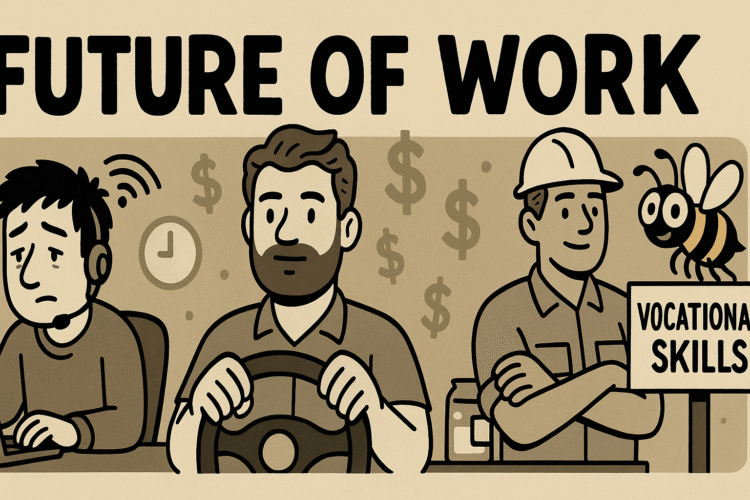
Welcome to 2025, where the American Dream has been converted into a 1099 form and a Slack notification. The office is dead, the commute is optional, and your job description now includes “personal brand ambassador” and “self-motivated hope archaeologist.”
Let’s talk about the “future of work,” shall we? A phrase that once conjured images of jetpacks and holographic boardrooms but now mostly refers to staring at a cracked laptop in a studio apartment while pretending not to hear your neighbor’s emotional support parrot scream “INFLATION” every hour on the hour.
Remote Work: The Office Left Us on Read
In 2020, remote work was a lifeline. In 2023, it was a perk. In 2025, it’s a mirage wrapped in an NDA.
Sure, you’re “working from home”—but you’re also working from the car, from the doctor’s office, from the funeral of your last functioning boundary. Your boss no longer tracks hours; they track green dots. You haven’t had a lunch break in six quarters, but congrats—you finally qualify for a digital detox app that charges $19.99/month to block your own emails.
Management insists remote work is a gift, a privilege. What they mean is: “We offloaded overhead costs, killed your sense of place, and expect you to be both available and deeply grateful.”
You’re not working from home. You’re living at work.
The Gig Economy: Now With Less Dignity
Gone are the days of stable employment. Welcome to the gig economy—where you’re always working, always hustling, and somehow always behind on rent.
In this bold new era, everyone is “entrepreneurial.” Which is corporate for: “no benefits, no protections, and no ability to sneeze without losing your algorithm placement.” You’re not a delivery driver—you’re a “mobile logistics technician.” You’re not a freelance writer—you’re a “content artisan.” You’re not underpaid—you’re “freedom rich.”
Job titles are now vibes. Job security is a spreadsheet. And your boss is an app that uses surge pricing to determine whether you deserve health insurance this week.
Don’t worry, though—the CEO of the gig platform you’re sacrificing your vertebrae to just bought his third lake house and tweeted “We’re all in this together 💪.”
Vocational Skills Are Back… Because College Is a Pyramid Scheme
In 2025, everyone’s talking about “bringing back the trades,” which is code for: “College is now a $180,000 scam that teaches you how to cry in MLA format.”
Vocational skills are booming. Want to be an electrician? A plumber? A solar panel tech with forearms that make finance bros weep? Congratulations—you’re now the only person in your extended family with a retirement plan.
Blue-collar work is in. But let’s be clear: society still romanticizes these jobs more than it pays them. You’ll get a TikTok series called Hot Roofers of Boise, but no dental.
Meanwhile, guidance counselors across America are pivoting from “Follow your dreams!” to “Maybe HVAC certification isn’t the worst idea.”
The future of work isn’t college. It’s whatever keeps the lights on, both literally and existentially.
Branding the Collapse
In true American fashion, the collapse of traditional labor structures has been rebranded as innovation. You’re not burned out—you’re “adaptive.” You’re not exploited—you’re “disrupting legacy workflows.” You’re not broke—you’re in a “growth season.”
Human resources now comes with a meditation playlist. Layoffs are announced via infographic. And your quarterly review includes a word cloud and a compliment sandwich that ends with: “Please train your replacement by Friday.”
Even resistance has been monetized. There’s an app for tracking ethical employers. It syncs with your therapist, who now accepts Apple Pay and lets you tip for breakthroughs.
Final Thought:
The future of work was never about hovercars or three-day weekends. It’s about labor dressed up in language so pretty, you forget it’s still labor. A remote job is still a job. A gig is still a grind. And vocational skills, while essential, still deserve respect and a living wage.
We were promised freedom. We got flexibility—just enough to bend without breaking. Or until we do.