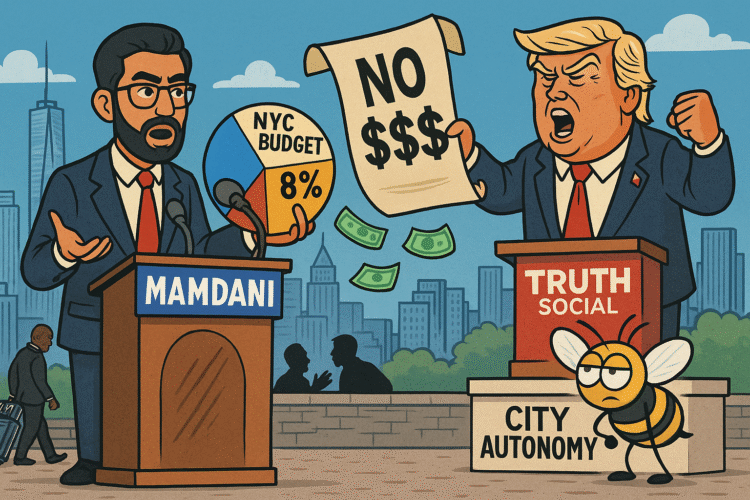
The stage was set when Eric Adams abruptly bowed out of the NYC mayoral race. The city’s Democratic machinery tiptoed toward a new favorite: Zohran Mamdani. Then Trump hit “post” on Truth Social, going full lurid: Mamdani “needs the money from me … to fulfill all of his FAKE Communist promises” and, crucially, “won’t be getting any of it.” In effect: fund me or withhold.
Within hours, Mamdani appeared in Lower Manhattan, calm but defiant. He framed Trump as going through the stages of grief over his own failure. He shrugged off the threat. “He’s threatened this before,” he said. “It’s a temper tantrum, not governance.”
The drama is more than a ginned-up headline. It’s a blunt test of the federal city relationship in a final campaign sprint. It raises constitutional questions about conditional funding, executive coercion, and how much a president can starve a city for political reasons.
Let’s rewind: what led here, what’s at stake, and whether a mayor of America’s greatest city is now at the mercy of one man’s tweet.
Timeline: From Adams Exit to Mamdani Showdown
Campaign pivots (August–early September)
Mamdani had been mounting a left-leaning candidacy built on housing, transit equity, social services, child care, climate, and restorative justice. As Adams floundered and approval slid, political actors quietly began circling Mdm. Mamdani as the heir apparent. Behind the scenes, Adams’s inner circle—some with ties to Trump allies—teased a strategic exit, to avoid a bruising primary among fellow Democrats.
September 28 – Adams suspends bid
At a press event, Adams announced he would not seek reelection. The city’s power brokers scrambled. Endorsements redistributed. Mamdani’s campaign, already gaining momentum, was now in the spotlight. Just days before ballots needed to be printed, the mayoralty became, in effect, open season.
September 29 – Trump’s post
Trump, no stranger to opportunism, posted that Mamdani “needs the money from me … to fulfill all of his FAKE Communist promises,” and added, “He won’t be getting any of it.” The implicit threat: a Trump administration might withhold federal funding to penalize a political opponent.
Same day – Mamdani presser
Holding court in Lower Manhattan, Mamdani responded: “He’s going through the stages of grief” over Adams’s collapse. He refused to engage the bullying in kind. He said, “I didn’t come into this to chase federal handouts—I came to fight for city funding equity, for New Yorkers, not for Trump’s grudges.” He challenged Trump to try the legal route, not the scold-and-threat route.
The Lines: Policies That Need Federal Dollars
The beauty and danger of city governance is that nothing is purely local. Even a mayor with bold promises must rely on overlapping federal, state, and municipal money. In Mamdani’s platform:
- Transit: MTA funding, capital grants, federal matching dollars for infrastructure modernization, bus electrification.
- Child care & early education: Federal Head Start, childcare subsidies, Early Head Start funding, CDBG or urban block grants.
- Social services, homeless services, housing voucher expansions: HUD programs, LIHTC, ESG (Emergency Solutions Grant) funds, FEMA adjuncts.
- Climate, resilience, infrastructure: EPA grants, DOT money, HUD resilience funding, clean energy matching grants.
- Health, mental health, public safety: DOJ grants, SAMHSA, CDC, etc.
If federal streams are partially cut, it doesn’t just stall new investments—it threatens core operations. A 8 percent federal share of NYC’s budget is no small wedge (figured at approximately $9.6 billion in FY2025). Some agencies might absorb small cuts; others would collapse or require emergency city bailouts. The question: whose programs bleed first?
Behind the Scenes: Adams, Trumpworld & Leverage Moves
Word is that before Adams dropped out, there were quiet conversations behind closed doors. Some Adams allies were reportedly in contact with Trump-aligned federal actors—“friendly intermediaries” who promised noninterference if certain lines were drawn in the transition. The sudden timing, the lack of a messy primary, the fluid picture of who would be amenable—these signs suggest federal pressure was never far off.
Trump’s post is not random. It is a coercive signal. It says: I know where your budget lies. I know who gives your money. And I can snip the hose. If the mayoralty goes to someone I don’t like, I can squeeze them with funding threats. That threat shifts power away from democratic city choice and toward federal political muscle.
Reactions, Roadblocks & Legal Hurdles
Not surprisingly, New York Democratic leadership, city council members, and civil-rights organizations pushed back hard. Aldermen demanded state or legal interventions. The NY advocacy sphere called Trump’s comment an unconstitutional attempt at coercion—“hold the city hostage,” some said. Some civil liberties groups threatened suits under the Spending Clause and anti-coercion doctrine.
Legal scholars note that conditional funding is not automatically unconstitutional—but there are limits. Congress can attach conditions, but only if they are unambiguous, germane to the federal program, and not unduly coercive. A president unilaterally withholding funds to punish electoral outcomes may cross that line, especially for municipal governance. The separation-of-powers balance is under threat.
Some responded cynically: “Go ahead and try. See how many courts you use to shut down our services.” Others mused whether Trump’s threat already violates the Administrative Procedure Act or constitutional mandates.
Stakes: Agencies, Services & Political Power
A funding freeze—or even the threat of one—delivers a double whammy:
- Operational collapse: Programs with bone-thin margins can’t function under uncertainty. Childcare, homeless support, subsidized housing, transit maintenance—they all risk cuts or shutdown.
- Political intimidation: Mayors will think twice before opposing Trump or taking progressive fiscal risks. Municipal leadership becomes about appeasement, not advocacy.
- Unequal harm: Low-income neighborhoods, immigrant communities, essential workers—they are hit hardest. The wealthy or politically connected shuffle resources.
- Legal and constitutional contest: If courts allow the president to ratchet funding based on political animus, the line between city autonomy and federal muscle disappears.
The threat of funding freeze is not just a bribe—it is a blueprint for executive dominance over cities.
Final Reflection
This showdown in New York is small in scale but enormous in meaning. A federal funding threat over a municipal race? That’s not tough negotiation—it’s blackmail. A president saying he will punish a city he doesn’t like by choking its budget? That’s not politics—it’s power.
What’s at stake is more than who runs NYC. It’s whether cities retain autonomy, whether public services can continue independent of political retribution, whether municipal democracy can withhold from national tyrants. Mamdani didn’t ask for extra money from Trump—he asked to be free of his threat.
The next few weeks aren’t just a campaign closing. They are a test: will cities be carved out as land where presidents can pull spine, or will they remain places where democracy demands more than a tweet?