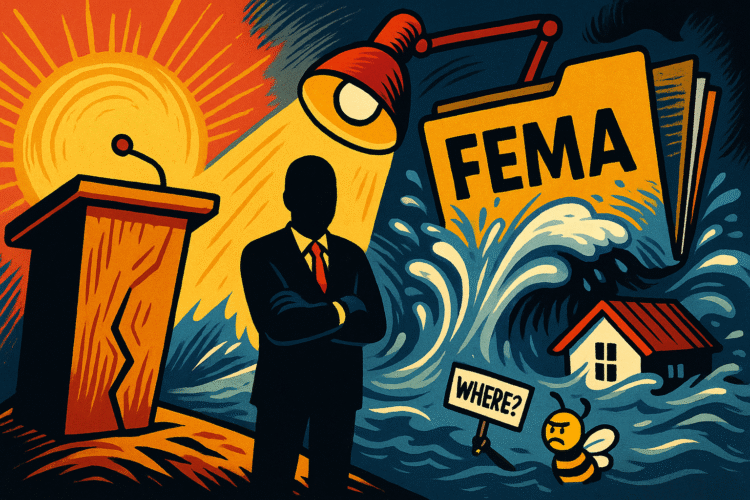
America asked for a functional disaster agency, and the administration handed us a shrug in a windbreaker.
There is a particular stillness that happens right before the government announces a resignation. You can almost hear the PowerPoint slides being frantically re-saved under new filenames, the comms staff muttering into their sleeves, the soft metallic clang of an empty chair spinning in a federal office nowhere near the crisis occurring in the outside world. And this week, that hollow echo belonged to David Richardson, the acting FEMA administrator who, it turns out, was a lot more “acting” than “administrator.”
Richardson walked out the door after six months, leaving behind the kind of legacy usually reserved for contestants who get eliminated first on reality shows. Except in his case, instead of failing to make a soufflé or bond with a Bachelorette, the stakes were 130 dead in Texas, drowned towns waiting for federal help that never arrived, and an agency gutted with the devotion of someone preparing it for taxidermy.
The official line is that he resigned. The unofficial line is that nobody noticed until someone tried to call him and realized, belatedly, that he hadn’t been answering the phone since July.
This is not what people typically mean when they say “lean government.”
This is instead what they mean when they whisper at dinner parties, “I think the administration might actually be allergic to competence.”
A Disaster Agency That Doesn’t Do the Disaster Part
Let’s start with the central Texas floods, the catastrophe that revealed the administration’s governing philosophy in all its neon-lit glory. Towns went under. People died. Local officials begged for help. And David Richardson, the man legally responsible for coordinating the federal response, went quiet for more than a day.
Not unreachable because he was in the field, heroically sandbagging a levee. Not unreachable because he was in a command center reviewing satellite data. Unreachable because nobody actually knew where he was. The best guess was “his truck.” That was his answer later on Capitol Hill. He was “managing operations” from his vehicle, a phrase that raises more questions than it answers, starting with: Was the truck even running?
Imagine if the head surgeon of a trauma unit explained a mass casualty response by saying, “Oh yeah, I handled all that from the parking lot. With the windows rolled up.”
And imagine the follow up question being, “Do you know what month hurricane season is?”
And the answer being an earnest silence.
That’s the man who just resigned. Or evaporated. Or ascended to a plane of existence where none of us can call him. Hard to say.
The FEMA Staffing Plan Known as: Have You Tried Not Having Staff?
Richardson’s departure would be less damning if it came from a stable, fully staffed agency. But FEMA, under the second Trump administration, is less “agency” and more “haunted warehouse with a logo.” Approximately 2,500 positions eliminated. Spending approvals rerouted through Homeland Security Secretary Kristi Noem, who treats budget oversight like a hobby sport requiring only instinct and a willingness to ignore experts.
The administration’s vision for FEMA is apparently to test how few people it takes to run a national disaster apparatus. Scientific method, meet libertarian fever dream.
It would be one thing if this were happening during a quiet year. But we now live in the part of history where flood maps need quarterly updates, wildfire smoke behaves like seasonal decor, and hurricanes arrive with the emotional predictability of jump scares in a horror film.
This is not the moment to experiment with a new “disaster management philosophy” based on the principles of wishful thinking and budget cosplay. And yet here we are, watching FEMA get hollowed out like a pumpkin two weeks after Halloween.
Kristi Noem: The Human Bottleneck
Politico and the Post both describe the same pattern: field teams begging for approval to deploy search and rescue units, Noem’s office insisting they wait, everybody drowning in paperwork except the actual drowning victims.
It takes a rare kind of talent to centralize disaster spending authority in a way that simultaneously slows emergency response, demoralizes staff, and makes budget cuts look like patriotic austerity. And Noem has that talent. She is the Marie Kondo of humanitarian crises.
Does this life-saving expenditure spark joy?
No? Into the bin it goes.
Meanwhile, a town is underwater.
Cameron Hamilton, the former FEMA administrator who was fired for defending FEMA’s continued existence, has been warning anyone who will listen that the agency is being run like a pop-up kiosk operated by people who believe flooding is a lifestyle choice.
The Union of Concerned Scientists has also been yelling from the rafters, holding up charts, pointing to atmospheric data, and basically screaming “THE PLANET IS TRYING TO KILL US” while the White House rebrands disaster preparedness as a Mediterranean diet for bureaucracies.
Richardson’s Qualifications: A Marine, A DHS Official, and Definitely Not a FEMA Administrator
Richardson had no emergency management experience. None. Not a drop. In a job that legally requires it. Instead, he had Marine Corps credentials, which the administration seemed to think were transferable to hydrology.
But leading federal disaster response is not a pushup. Nobody cares how many miles Richardson could run when the maps show an entire county disappearing under water. And yet, this was the résumé they chose, then defended, then lost track of somewhere between a truck cab and the worst floods in Texas in a decade.
The Atlantic hurricane season confused him. FEMA staff had to explain technical basics to him. Operations teams reportedly ended meetings unsure whether their acting administrator understood the difference between a flash flood and the flash drive containing the emergency plan.
This is what happens when you treat expertise like a political liability.
Karen Evans Steps In, Because Someone Has To
Karen Evans, FEMA’s chief of staff, takes over December 1. Good for her. She is about to inherit an agency with:
– No permanent administrator
– A workforce shrunk to pre Katrina levels
– A secretary who wants to devolve responsibilities to states that explicitly cannot handle them
– A president who asks whether we really need FEMA at all
– A climate trajectory that looks like a tantruming toddler hurling weather events at the wall just to see what breaks
The only silver lining is that morale cannot get much lower. FEMA staff describe a culture of exhaustion, fear, and resignation. If Evans can give them clarity, stability, and the radical luxury of knowing who signs off on deploying rescue boats, she will already have achieved more than Richardson did.
The FEMA Review Council: Imagine a Blue Ribbon Commission, Except It’s a Chainsaw
This Council, assembled by the administration, is reportedly preparing recommendations that could shrink FEMA further or outsource major functions to states. The same states that are now politely screaming into the phone: “Please do not make us do this.”
But that is the governing model. If a program can’t be eliminated, it will be suffocated. If suffocating it takes too long, it will be disassembled. If disassembling it is too noticeable, it will be passed to the states with a brochure that says “Good luck, champions!” in Comic Sans.
Climate resilience has become a partisan toy. Disaster response, a hot potato. Federal capacity, a myth resurrected only when convenient for campaign ads.
The Symbolism of a Quiet Exit
Richardson did not resign in a press conference. He did not reflect on lessons learned. He did not apologize to Texas. He did not even send a farewell email to FEMA staff, which is federal government culture equivalent to disappearing in the middle of your own wedding.
He simply left. Out the side door. No explanation. No closure. No accountability. Which makes perfect sense because that is the governing philosophy of this administration.
When they fire someone, they brag. When they keep someone, they hide them. When someone quits, they let the country discover it like a misplaced sticky note.
Richardson’s departure is not a scandal. It is not even a surprise. It is the final puzzle piece in a picture that FEMA staff have been waving in front of the press for months: the disasters are bigger, the stakes are higher, but the people in charge are smaller.
A Government That Treats Disaster Response Like Fan Service
The second Trump administration has developed a taste for chaos governance. Agencies are props. Roles are interchangeable. Competence is optional. And experience is a sign of prior corruption.
In this worldview, the best FEMA administrator is one who asks no questions, signs no forms, and appears in no photographs. Someone who can be counted on to do nothing, quickly and quietly.
Richardson excelled at that part.
The tragedy, of course, is that communities in crisis cannot afford a government that treats disaster response like a mood board. They cannot survive on vibes. They cannot replace drowned infrastructure with talking points.
They need water pumps, helicopters, food, shelter, generators, rescue teams, housing assistance, and leaders who know how to coordinate them.
They need FEMA the agency, not FEMA the experiment.
Final Section: The Weather Is Not Waiting
There is a certain arrogance to believing you can hollow out the nation’s disaster agency in the middle of a climate crisis and get away with it. But the climate has no interest in partisan performance art. Floods do not wait for vote counts. Fires do not respect jurisdictional arguments. Hurricanes do not ask whether the administrator is taking calls in his truck.
Texas learned this the hard way. Now the rest of the country watches as FEMA cycles through leadership like a temp agency while storms grow larger and deadlines grow shorter.
Richardson’s resignation is not a footnote. It is a warning. A neon sign. A siren in a world already drowning in them.
And it leaves us with a government that keeps insisting the states can fend for themselves while quietly dismantling the only agency designed to help them.
Climate change is no longer theory. Disaster is no longer eventual. And FEMA is no longer stable.
We are entering an era where the storms get stronger, the fires get hotter, and the federal response gets smaller.
And the administration seems determined to test how many disasters America can survive before someone notices the agency meant to protect them has been reduced to a desk, a logo, and an empty chair that no longer even bothers to answer the phone.