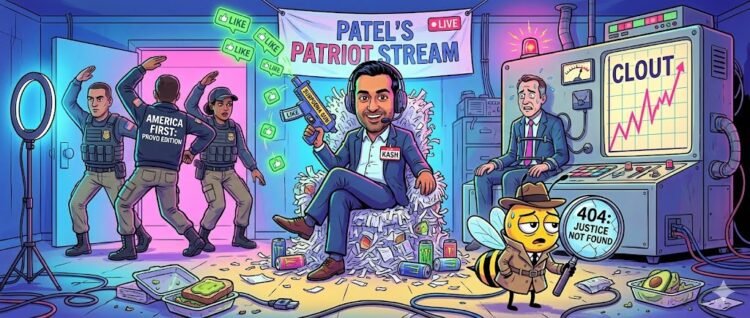
The G-men have left the building, and the content creators have moved in.
The most terrifying documents in American history are rarely the ones stamped top secret or buried in a bunker in Virginia. They are the ones that are leaked in a panic, the bureaucratic distress flares fired by people who have realized that the ship isn’t just sinking but is being actively scuttled by the captain for the sake of a better camera angle. We are currently staring at one of those documents. A massive 115-page internal assessment has clawed its way out of the J. Edgar Hoover Building and onto the desks of Congress, and it reads less like a government report and more like the frantic diary of a hostage who has realized their captors are not only dangerous but deeply, profoundly stupid.
Compiled by a coalition of retired and current FBI agents, intelligence analysts, and field supervisors, this report is a portrait of an institution in the final stages of a nervous breakdown. It describes an agency where the primary directive is no longer the enforcement of federal law or the protection of national security, but the maintenance of Director Kash Patel’s personal brand. The document, built on confidential interviews with two dozen insiders, sketches a reality that is almost hallucinogenic in its incompetence. It depicts a Bureau frozen in a “panic fog,” a place where veteran investigators are afraid to open a file without checking the prevailing political wind, and where senior officials describe their daily existence as “career Russian roulette with all chambers filled.”
We knew this was coming. We watched the confirmation hearings where Patel, a man whose previous experience seemed to consist largely of appearing on Fox News to complain about the Deep State, was grilled by senators who looked like they were watching a toddler play with a loaded handgun. Sixty civil-rights organizations warned us. They told us he was a political activist masquerading as a security professional, a partisan grenade with the pin pulled. But in the current political climate, a pulled pin is considered a qualification, and a grenade is just a tool for disrupting the status quo. Now, the explosion has happened, and the shrapnel is hitting everyone.
The report details a culture of fear that is both systemic and paralyzing. This is not the healthy caution of a law enforcement agency that understands the gravity of its power. This is the trembling paralysis of a beaten dog. Managers are refusing to make decisions. Investigations are stalling because no one wants to put their name on a piece of paper that might later be used as evidence of “disloyalty.” Case approvals sit in limbo, gathering dust, because the people authorized to sign them are too busy trying to decipher the Director’s latest mood swing. Entire units have essentially ceased to function, terrified that any independent initiative will result in public humiliation or a career-ending tweet from the White House.
The paralysis is the point. When you want to dismantle an institution, you don’t need to fire everyone. You just need to make them afraid to do their jobs. You create an environment where competence is a liability and loyalty is the only currency that matters. And in Patel’s FBI, loyalty is not defined by adherence to the Constitution or the rule of law. It is defined by how loudly you clap for the performance.
And what a performance it is. The report describes a tactical rollout in Provo, Utah, that sounds like something dreamed up by a marketing intern on a cocaine bender. Within his first six months, Patel reportedly forced a local FBI office to conduct SWAT-style operations wearing jackets branded not with the standard, terrifyingly sterile FBI insignia, but with “America First” tags. The font, according to witnesses, looked like it was ripped from a discount energy drink can. Veteran agents described it as “tactical cosplay,” a phrase that perfectly captures the aesthetic of the new regime. It is war as merchandise, law enforcement as a lifestyle brand.
The Provo incident is funny in a dark, absurdist way, until you remember that these are people with automatic weapons kicking down doors. The blurring of the line between a federal agent and a militia member is not an accident; it is the goal. By dressing his agents in the iconography of a political movement, Patel is signaling that the FBI is no longer a servant of the state but a private security force for a specific ideology. The agents on the ground feared someone would get killed because federal protocols were ignored, but safety is a secondary concern when you are trying to get the right shot for the sizzle reel.
Then there are the purges. The report details a campaign of “loyalty hunts” that would make Joseph McCarthy blush. Patel has ordered polygraphs for employees suspected of “not supporting the mission,” a phrase that remains terrifyingly undefined. What is the mission? Is it to catch spies? To stop terrorists? Or is it to protect the ego of the man in the corner office? No one knows, so everyone is suspect. Agents describe the experience as “witch hunt chic,” a purge disguised as Human Resources. It is a way of clearing the board, of removing anyone who might be burdened by an institutional memory or a conscience.
The most glaring symbol of this new “meritocracy” is the elevation of Dan Bongino to Deputy Director. Patel personally greenlit a security waiver for the former Secret Service agent turned podcast screamer, bypassing the normal vetting and background checks that apply to literally everyone else in the federal government. This is the moment, according to sources, where “the walls started to tilt.” You cannot run an intelligence agency if your second-in-command is a walking, shouting security risk. The panic about counterintelligence vulnerabilities is real. Foreign influence operations do not need to hack our servers anymore; they just need to subscribe to the Deputy Director’s podcast to find out what the operational priorities are.
The vetting meltdown is emblematic of a broader rot. The administration loves to talk about “merit” and “standards” when they are dismantling diversity initiatives, but the moment they need to hire one of their own, the standards evaporate. The report notes that Patel touts his rollback of DEI programs as a restoration of excellence, yet he is filling senior roles with YouTube personalities and political loyalists whose resumes look like satire. It is a classic authoritarian two-step: claim you are purging the “unqualified” diversity hires while simultaneously handing the keys to the castle to a guy whose primary qualification is that he owns a ring light and a microphone.
The operational priorities of the Bureau have shifted to match this new reality. Investigations are no longer driven by evidence or threat assessments but by social media trends. One supervisor told the authors of the report that cases are greenlit if they are “lighting up the right corners of Truth Social.” Another described being told to drop a financial-crime investigation because it “wasn’t getting traction.” This is the gamification of justice. The FBI is being run like a content farm, chasing engagement metrics instead of criminals. If a crime doesn’t fit the narrative, if it doesn’t enrage the base, it doesn’t exist.
The result is a collapse in morale that is absolute and total. Agents are leaving in droves. Retention is plummeting. Recruiters are privately warning that no one with other options will want to work there. Why would you? Why would you dedicate your life to a difficult, dangerous job if you know that your career depends on the whims of a man who governs like a Telegram channel admin? The “hostile, volatile and unserious” culture described by career staff is a recipe for disaster. You cannot run a complex organization on fear and vibes. Eventually, something breaks.
The international consequences are already starting to manifest. Our foreign intelligence partners, the people we rely on to stop terrorist attacks before they reach our soil, are quietly backing away. They are afraid that the FBI’s instability could compromise shared operations. They are moving sensitive intel away from FBI channels because they don’t know who is reading the files. When the British, the French, and the Germans decide that the American FBI is too leaky and too crazy to trust, we are in trouble. We are blinding ourselves to the world at the exact moment the world is becoming more dangerous.
The White House, naturally, is gaslighting us about all of this. They call Patel’s leadership “a restoration of integrity,” a phrase that means absolutely nothing. They are ignoring the subpoenas, ignoring the outrage, and betting that the public is too exhausted to care. They are counting on the fact that the sheer volume of the chaos acts as a kind of camouflage. It is hard to focus on the security waiver scandal when you are still trying to process the “America First” SWAT jackets. It is a strategy of sensory overload, a way of flooding the zone with so much nonsense that the truth gets washed away.
But the truth is in the report. It is in the 115 pages of testimony from people who dedicated their lives to an agency that is being murdered in front of them. The legal fallout is coming. Lawsuits are being drafted. Inspector General investigations are looming. But legal remedies take time, and time is something we do not have. Every day that Patel runs the Bureau is a day that our national security is degraded. Every day that investigations are driven by Twitter trends is a day that real threats go unnoticed.
This is not just about bad management. It is about the systematic dismantling of the guardrails that keep a democracy functioning. The FBI, for all its historical flaws, is supposed to be a check on power, not an arm of it. It is supposed to be the agency that investigates corruption, not the agency that embodies it. By turning the Bureau into a political weapon, Patel and his enablers are attacking the very concept of the rule of law. They are saying that the law is whatever they say it is, and that anyone who disagrees is an enemy of the state.
The satire here is difficult because the reality is so absurd. How do you parody a Director who acts like a parody? How do you exaggerate a situation where the Deputy Director is a podcaster and the tactical teams look like extras from a dystopian B-movie? The FBI has become a funhouse mirror, distorting everything it touches. It looks like a law enforcement agency, it has the buildings and the badges, but inside it is something else entirely. It is a hollow shell, filled with political appointees playing dress-up.
We are watching a tragedy unfold in slow motion. The agents who are trying to do their jobs, the analysts who are trying to connect the dots, they are the ones paying the price. They are being forced to choose between their integrity and their pensions. They are being told to shut up and get in line. And the rest of us are left to wonder what happens when the next crisis hits. What happens when there is a real terrorist threat, a real cyberattack, a real emergency? Will the FBI be ready? Or will they be too busy polygraphing the janitorial staff to make sure they voted the right way?
The report describes a “bureaucratic apocalypse,” and that feels accurate. It is the end of the world as we know it, at least for the federal government. We are witnessing the replacement of competence with loyalty, of expertise with ideology. It is a purge of the serious people, leaving behind only the sycophants and the grifters. And when the serious people are gone, there is no one left to keep the lights on.
The danger is that we will get used to this. We will accept that the FBI is just another partisan battleground, another spoil of war to be claimed by the victor. We will forget that it wasn’t always like this, that there was a time when the Bureau, for all its faults, was at least trying to be a professional organization. We will normalize the incompetence, just like we have normalized so much else. We will shrug when we see the “America First” jackets, and we will scroll past the news about the latest loyalty test.
But we shouldn’t. We should be furious. We should be reading every word of that 115-page report and demanding answers. We should be supporting the whistleblowers and the leakers who are risking everything to tell us the truth. Because if we don’t, if we let this slide, then we are complicit. We are allowing our own protection to be sold off for parts. We are watching the watchmen turn into the wolves.
The image of Kash Patel, the Fox News guest turned FBI Director, is the defining image of our time. It is the triumph of the spectacle over the substance. It is the victory of the troll over the public servant. He is the perfect leader for an era that values engagement over truth, an era where reality is just another content vertical. He is not running the FBI; he is streaming it. And we are all just subscribers, waiting to see what happens in the season finale.
The tragic irony is that the people who scream the loudest about “law and order” are the ones destroying it. They are the ones turning the premier law enforcement agency in the world into a joke. They are the ones making us less safe, less free, and less American. And they are doing it all while wrapped in the flag, selling us a version of patriotism that is nothing more than a marketing campaign for their own power.
There is a specific kind of horror in watching an institution die. It’s not a sudden event; it’s a series of small surrenders. It’s the memo that doesn’t get sent. The question that doesn’t get asked. The good agent who decides to retire early. The bad hire who gets promoted. It accumulates, layer by layer, until the structure rots from the inside out. The building still stands, the sign is still on the door, but the thing inside is dead.
This report is the autopsy. It tells us exactly how the patient died. It lists the causes: political interference, incompetence, fear, retaliation. It names the killers. And it leaves us with a terrifying question: what comes next? When the FBI is gone, when it has been fully converted into the enforcement arm of a political movement, who will protect us? The answer, increasingly, seems to be no one. We are on our own.
The Unsubscribe Button
The final indignity isn’t the fear or the uniforms or the podcasts. It is the realization that we are trapped in a subscription we cannot cancel. We are paying for this service—with our taxes, with our safety, with our trust—and the terms of service have been changed without our consent. The product is broken, the customer support is hostile, and the management is actively mocking us. There is no refund policy for a failed state. The only option is to stare at the screen, watch the buffering wheel of bureaucracy spin, and hope that the system crashes before it deletes us entirely. We are not citizens anymore; we are captive engagement metrics, and the algorithm has decided that our anxiety is good for business.