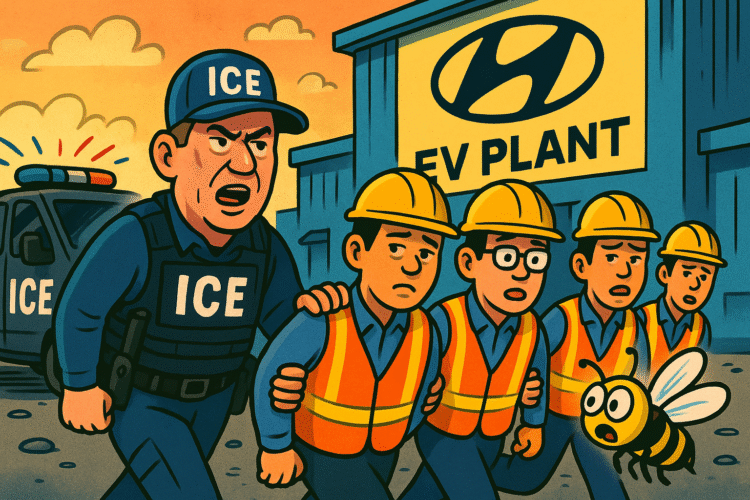
On September 5, 2025, the largest worksite immigration raid in DHS history turned Hyundai’s much-hyped “Metaplant” electric vehicle complex in Ellabell, Georgia, into a live broadcast of American contradiction. About 475 workers were detained—most of them South Korean nationals—during a sweep that hit not just Hyundai’s $12.6 billion EV complex but especially the adjacent Hyundai–LG Energy Solution battery plant still under construction.
For months, Georgia politicians had been crowing about this place. It was sold as the “jobs miracle,” the golden goose of re-shoring, proof that America could not only build the future but do it in the South, with the stars-and-bars of economic nationalism flapping proudly overhead. Instead, it turned into a morality play staged for cameras: workers in hardhats marched out by immigration agents, construction paused indefinitely, and South Korea’s diplomats scrambling like someone had just spoiled their barbecue.
Welcome to the American supply chain, where miracles last until the next raid.
The Contractors’ Defense
Hyundai and LG immediately distanced themselves, clarifying that the detained workers weren’t direct hires but contractors and subcontractors. Translation: “Don’t blame us, blame the people we hired to do the hiring we didn’t want to be responsible for.”
It’s the corporate version of “I didn’t know the soup was hot when I spilled it on you.” A $12.6 billion facility built on the promise of jobs, and the first headlines are not about groundbreaking or grand openings but about visa overstays and construction delays.
In other words: the miracle was subcontracted, and so was the blame.
Diplomatic Whiplash
South Korea, America’s ally and EV battery lifeline, lodged immediate diplomatic protests. Imagine the awkwardness: you’re supposed to be co-writing the script for the clean-energy transition, and instead you’re calling the embassy to get your nationals out of ICE detention.
Officials scrambled to provide consular support. Hyundai paused construction. The entire episode exposed how fragile “strategic partnerships” really are. One day you’re shaking hands over a battery plant ribbon-cutting. The next day you’re arguing over who has jurisdiction over 475 handcuffs.
Allies may forgive tariffs, but televised raids are harder to swallow.
The Spectacle Raid
Rights groups called it a “spectacle raid,” and they weren’t wrong. The choreography was precise: immigration agents descending in force, cameras catching rows of workers escorted out, the administration bragging about enforcement numbers like they were stock tickers.
It was designed to send a message. Not to Hyundai. Not to South Korea. To voters. The message: “We’re serious about law and order, even if it means torpedoing your EV rollout.”
Policy was secondary. Optics were the point.
The Parallel Raid
The same day, ICE conducted a smaller raid in upstate New York. This is how enforcement works in the Trump era: synchronized events, spread across regions, to create the impression of momentum. Think of it as law enforcement by press release.
What gets lost is what always gets lost: the lives of workers whose only crime was showing up to build the future America claimed it wanted.
The Economic Boomerang
Pausing construction isn’t just a hiccup. It’s a body blow to the EV supply chain. Every day the battery plant sits idle is another delay in U.S. ambitions to compete with China, another hole in the “re-shoring miracle” narrative. Local jobs—supposed to number in the thousands—are suddenly in jeopardy.
The irony is exquisite: a raid meant to “protect American jobs” may end up costing them. That’s the boomerang of economic nationalism: throw it hard enough, and it circles back to crack your own skull.
The Visa Blame Game
Officials said many workers had overstayed visas or entered on the visa waiver program and then went to work illegally. As though any of this was shocking. Large-scale construction projects rely on layers of subcontractors, middlemen, and labor brokers. Paperwork gets blurred. Incentives get misaligned. And suddenly you’ve got a project marketed as an all-American jobs miracle being built by foreign nationals with questionable visas.
It’s not scandal. It’s supply chain math.
Religion of the Raid
There’s a ritualistic quality to immigration raids. They’re not designed to solve problems. They’re designed to perform purity. To remind the faithful that America’s borders are sacrosanct, even if it means sacrificing the very workers who make “America First” possible.
It’s theater, but theater with real consequences: lost jobs, fractured alliances, stalled infrastructure. The raid is the altar. The workers are the sacrifice.
The Camera Loves Handcuffs
If you want to understand why this happened, don’t look at the visa paperwork. Look at the cameras. The administration is in the middle of a nationwide ICE surge, and nothing says “surge” like footage of hundreds of workers being marched out of a billion-dollar complex.
Handcuffs play well on television. They’re visible, visceral, undeniable. What you won’t see on television are the supply-chain delays, the quiet panic in boardrooms, the South Korean diplomats cancelling golf to put out fires. Those don’t make good b-roll.
Re-shoring as Morality Play
The Georgia plant was supposed to symbolize the triumph of re-shoring—proof that America could build cars, batteries, and dignity without relying on faraway supply chains. Instead, it became a morality play about who gets punished.
Corporations? No. Governments? Not really. Workers. Always workers. The miracle of American re-shoring turns out to be that the labor is still disposable, just closer to home.
The EV Future on Pause
The consequences ripple outward. Hyundai and LG paused construction, which means delayed production, which means delayed EV rollouts, which means China gets another quarter to dominate the market. The raid wasn’t just about visas. It was about time—and time is the most valuable commodity in the race for clean energy.
A spectacle raid may play well for a week. The consequences may last years.
Georgia’s Hollow Victory
Local politicians once bragged about Ellabell as the jewel of Georgia’s economic crown. Now it’s the site of the largest immigration raid in DHS history. That’s not just a blemish. It’s a brand change.
The town that was supposed to symbolize progress is now shorthand for contradiction: the jobs miracle that ended in handcuffs.
The Haunting Close
On September 5, 2025, America didn’t just detain 475 workers. It detained its own narrative. The story of re-shoring, of EV miracles, of allies working together—it was all hauled out in handcuffs for the cameras.
The haunting truth is this: raids don’t build anything. They destroy. They don’t protect jobs. They pause them. They don’t strengthen alliances. They fracture them.
What they do, flawlessly, is perform. They produce the optics of control while revealing the absence of it. They repave the Rose Garden of nationalism with the concrete dust of contradiction.
And when the cameras move on, the workers are gone, the construction is paused, the allies are bruised, and the miracle has evaporated. What remains is the ritual, replayed endlessly: applause for the raid, silence for the ruin, and a future that never quite arrives.