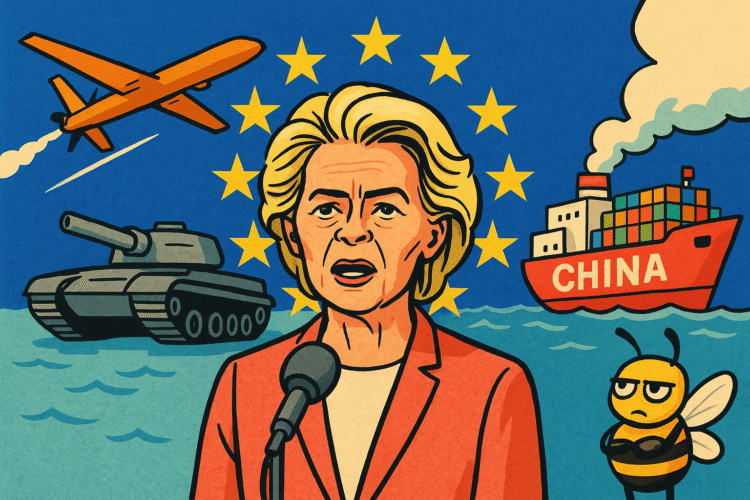
Ursula von der Leyen, President of the European Commission and owner of Europe’s most determinedly practical haircut, took the stage in Strasbourg on September 10 to deliver her State of the Union. And let me tell you, it was not the milquetoast Euro-babble of years past. Instead, von der Leyen announced what she called Europe’s “independence moment.” Translation: We’re breaking up with America, but in a polite Brussels accent.
This was not subtle. This was a Dear John letter written in drone contracts, frozen-asset schemes, and sanctions packages. For once, the EU decided to act less like an anxious roommate and more like a tenant finally changing the Wi-Fi password. While President Donald Trump charges 15% tariffs on bratwurst and Peugeot hatchbacks, and China quietly buys every major shipping port on the planet, Europe has decided to pick up its own weapons—literally and metaphorically—and step into the geopolitical ring.
The €6 Billion Drone Wedding Registry
The highlight of von der Leyen’s announcement was a €6 billion EU–Ukraine “drone alliance.” Forget wine, cheese, and bureaucratic process—Europe is marrying itself to drone warfare. Six billion euros for the buzzing, whirring, camera-eyed future of war, because nothing says “independence” like joining the global Drone Arms Race Olympics.
It’s a love story, really. Europe pledges funds, Ukraine provides the battlefields, and together they build a swarm that will haunt Russia’s already pitiful air defenses. “Independence moment”? Try “marriage of convenience.” And like every marriage, it’s expensive, noisy, and destined to irritate the neighbors.
The Reparations Loan That Isn’t a Loan
Von der Leyen also pitched a reparations-style loan backed by profits from frozen Russian assets. Roughly €200 billion sits in European limbo, generating €3.5 billion in interest last year. That’s right: Russian wealth is now Europe’s piggy bank. The EU wants to use that interest to bankroll Ukraine—because nothing teaches a kleptocracy like letting your yacht money fund drone warfare against you.
It’s poetic justice, with just enough accounting jargon to bore everyone into compliance. Reparations without saying reparations, interest without principle. It’s not technically stealing if you call it “redirecting liquidity flows,” right?
Sanctions, But Make Them Spicy
Von der Leyen, who once treated sanctions like an artisanal product—delicate, slow-cooked, carefully portioned—went full spice rack in Strasbourg. More sanctions on Russia, more restrictions on Israel, even trade penalties over Gaza. The woman who once bent over backward not to irritate Benjamin Netanyahu suddenly discovered her inner embargo artist.
This is new territory. Europe imposing sanctions on Israel is like your notoriously polite grandmother finally swearing at Thanksgiving. Once it happens, you know something fundamental has shifted.
Trump, Tariffs, and the Great Capitulation
And then there’s Trump. Over the summer, von der Leyen cut a deal with the U.S. president that left a 15% tariff on most EU exports while Europe cut its own duties. She called it a success, arguing it “averted a bigger trade war.” That’s like saying you’re thrilled to have only broken your arm because you might have broken your spine.
It’s a classic EU move: define humiliation as victory, call it pragmatism, then release a 300-page report justifying why you got fleeced. Europe is slowly realizing that while America used to be a protective parent, it’s now more like an unpredictable landlord who charges late fees just for fun.
Independence Day, But in Beige
Von der Leyen’s “independence moment” wasn’t fireworks and flag-waving—it was spreadsheets, tariff charts, and risk assessments. Europe doesn’t do chest-thumping nationalism; it does passive-aggressive self-assertion. Its independence sounds less like “Give me liberty or give me death” and more like “Please stop making us choose between bankruptcy and irrelevance.”
Still, the subtext is unmistakable: the EU is preparing for a world where the U.S. is unreliable, China is ascendant, and Russia is the neighbor you file restraining orders against but still occasionally see at the grocery store.
What It Means for Us (Spoiler: Less Influence, More Whining)
For the United States, this is the part where we realize we’re not the main character anymore. While Trump tweets tariff threats and Congress bickers about TikTok bans, Europe is building its own alliances, funding its own wars, and setting its own sanctions. China, meanwhile, is writing the global syllabus for trade, infrastructure, and diplomacy.
We, the once-undisputed superpower, are now the guy at the high school reunion insisting we could have gone pro if we hadn’t hurt our knee. Except the “knee injury” is two decades of endless wars, financial crises, and choosing reality TV stars as political leaders.
The EU is looking east, China is looking everywhere, and America is looking inward—at whether drag queens or gas stoves are the greater threat to national security. Spoiler: neither. The actual threat is that the world is moving on without us.
The Drone Buzz Heard Round the World
Here’s the satire baked into von der Leyen’s speech: Europe is calling it “independence” even as it ties itself tighter to Ukraine’s survival, U.S. tariffs, and Chinese markets. Independence is a stretch when you’re still negotiating the price of your dairy exports with a man who thinks tariffs are foreplay.
But in a perverse way, the EU is right. Independence today isn’t about total sovereignty—it’s about choosing whose leash is shorter. Europe has decided it would rather tangle with drones, frozen Russian yachts, and sanctions than be America’s junior partner in a Trump-led trade war.
The irony is delicious: by demanding tribute through tariffs, Trump has done what no European Commission president could—unite the EU around the idea of strategic autonomy. Nothing breeds independence like shared humiliation.
Voter Anger: The Wild Card
Von der Leyen framed all of this as a pivot toward sovereignty, but the audience that matters most is not in Strasbourg—it’s in the polling booths. Europeans are tired. They’re tired of high energy costs, tired of inflation, tired of footing the bill for wars they didn’t start. The drone alliance may be a shiny geopolitical move, but it will be hard to explain to a voter in Milan why their heating bill funds buzzing robots over Kharkiv.
If unity falters, the EU’s independence moment could collapse into 27 different versions of “not my problem.” And nothing screams European sovereignty like a fractured chorus of complaints in 20 different languages.
China: The Elephant in Every Room
As Europe declares independence from the U.S., it is simultaneously sidling up to China with the nervousness of a teenager asking for a prom date. China controls the minerals for the drones, the markets for the cars, the ports for the exports. Independence from America often means dependence on Beijing, but von der Leyen left that part out of her speech—because nothing kills the vibe like acknowledging you’ve swapped one leash for another.
Still, the EU’s pivot is a reminder that the future of international order isn’t written in Washington anymore. It’s written in Brussels, Beijing, and, increasingly, in places like Delhi and Ankara. America is just another actor in a crowded play, one prone to stumbling on stage and ad-libbing lines that throw the script into chaos.
Satire in Beige Suits
The satire of all this is that Europe is framing survival as sovereignty. They call it independence, but it’s really triage—patching up alliances, freezing assets, buzzing drones, avoiding Trump’s wrath, managing voter anger, all while hoping China doesn’t swallow the global economy whole.
And yet, in its dull, bureaucratic way, Europe might actually be ahead of us. They see the multipolar world for what it is. They are not clinging to fantasies of eternal American dominance. They are preparing for the long grind, the age of permanent rivalry.
Meanwhile, we’re still debating whether banning gas stoves is socialism.
Summary of Independence in Beige
Ursula von der Leyen’s “independence moment” is less about fireworks and more about accounting ledgers: a €6 billion drone alliance with Ukraine, sanctions on Russia and even Israel, reparations-style loans funded by frozen assets, and a humiliating tariff deal with Trump spun as a success. It marks Europe’s pivot away from dependence on the U.S. as China rises and America shrinks into self-absorption. For the U.S., the satire is brutal: while Europe prepares for prolonged war and rivalry, we’re busy treating culture wars as actual wars. The EU’s independence is really just triage—but at least they’re doing triage. We, by contrast, are still waiting for someone to ice our metaphorical knee while China writes the playbook for the next century.