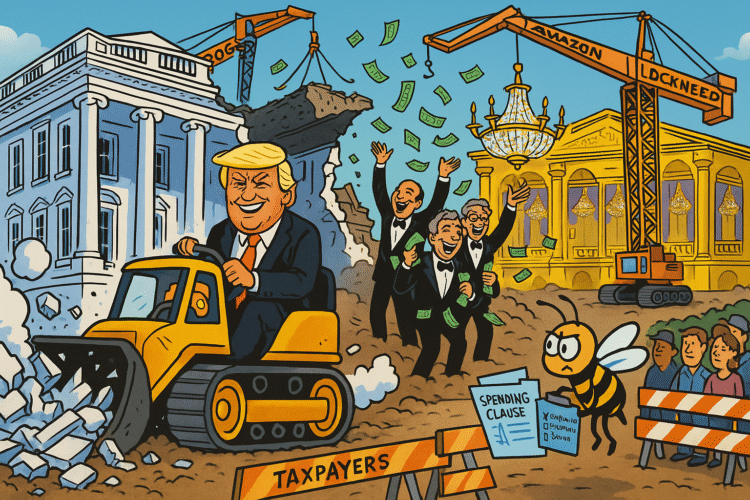
There are many ways to announce the end of an era. Some presidents sign bills, others write memoirs. Donald Trump brought in the bulldozers. Last month, under the glare of work lights and the applause of donors, the East Wing of the White House collapsed into dust, making way for what the administration calls the Freedom Ballroom, a 90,000-square-foot monument to money and memory loss. Funded entirely by corporations that have spent decades lobbying the same government now returning the favor, the project represents what may be the most literal merger of public office and private interest in American history.
The sound of progress, it turns out, is a backhoe chewing through democracy.
Trump’s aides have described the new structure as “the people’s ballroom.” The phrase is almost perfect in its audacity, considering that the people in question are the same ones holding multi-billion-dollar contracts with the United States. Google, Amazon, Lockheed Martin, Comcast, and Apple headline the donor list, together representing roughly 279 billion dollars in government business over the past five years. Between them, they’ve spent another 1.6 billion on political giving and lobbying. It is difficult to imagine a more efficient return on investment than replacing a public wing of the White House with your own event space.
The original plan, announced in July, was modest by Trumpian standards: a privately funded 200 million-dollar renovation for 650 guests. By September, the numbers had metastasized into 300 million dollars and nearly a thousand seats. Transparency, like the East Wing, was quickly demolished.
Preservationists begged for review. Environmental lawyers pointed out that any federal property alteration required agency oversight. The administration replied with a new phrase—“self-financed modernization”—which apparently translates to “laws are for people who can’t afford exemptions.” Within three days, the bulldozers finished what lawyers had barely begun to question. Marble cracked, portraits were carted off, and the former First Ladies’ offices vanished under tarps bearing the Trump Organization logo.
For once, there were no metaphorical walls. He was simply tearing the building down.
The White House press office framed the project as a public-private “partnership for excellence.” The renderings look like Versailles crossed with a casino: 40-foot ceilings, imported marble columns, a retractable chandelier system designed for aerial camera shots, and a gilded stage for “national celebrations.” Critics call it Mar-a-Lago East, though that’s unfair to Mar-a-Lago, which at least pretends to host weddings rather than contracts.
Every donor, coincidentally, has business before the federal government. Amazon seeks new logistics contracts with the Pentagon. Lockheed is waiting on a missile system renewal. Apple faces ongoing antitrust litigation. Google is negotiating a privacy settlement. Comcast has FCC proceedings in play. The checks cleared as the excavators rolled in. It’s not corruption, the aides insist; it’s synergy.
The timing couldn’t be clearer if they’d printed it on the invitations. The demolition occurred the same week the administration quietly paused enforcement actions against two donor firms and fast-tracked a third company’s procurement approval. The ballroom, officials say, will host future “innovation showcases.” Translation: government-adjacent cocktail hours with better lighting.
At the October donor dinner—held in a tent on the freshly razed lawn—Trump toasted his guests with a smile large enough to register as tax-exempt. “You built America, and now you’re building America’s house,” he declared, ignoring that most of them had already billed America for it. One lobbyist described the scene as “Davos meets demolition derby.” Champagne flutes clinked over the ruins of the Roosevelt Room.
To understand why this moment feels different, you have to consider how small the fig leaves have become. Previous presidents at least pretended to separate donors from decisions. Trump dispensed with pretense. His administration now boasts of turning influence into infrastructure, bragging that private financing “saves taxpayers money” while omitting that the taxpayers will repay the favor through deregulation and procurement. The Spending Clause was not designed for this kind of barter economy, but the Constitution, like the East Wing, was not built to withstand this level of excavation.
Legal scholars call it the Pay-for-Presence Problem: when the same entities funding public projects also appear before the government for enforcement, contract, or regulatory decisions. The potential conflict is not theoretical. Over half the donor firms currently face active or recent investigations. Yet every time watchdog groups ask for the full donor list, the foundation managing the funds cites “donor privacy.” The same phrase was used in campaign finance before “dark money” became a household term. Now it’s just house money.
The administration’s ethics lawyers—those who haven’t resigned—insist that the project’s private financing exempts it from congressional oversight. In effect, they have invented the concept of a privately owned public building. The logic runs like this: if you fund it, you own the oversight. The implications run like this: the next president may need written permission to enter his own ballroom.
Still, the spectacle sells. Cable coverage shows glittering renderings while ignoring the constitutional rot beneath. Business channels praise the project as “a model for corporate partnership.” The word “kickback” appears only in satire columns like this one, because mainstream coverage prefers metaphors to accountability.
Inside the Beltway, the mood is half amusement, half resignation. One longtime bureaucrat described it as “watching a wedding between capitalism and kleptocracy.” Another noted that procurement officers have started referring to the ballroom as “Contractor Hall.” The irony is that ethics rules technically bar executive-branch employees from accepting gifts over twenty dollars. The new hall cost three hundred million.
Public opinion, for what it’s worth, is not buying it. Polls show Americans oppose the teardown by a two-to-one margin. Among independents, the ratio is closer to three-to-one. Even some conservative columnists have begun to worry aloud about what happens when democracy becomes a franchise opportunity. “It’s not corruption,” one wrote, “it’s vertical integration.”
The watchdog community, bless their persistence, has begun tracing the money. Early tallies show that major donors have received or are bidding on federal contracts totaling nearly 280 billion dollars. Lobbying filings confirm that several of the same firms are advocating for relaxed disclosure rules, environmental waivers, and accelerated tax credits. It is as if the donors were not content to build the ballroom—they also wanted to write the fire code.
Inside the agencies, morale has sunk lower than the excavation pit. Enforcement attorneys whisper about “timing adjustments.” Procurement staff say contract reviews have been “reprioritized.” Nobody wants to be the first to test how independent they still are. The government is now a tenant of its own benefactors.
The larger story, though, is architectural. The White House has always symbolized endurance, a physical stand-in for continuity. Its renovation history reflects political eras: Jefferson added terraces, Roosevelt added the West Wing, Truman added steel. Trump added a paywall. He didn’t restore the people’s house; he rebranded it.
By next year, the Freedom Ballroom will open with fireworks, televised dinner galas, and perhaps a dedication plaque reading “Made Possible by the Private Sector.” Lobbyists will mingle under chandeliers shaped like the presidential seal. Cameras will pan across tables where regulators and the regulated toast one another. Viewers at home will see luxury; historians will see the moment the republic outsourced symbolism.
Outside the gates, protestors have been gathering weekly. Preservationists chant about heritage; progressives chant about corruption. The administration calls them “ungrateful.” The Secret Service has installed extra fencing to protect the construction zone, a perfect metaphor for a government fortifying itself against the governed.
Even the environmental review is a casualty. The National Park Service declined to issue a full impact assessment, citing “non-federal funding.” The Council on Environmental Quality, whose director attended the donor dinner, waved the process through. Apparently, when a corporation demolishes a historic structure for civic branding, it counts as “temporary disturbance.”
Meanwhile, congressional oversight committees have been oddly quiet. House leaders cite jurisdictional confusion; Senate leaders cite scheduling conflicts. Translation: nobody wants to subpoena their own donors. The public may not know it yet, but the ballroom is already performing its function—it has made influence visible and accountability invisible.
In private, staffers call it “the Gilded Rubble.” The name fits. The project embodies the modern political economy: destroy something meaningful, rebuild it as a spectacle, sell naming rights to the highest bidder, and declare victory for efficiency. What used to be an institution is now an influencer.
There is an unintentional poetry in the image of Trump atop a bulldozer, smiling as history collapses behind him. It is the perfect self-portrait: power as performance art, destruction as branding. His supporters see strength; the rest of us see smoke. Either way, the dust settles the same.
The only remaining question is whether the republic notices the noise.
Coda for a Republic
The ballroom will open soon, and with it, a new kind of pageantry. Every chandelier will shimmer with tax write-offs. Every speech will echo with the soft hum of procurement pipelines. Somewhere in the marble, the ghosts of better intentions will listen for accountability and hear applause instead.
In the months ahead, watch for the small tells. Which donor firms see their enforcement cases quietly resolved? Which contracts renew early? Which regulatory reviews vanish from public calendars? These are not coincidences; they are the soundtrack of payback.
History will remember the image of a president bulldozing the White House to build a hall for his benefactors. It will remember the crowd that cheered and the silence that followed. Democracy, ever polite, will keep sending invitations to a party that was never meant for it.