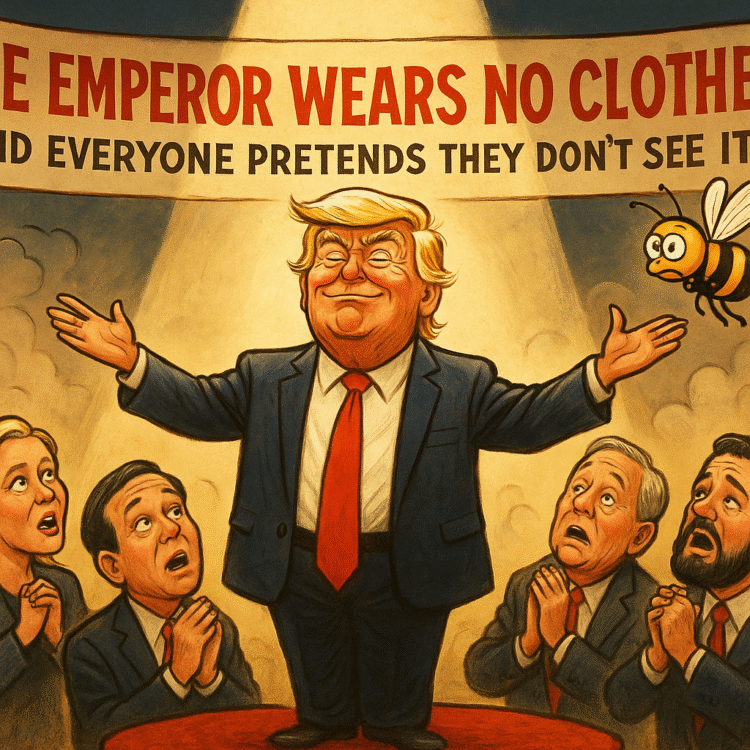
There’s something disorienting about watching people who once called Donald Trump a national emergency now speak of him as though he were a misunderstood prophet in golf cleats. The same mouths that used to choke on his name now spit-polish it with reverence. Meghan McCain, Megyn Kelly, Marco Rubio, JD Vance, Lindsey Graham, Ted Cruz, Stephen Miller—each of them once saw the danger clearly, named it publicly, and swore never to bend the knee. Yet here they are, lined up like extras in The Emperor Wears No Clothes, nodding solemnly as the naked man struts by insisting his ratings are tremendous.
It’s a parade of amnesia dressed as loyalty. The soundtrack is denial, the choreography survival. The Trump era’s most damning legacy isn’t the damage he inflicted—it’s the willingness of those who once knew better to pretend they never did.
The Daughter of Principle, the Silence of Convenience
Meghan McCain once embodied the rare conservative willing to speak aloud what the rest only whispered: that Trump desecrated everything her father stood for. She called out his cruelty, his pettiness, his habit of mistaking moral cowardice for strength. Her eulogy for John McCain cut through partisan fog like a sword. It wasn’t just grief; it was a warning.
Now, she speaks of “seeing him differently,” of “moving past old divisions,” as if moral clarity were a phase, not a foundation. The woman who once defined herself by defiance has learned to find the camera angle where surrender looks like grace. The daughter of a man who refused to bow before torture now genuflects before the man who mocked him for it. And if there’s poetry in that inversion, it’s the kind that leaves an aftertaste.
Megyn Kelly and the Art of Bleeding Gracefully
When Megyn Kelly stood on that 2015 debate stage and asked Trump about his record of misogyny, she became an instant symbol of journalistic spine. He responded by saying she was “bleeding from her wherever,” a phrase so crude it made late-night hosts blush and dictionary editors quit their jobs. It was the moment that should have defined her career—proof that even in a room full of cowards, one person could hold a tyrant to account.
But time softens outrage, especially when the market rewards amnesia. Today, Kelly gushes about his “strength,” praises his “vision,” and treats his second act like an inevitable restoration. The same woman who once recoiled from his vulgarity now courts his audience by framing her surrender as insight. She didn’t evolve; she adapted. There’s a difference. Evolution means survival with integrity intact. Adaptation means learning which hand feeds you and pretending you’ve always liked the taste.
Little Marco and the Tall Order of Submission
Marco Rubio’s transformation is almost operatic. Once “Little Marco,” mocked for his height, his sweat, his ambition, he fought back with venom, warning that Trump’s brand of politics would destroy conservatism from within. He was right—prophetically, perfectly right. And then, like so many prophets before him, he betrayed his own revelation.
These days, Rubio parrots Trump’s policies as if he authored them. His tone has mellowed into the smooth hum of complicity. The young senator who once vowed to protect American institutions now props up the man dismantling them, one courthouse at a time. It’s not ideological conversion—it’s survival instinct in a red hat. And if you look closely, you can still see the faint outlines of the spine that used to be there.
JD Vance: The Memoirist Who Sold the Plot
JD Vance wrote Hillbilly Elegy as a lament for America’s forgotten working class. He warned about con men who prey on despair, who feed resentment to hide their greed. He called Trump “America’s Hitler.” That sentence should have been engraved on the tombstone of his political career. Instead, it became his résumé.
Now, he kneels at Trump’s rallies like an altar boy awaiting communion. He praises the very demagogue he once dissected. In literary terms, it’s as though Vance tore out his own last chapter and replaced it with a loyalty oath. Maybe every memoirist dreams of a sequel—but not everyone is willing to sell the moral of their story for a seat in the Senate.
Lindsey Graham: The Orator of Hypocrisy
Lindsey Graham was once incandescent in his contempt. He called Trump “a race-baiting, xenophobic, religious bigot.” He warned that nominating him would destroy the GOP. Then, Trump won, and Graham’s principles went up for auction.
The senator from South Carolina now defends every abuse with the zeal of a man trying to rewrite his own Wikipedia page in real time. His tone has shifted from outrage to obsequiousness, from warnings to worship. It’s not just the betrayal of language—it’s the betrayal of memory. Graham’s devotion is so complete, so frantic, it borders on performance art. If Shakespeare were alive, he’d have to write a new tragedy titled The Taming of the Lindsey.
Ted Cruz: The Self-Flagellation Tour
Ted Cruz once called Trump “a pathological liar” and “a sniveling coward.” Trump responded by mocking his wife’s looks and hinting that his father was involved in JFK’s assassination. That should have been the end of it. But humiliation, it seems, is a renewable resource in American politics.
Cruz has since become one of Trump’s most dependable defenders, defending him through impeachments, indictments, and insurrections. Watching Cruz now is like watching a man try to drink from a firehose of self-loathing. Every endorsement, every statement, every groveling grin feels like an act of spiritual dehydration. The man who once stood for constitutional purism now stands only for proximity to power.
Stephen Miller: The Prophet of the Plague
Stephen Miller’s story is less about conversion and more about coronation. He began as a critic, yes, but only because he hadn’t yet realized the extent of his own darkness. Once Trump opened the gates, Miller found his calling: to give bureaucratic language to cruelty. His speeches are the Psalms of punishment, his policies the commandments of control.
He is the dark cleric of the MAGA movement—devout, cold, unflinching. While others rebranded to survive, Miller never had to. He believed all along; he was just waiting for a temple to preach in.
The Cult of Forgetfulness
The thread connecting all of them is not ideology—it’s self-preservation. They have learned that in Trump’s America, survival depends not on principle but on performance. They didn’t just forgive him. They erased him and replaced him with a myth they could serve without shame.
This is what happens when power replaces faith: the heretics become priests. They no longer remember what it felt like to believe he was dangerous, because remembering would mean acknowledging the trade they made. The trade is always the same—truth for access, dignity for airtime, humanity for relevance.
It’s why they speak of loyalty as if it were a virtue instead of a leash. It’s why they describe chaos as strength and cruelty as candor. They have convinced themselves that if they keep praising him long enough, the rest of us will forget what they once said.
The Emperor’s New Devotees
The parable fits too well. Trump, the self-anointed emperor, marches through history bare-assed and boastful, certain that his charisma makes him invincible. Around him walk his courtiers—the very people who once screamed that he was naked—now applauding his imaginary robe. Meghan claps first, Megyn nods solemnly, Marco adjusts the train, and Ted, ever the dutiful servant, whispers that the fabric is flawless.
Lindsey announces that only true patriots can see the robe. JD Vance declares it the finest textile ever woven by man. Stephen Miller writes a decree declaring it mandatory attire. And the crowd—half horrified, half hypnotized—watches as the procession winds down Pennsylvania Avenue toward a White House that has begun to look less like a seat of government and more like a stage.
The child in the story—remember him? The one who shouted, “But he’s not wearing any clothes”? He exists here too. Only this time, he’s been doxxed, arrested for “disrupting a national event,” and called a terrorist on cable news. The lesson has changed: in this America, the price of honesty is isolation.
Selective Amnesia as State Religion
Trumpism has turned self-contradiction into theology. Yesterday’s insult becomes today’s benediction. To question the leader is blasphemy, to remember the past heresy. Each of these former critics is now a priest in that church, baptizing new converts in the waters of denial.
They tell themselves they’re choosing pragmatism over pride. But it’s not pragmatism. It’s cowardice wrapped in the language of strategy. It’s what happens when survival becomes the only moral compass left. They’ve replaced the old conservative trinity—character, country, constitution—with a single commandment: Thou shalt not anger the base.
The Mirror of the Masses
The danger isn’t confined to the people in power. It seeps outward, into those who once trusted these figures to draw moral lines. If Meghan McCain can excuse the man who insulted her father’s heroism, why shouldn’t anyone excuse their own compromises? If Megyn Kelly can fall back in love with her abuser, why shouldn’t the public fall in love with the myth again too?
This is how authoritarianism sustains itself—not through fear, but through normalization. When everyone agrees to stop noticing, the absurd becomes ordinary. When hypocrisy becomes a shared language, honesty begins to sound extremist.
The Final Curtain Call
The emperor, still naked, still convinced of his splendor, prepares for another coronation. The same people who once tried to warn us now carry his train of lies like relics. They will tell you it’s strategy. They will say it’s unity. They will whisper that it’s better to have influence from within. But what they mean is that it’s easier to kneel than to stand alone.
And maybe they’re right—maybe the world no longer rewards integrity. But there’s still something obscene about watching those who once saw clearly now pretend blindness is enlightenment.
Because every empire built on delusion eventually falls, and when it does, the courtiers always insist they were just following orders. The emperor will swear he was betrayed. The priests will claim divine misunderstanding. And the rest of us—if we’re lucky—will remember that we were warned.
But not by them. Never by them.