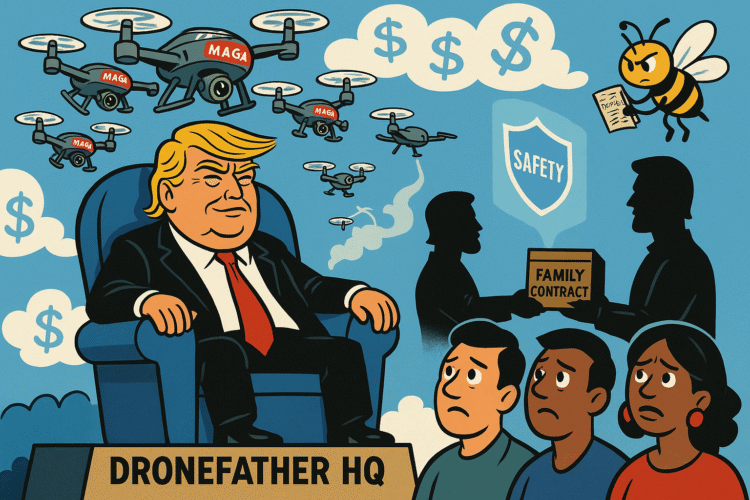
It starts, as all American dystopias do, with a slogan and a waiver. On June 6, President Trump signed two executive orders declaring it was time to “unleash American drone dominance” and “restore airspace sovereignty.” Which sounds patriotic enough—until you realize it’s the bureaucratic equivalent of saying, “We’re going to fill the sky with surveillance robots and maybe get my kid a contract while we’re at it.”
Because nothing says “national security” like a procurement form signed in the same pen that autographed campaign hats.
The Pentagon, ever eager to serve whoever’s in charge, calls this an “air-domain transformation.” Translation: they’re moving money out of old-school fighter jets and into fleets of small, cheap, expendable drones—basically airborne iPhones programmed to explode on command. Congress is debating an $893 billion defense budget that trims F-35s and bulks up the drone line item like a gym bro before deployment. The catch? A recent Financial Times scoop revealed that one of the Army’s new parts suppliers for this thousand-drone future happens to have ties to Donald Trump Jr.
If the sky really is the limit, the Trump family intends to bill us for the clouds.
The Sky Is Watching, and It Has a PAC
The Pentagon insists this is about deterrence, agility, and modernization. They call it “distributed lethality,” a phrase that feels like it should come with its own Miranda warning. The idea is simple: smaller drones, cheaper to make, faster to deploy, harder to shoot down. Thousands of them. Think less Top Gun, more SkyMall with Hellfire missiles.
But as with every Trump-era innovation, the line between public policy and private enrichment is drawn in disappearing ink. The Army just ordered 3,500 motors with an option to scale to tens of thousands. And by some cosmic coincidence, one of the companies benefiting has familial proximity to the First Family’s dinner table.
You almost have to admire the efficiency. Most presidents wait until after leaving office to launch ethically compromised ventures. The Trumps have streamlined the process: announce a policy on Monday, profit on Friday, deny everything by Sunday, and hit the golf course before the ethics office can find toner for the subpoena.
Drones, But Make Them Domestic
The administration swears this buildout isn’t just for overseas operations—it’s also to “secure the homeland.” That’s government-speak for “you’ll be seeing these things over your neighborhood soon.” The orders include provisions for expanded domestic airspace monitoring, new detection grids at “federal interest sites,” and an ambiguous clause authorizing “routine BVLOS operations.” For the uninitiated, BVLOS stands for “beyond visual line of sight,” which is military code for “you won’t see it coming.”
The Department of Defense and Department of Homeland Security already have limited authority under the 2018 Preventing Emerging Threats Act to take down rogue drones over federal facilities. But “limited” is such a flexible word when the president’s lawyers get creative. In practice, those powers are now creeping outward—beyond government buildings, into airports, public events, even city protests—under the noble banner of “public safety.”
And while the Pentagon can track every quadcopter in a three-mile radius, it apparently can’t locate a single copy of the Constitution.
The Legal Fine Print They Hope You Won’t Read
This is where the theater of “law and order” runs headlong into the law itself. The 2018 counter-UAS statutes were supposed to prevent terrorist attacks and critical infrastructure sabotage. They were not meant to turn the Pentagon into your local police department. The Posse Comitatus Act forbids the military from enforcing domestic law. The Fourth Amendment forbids warrantless surveillance of private citizens. And yet, the administration is now proposing “routine monitoring” of domestic airspace for “anomalous activity.”
Anomalous according to whom?
Because in Trump’s America, “anomaly” can mean anything from “unauthorized drone” to “citizen holding a protest sign.” The risk isn’t theoretical. Once detection grids and signal-jamming technology are installed, they can just as easily be used to track journalists’ drones, ground media coverage of protests, or quietly collect data on civilian movements.
In other words, it’s a turnkey surveillance state waiting for a memo. And if history tells us anything, the memo will arrive exactly three days after a critical news story about the First Family hits cable.
Meanwhile, Abroad: The Cartel Exception
Abroad, the president boasts of “new rules of engagement” against “cartel networks” in Mexico. Which sounds tough until you read the fine print and discover the U.S. military doesn’t actually have legal authority to drone anyone across the border without an act of Congress. But this administration has never let legality ruin a good headline.
Officials are already leaking tales of “precision deterrence” operations coordinated with allies. That’s Beltway slang for “we haven’t done it yet, but we really want the press to think we did.” Every time the Pentagon denies a strike, a new influencer video pops up online showing grainy footage of something exploding under the caption “Message sent.”
And while Congress fumbles over whether to retroactively authorize these adventures, the drone contractors are already celebrating in the stock market. Because nothing fuels American defense spending like an enemy that can’t be verified but definitely exists somewhere brown.
Procurement, Meet Nepotism
The ethical rot isn’t subtle. When the Army signs a multimillion-dollar deal with a company reportedly linked to Donald Trump Jr., that’s not a coincidence—it’s a business plan. The Trump administration has treated conflict-of-interest laws like dietary guidelines: optional if you believe in yourself.
The pattern is painfully familiar. You take a national policy—say, infrastructure, real estate, or now, drone warfare—declare it essential to American greatness, then funnel the contracts to friendly firms and family connections. It’s privatized patriotism, where loyalty is measured not by service, but by invoice.
The administration insists there’s “no direct evidence” of wrongdoing. Which is true, in the same way there’s no direct evidence of oxygen in the air—you just keep noticing the symptoms when it’s gone.
The Budget That Ate Democracy
The 2026 defense budget, now hovering near $893 billion, reflects the quiet revolution underway: fewer manned fighters, more munitions and drones. The Pentagon calls it “future-ready.” Critics call it “militarized austerity.” Every dollar shifted from an F-35 cockpit to a drone swarm is a dollar that trades pilot accountability for plausible deniability.
The moral hazard is breathtaking. It’s one thing to spend billions on human pilots with names and consciences. It’s another to give a joystick to an intern with a security clearance and an algorithm that can’t tell the difference between a cartel truck and a wedding party.
The more drones you build, the less the public knows who’s responsible. And that’s exactly the point. Accountability doesn’t scale, but profits do.
The Domestic Side Effects
Meanwhile, back home, the infrastructure to “protect” us is metastasizing. Temporary drone-detection zones around federal property have become semi-permanent fixtures. Surveillance grids originally deployed for “large events” are being quietly repurposed for “routine operations.” The Pentagon has tightened communication channels to restrict leaks on drone-related programs.
If you want a preview of how this looks, consider the 2024 Republican Convention, where every square inch of sky over Milwaukee was mapped, monitored, and occasionally jammed. The justification was security. The result was silence: independent media drones grounded, journalists restricted, and a digital perimeter that made dissent invisible.
The machinery of control doesn’t announce itself—it just hums above your head until you forget it’s there.
The Ethics of Altitude
This isn’t the first time technology outpaced ethics, but it might be the most literal. Drone warfare used to be a foreign policy problem. Now it’s a domestic operating system. The same systems that target “threats” abroad can monitor crowds at home. The same algorithms that classify “hostile movement” can flag “unauthorized gatherings.”
The constitutional firewall between defense and policing was never designed to handle mass automation. But the current administration treats legal gray areas like invitations. Every “pilot program” becomes a precedent. Every precedent becomes policy. Every policy becomes profit.
And once a surveillance grid is built, it never goes away. It just waits for the next justification.
The American Dream, But Automated
Trump’s America has always been about spectacle: the border wall, the tariffs, the flags the size of small countries. The drone program is simply the logical next act—a show of strength you can’t see until it’s too late. It combines all the administration’s favorite motifs: nationalism, fear, deregulation, and self-enrichment.
“Unleash American drone dominance” sounds bold, decisive, patriotic. But read it backward and it means: normalize perpetual surveillance, militarize the sky, and let the right family cash the check.
There’s an old saying in defense circles: “He who controls the air controls the war.” Under Trump, it’s been updated to: “He who controls the air controls the contract.”
The Thin Line Between Safety and Suppression
The next few weeks will reveal whether the government plans to formalize rules of engagement for domestic airspace monitoring—or simply improvise them like a late-night tweet. Congress may choose to expand counter-UAS authorities under the banner of “public safety.” Inspectors general might, if they remember how to spell “conflict of interest,” investigate the procurement trail. Governors could push back if “protection missions” start stretching from federal fences to city blocks.
But the line between safety infrastructure and crowd control is thin. It’s the width of a waiver, a memo, a contract with the right last name. And once that line blurs, no law will redraw it.
Because the sky, it turns out, is the perfect authoritarian playground: vast, invisible, and easy to claim in the name of freedom.
Final Approach: The Sky Belongs to Everyone
So here we are, staring at the future—half drone dystopia, half family business. The president calls it innovation. The Pentagon calls it modernization. The rest of us might call it what it is: the federalization of fear.
Still, there’s room for hope, at least in the cracks of the system. Watchdogs, whistleblowers, and lawmakers who still read the Fourth Amendment could slow this down. Journalists—if their drones aren’t jammed—can keep asking where the contracts go. And citizens, those ground-dwelling nuisances democracy depends on, can remember that airspace is public property, not private inheritance.
If there’s any justice left, the next time someone says “Make America Safe Again,” we’ll ask to see the invoice. Because when the government starts calling the sky its own, and the president’s son starts selling it back to us, that’s not security. That’s franchise warfare.
And like every Trump venture before it, it ends the same way: with the lights flickering, the debts unpaid, and the rest of us footing the bill.