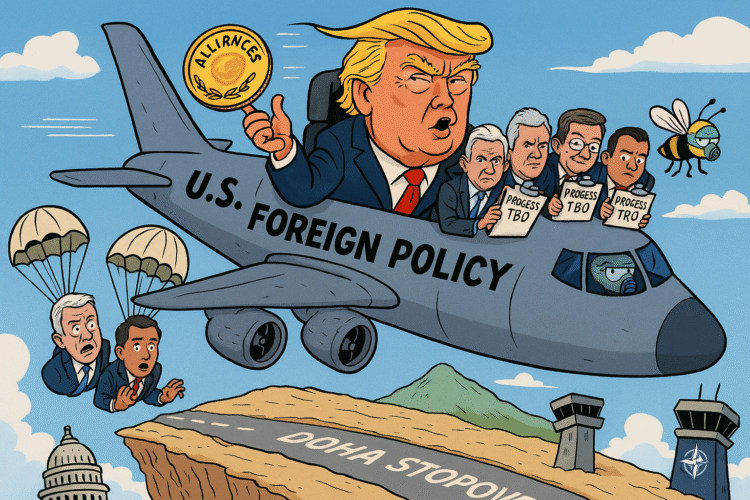
By now, America’s allies have learned to read the signs. The tweet that drops at 3 a.m. Doha time. The “unscheduled meeting” that doubles as a refueling stop. The grinning photo op that becomes a tariff threat before the plane lands. Donald Trump’s second-term foreign policy isn’t so much a doctrine as a recurring flight delay, powered by improvisation, grievance, and the haunting suspicion that no one on the plane actually filed a flight plan.
The latest episode unfolded like a diplomatic fever dream: the president, en route to Asia for an ASEAN swing, makes an impromptu stop in Doha, meets Qatar’s emir without notifying half his staff, announces a hurried Gaza ceasefire, and teases a trade breakthrough that no one can quite locate in the paperwork. Within 24 hours, senior aides are issuing clarifications faster than Air Traffic Control can clear departures.
In this administration, policy isn’t forged, it’s refueled midair, with Robert O’Brien, Richard Grenell, John Ratcliffe, and Kash Patel serving as the in-flight entertainment system, each offering their own version of the story to the press before the jet hits the tarmac.
The Photo Op That Ate the Doctrine
The Doha stop, by all accounts, wasn’t on the official itinerary. Aides described it as a “strategic refueling” that “evolved into a productive discussion.” Translation: the president saw an opportunity for a backdrop and no one dared say no.
Cameras caught Trump clasping hands with Emir Sheikh Tamim bin Hamad Al Thani, smiling like they’d just closed escrow on the Middle East. Moments later, he told reporters that “a ceasefire deal” was “basically done.”
State Department officials, who first heard about the ceasefire on cable news, reportedly sprinted through the West Wing looking for a copy of whatever had just been agreed. There wasn’t one.
But optics, not outcomes, are the coin of the realm. The president’s improvisational diplomacy is designed for screens, not statutes. It’s performance governance a rolling reality show where every handshake is a ratings stunt, and every briefing note is just a suggestion.
ASEAN: The Acronym as Apology Tour
After Doha came the ASEAN leg, billed as a trade and security reset but executed as a multi-country mood swing. The White House declared “tremendous breakthroughs” on tariffs, tech cooperation, and shipping corridors. Local ministers declared confusion.
At one stop, Trump promised to “end unfair trade practices immediately.” At another, he floated Section 301 tariffs on countries that “don’t respect us enough.” His aides then told reporters he didn’t mean it “literally.” By that afternoon, he told Fox News he “meant every word.”
It’s foreign policy as gaslighting exercise; contradictory enough to keep allies guessing, but theatrical enough to keep the base entertained.
Meanwhile, Asia’s leaders have learned to hedge. Singapore’s finance ministry quietly commissioned scenario models for “U.S. tariff volatility risk.” Japan accelerated defense spending for the first time in a generation. The Philippines requested “written clarification” on troop posture, which is the diplomatic equivalent of saying “we don’t trust your memory.”
Europe’s Existential Eye Twitch
Across the Atlantic, Trump’s revival of NATO’s 2% defense-spending ultimatum landed like déjà vu with a migraine. “Pay up or we reassess our commitments,” he warned, as if the alliance were a subscription service about to auto-renew.
European officials scrambled to decode the math: Is it 2% of GDP, 2% plus tariff concessions, or 2% and no French wine imports until further notice?
The European Council on Foreign Relations issued a report calling the president’s threats “corrosive to deterrence.” German Defense Minister Annegret Kramp-Karrenbauer described it more bluntly: “We are living through an era of improvisation.”
Markets, meanwhile, translated “improvisation” into insurance premiums, as energy, shipping, and semiconductor sectors began pricing volatility like a weather forecast. The euro fell half a percent. Defense contractors rose two. The global economy has learned what diplomats already knew: Trumpian unpredictability is its own fiscal policy.
Personnel Is Policy, and Policy Is Chaos
Inside the administration, a familiar rule governs: whoever’s in the room when Trump tweets, wins. The old establishment figures are gone. What remains is a coterie of loyalists fluent in grievance and television lighting.
- Robert O’Brien, still styling himself as “the steady hand,” issues reassuring statements that evaporate on contact with reality.
- Richard Grenell, unofficial envoy-at-large, makes the rounds on talk shows defending the president’s “refreshing candor.”
- John Ratcliffe, the intelligence whisperer, briefs only the information that fits the day’s mood.
- Kash Patel, the self-appointed envoy slayer of “deep state diplomacy,” tells aides not to “overthink the details.”
It’s not a chain of command it’s a chain of improvisers.
Career diplomats, those mythical creatures who still think treaties matter, describe their days as “damage control with frequent flyer miles.” One ambassador compared it to “teaching your toddler about fire safety while he’s already holding a match.”
Legal Posture: Article II, Meet Reality
On paper, the president’s powers in foreign policy are vast. Article II gives him authority to recognize states, receive ambassadors, and negotiate treaties. But every spontaneous policy announcement, every off-script ceasefire or trade deal tease, bumps against the guardrails Congress installed after Vietnam and Watergate:
- The War Powers Resolution requires reporting to Congress within 48 hours of hostilities, and withdrawal after 60 days unless authorized. In practice, that’s a suggestion Trump reads as “60 days to improvise.”
- Section 232 of the Trade Expansion Act lets the president impose tariffs on national security grounds—a loophole that has become the administration’s Swiss Army knife.
- Section 301 allows retaliation for unfair trade practices, though traditionally after investigation, not before lunch.
- Treaty obligations under NATO, the WTO, and the UN Charter limit unilateral action—but only if you remember to tell your lawyers before you act.
One constitutional scholar described the second term as “a living stress test of the separation of powers.” Another called it “Article II fan fiction.”
Polling the Fallout
According to Reuters/Ipsos, 61% of Americans now describe Trump’s foreign policy as “chaotic,” 27% as “confident,” and 12% as “confusing but entertaining.” Among allies, a YouGov EU survey found 68% of respondents view U.S. leadership as “unpredictable,” up from 52% in the first term.
Markets have noticed. The VIX volatility index spikes every time Trump announces a “breakthrough” without details, then falls when his staff walks it back. It’s a new rhythm of governance: chaos priced in, correction optional.
Oversight and the Courts: The Cleanup Crew
Congressional committees, long accustomed to playing catch-up, are again mobilizing to investigate what they can’t predict. The Senate Foreign Relations Committee has already requested briefings on the Doha meeting, the ceasefire terms, and any related “use of appropriated funds.” Translation: what did we just pay for and why?
The House Oversight Committee wants to know how the ASEAN agreements were drafted and by whom. Meanwhile, inspectors general at State and Defense are reportedly reviewing “decision flow processes”—bureaucratic code for “was anyone sober when this policy was made?”
Legal analysts predict the next collision will come through the courts, as plaintiffs—ranging from Congress to U.S. industries hit by tariffs—test whether rapid executive pivots violate procedural statutes like the Administrative Procedure Act (APA). Courts have already slapped down several first-term attempts to rewrite trade and immigration policy without notice or rationale. But Trump’s allies have learned to weaponize tempo: act fast, confuse everyone, then declare victory before the injunction arrives.
Allies Hedge, Markets Flinch
While Washington plays improvisational jazz, allies are quietly rewriting their sheet music.
- Germany unveiled a €100 billion “strategic autonomy” fund to insulate its defense and energy supply chains from U.S. mood swings.
- France renewed talks with India on joint patrols, calling it “prudent diversification.”
- South Korea fast-tracked semiconductor subsidies to hedge against trade volatility.
- Japan authorized new arms exports, a move unthinkable a decade ago.
The message is clear: the United States remains a superpower, but one with the consistency of a light switch.
The Mirage of “America First”
Every presidency projects an image; this one projects a flicker. “America First” sounds sturdy until you realize it changes definition by the hour. At sunrise, it’s a doctrine of sovereignty. By lunch, it’s a tariff threat. By dinner, it’s an Instagram caption under a handshake photo from Doha.
The throughline isn’t strategy—it’s self-reference. Every initiative must be a stage, every headline a rating. Diplomacy has been absorbed into brand management.
That’s why the president’s foreign trips feel less like summits and more like roadshows: new markets, same merchandise. Allies know to smile for the cameras, issue polite communiqués, and wait for the inevitable reversal before committing to anything measurable.
The Legal and Political Checkpoints Ahead
Over the next quarter, a few key fault lines will test whether law or spectacle wins:
- Congressional Hearings: Expect multiple committees to summon O’Brien, Grenell, and Patel for testimony about process integrity, a phrase that will die of irony mid-hearing.
- Judicial Challenges: If new tariffs or troop withdrawals proceed without statutory notice, injunctions will fly faster than the presidential motorcade.
- Inspector General Reports: Quiet but lethal, these audits may reveal internal dissent over decisions like the Doha ceasefire—proof that the bureaucracy still takes minutes while the president takes selfies.
- Allied Adjustments: Expect formal policy shifts from NATO states emphasizing “European defense independence,” which is diplomatic code for “we’re building backup friends.”
- Market Responses: As the ASEAN “breakthroughs” unravel under scrutiny, traders will pivot from optimism to aspirin.
The Coin Toss Superpower
What makes this second-term turbulence uniquely dangerous isn’t just the unpredictability—it’s the normalization of unpredictability. Deterrence depends on consistency; diplomacy depends on trust. Trumpism depends on the opposite.
When allies can’t tell whether a commitment will last past breakfast, they hedge. When adversaries sense incoherence, they test limits. The net effect is that U.S. power has become a coin toss, and everyone else is betting against heads.
Even Trump’s defenders admit as much. One European diplomat described Washington’s approach as “transactional without the transactions.” Another called it “a casino where the dealer keeps leaving the table.”
The cumulative toll is measurable not in treaties broken, but in expectations lowered. The United States no longer leads by predictability; it leads by spectacle. And spectacle is a fragile currency.
The End of Euphemism
Mainstream coverage, ever allergic to plain language, calls this “unorthodox diplomacy.” But the real phrase is simpler: erratic rule from an improvisational center.
It’s not “fluid strategy.” It’s whiplash.
It’s not “creative engagement.” It’s policy roulette.
And it’s not “America First.” It’s America for now.
The sooner journalists abandon the thesaurus of denial, the clearer the picture becomes: the world’s most powerful government has turned its foreign policy into a series of half-scripted episodes, where every ally is a guest star and every crisis a cliffhanger.
Final Boarding Call
Next month’s congressional hearings, the rumored inspector general reports, and the likely court challenges to new tariffs will reveal whether any institutional ballast remains. But allies aren’t waiting for a verdict—they’re already acting as if U.S. reliability is a rumor.
When America’s word becomes provisional, treaties become paperweights. And when “policy” means whatever fits in a photo frame, the rest of the world learns to smile for the camera, shake hands, and check the exchange rate before the next reversal hits.
In the end, the Trump Doctrine of term two isn’t a doctrine at all—it’s momentum without memory, a government perpetually boarding the next flight, convinced that the next handshake will make the last one irrelevant.
And somewhere over Doha, the cameras are already rolling.