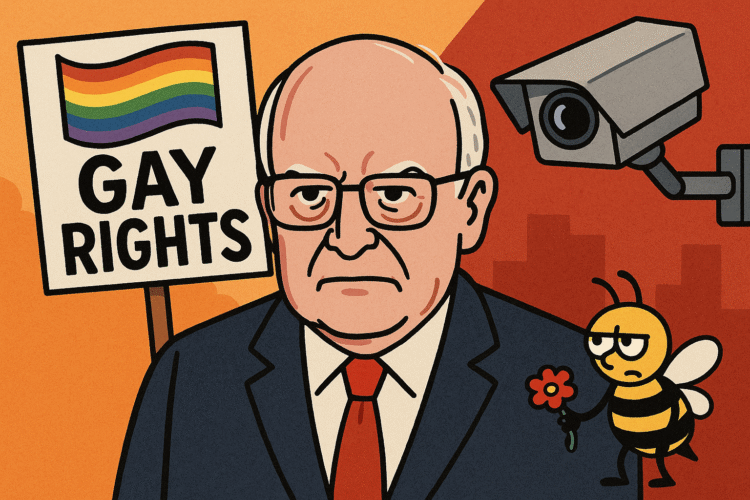
At 84, Dick Cheney leaves us a blueprint of power run amok, and a side note on gay rights that doesn’t redeem the wreckage.
There is a kind of irony that follows the news of Dick Cheney’s death in 2025 like an aftershock: the man who helped expand the presidency’s power, condone torture, harden the surveillance state and launch disastrous wars also spoke publicly in favor of gay rights and marriage at a time when his party largely did not. The shape of that irony is important. Because yes, he made those comments. Yes, at some point he said gay love deserved dignity. But from a liberal perspective the nuance barely registers. The systems he bolstered affected millions—including LGBTQ people—and the personal relief granted to his daughter barely offsets an empire of extra-legal presidential might.
An Empire of Unchecked Power
Cheney’s decades in Washington were not quiet. He was a congressman, then Defense Secretary, and finally vice-president. Through each role he built a blueprint for what the executive could do when unbound by restraint. In 2003 he was a major driver of the invasion of Iraq. He embraced bold notions of pre-emptive war, expansive detention powers, and asserted that national security often required setting aside traditional checks and balances. From a liberal standpoint that argument remains deeply troubling. Because once you accept that the presidency need not ask permission, you reshape governance.
During the post-9/11 era Cheney did more than talk. He helped erect legal rationales for detention without charge, secret prisons, enhanced interrogation—or torture by any definition most democratic societies accept—and domestic surveillance that creeped into private lives under the guise of emergency. He argued that the war on terror justified extraordinary measures. A liberal reading says this: a government built to serve can also be built to dominate. Cheney’s career shows which side won.
The Surveillance State and Torture Legacy
Cheney’s imprint on policy still echoes. The surveillance logic once excused by “emergency” during war has become routine. Metadata sweeps, drone operations, indefinite detentions—all trace lines back to the architecture he supported. He pushed executive privilege beyond what many foresaw, eroding the separation of powers gradually, then definitively.
He defended “enhanced interrogation,” argued that ordinary rules of warfare or rights were secondary to the objective of defeating terror. From a liberal view that means normalising exceptions instead of protecting rules. The consequence is generational: liberties once considered fundamental now treated as optional in times of “national emergency.” But emergencies stretch. They last. And the expansion tends to stay.
The Gay Rights Side Note
And yet. There is another part of the story. At multiple points Cheney made statements in support of gay rights, same-sex marriage and partner benefits. He voiced support for the repeal of “Don’t Ask, Don’t Tell.” He indicated that same sex partners of veterans should receive benefits. On its face it is progress. For a man of his background and party it was atypical. For a liberal observer it registers as a flicker of empathy.
But—and this is the crucial but—the context is messy. His daughter, Mary Cheney, is a lesbian. The timing of his public statements aligns with a personal narrative. He did not appear to expend his energy challenging the surveillance machinery, the war powers, the indefinite detentions that impacted countless gay people and every other citizen. He changed his stance when it was personally relevant and politically safe. That nuance matters. Because the question is not only whether someone supports rights, but whether they dismantle the power structures that oppress.
The Paradox of Principle and Privilege
Here is the core liberal appraisal: Cheney’s advocacy for gay rights was real, but only modestly so. It did not challenge the system he helped create. It did not undercut the surveillance apparatus. It did not restore the rule of law to those whose liberties he’s arguably helped undermine. It was beneficent, but a side track in a career defined by the expansion of state power under secrecy.
When the state you helped build monitors, detains and invades the lives of its people, a personal change of heart counts. But it does not redeem the structural outcome. You may say “He supported gay rights.” And you may hold that in memory. But you cannot ignore the fact that he also helped weaken the very freedoms you say you cherish. The half-credit is still half. The balance sheet skews.
Structural Harm Beyond the Personal Gesture
The invasion of Iraq cost thousands of lives, trillions of dollars, destabilised regions and diminished American moral standing. The claims about weapons of mass destruction now widely discredited. The surveillance expansion and war-power surge remain with us: once made plausible, always made possible. Cheney’s name is embedded in memos, in authorisations, in decisions that altered the world.
For liberals, the real legacy is not the policies you liked, but the frameworks you built. Cheney consumed law and turned it into tool. He viewed Congress as a nuisance, courts as obstacles, civilians as collateral. When your vision of governance includes bypassing oversight, you build a permanent state of exception. And exceptions always find reasons to persist.
The Personal Gesture Doesn’t Cancel the System
To recognise Cheney’s support for gay rights is not naive. It is fact. To then treat that support as a form of redemption is naïve in a different way. Because the rights he championed were narrowly focused—on his daughter, her partner, the personal circle. The rights he tolerated for the many he never challenged. The systemic power he authorised remains.
Would gay persons seeking redress for illegal surveillance or indefinite detention have found refuge in the system Cheney endorsed? Doubtful. His support for them didn’t translate into structural reform. So when we ask “did his stance matter,” we might answer yes. But the more important question is “did his stance change the system?” And the honest answer is: it did not. That distinction is essential for liberals who believe policy matters more than personalities.
Moral Accounting
In the ledger of public service, we tally not only what was done but who paid the cost. Did you help the vulnerable—even when it cost you? Did you challenge the powerful—even when it hurt your institution? For Cheney the record shows selective cost. He supported a marginalized group when his immediate family was part of it. He did not sacrifice the apparatus of power he helped build.
From a liberal vantage, that means admiration must be tempered by critique. The strengths of the gesture do not erase the burden of the structures. We may say “thank you for that acknowledgement.” But we must also say “we are still being governed by the systems you fortified.” To treat the two as equal would be to confuse tokenism for transformation.
The Legacy That Remains
As tributes flow in and histories get written the obituaries will try to soften the edges. “Statesman,” “Hawk,” “Champion of Civil Rights for Gay Americans”—all phrases that will appear. They might feel courteous. But they risk forgetting what really matters: the architecture of power. The laws changed, but the reach of the state expanded. The values shifted, but the mechanism stayed larger.
The liberation of some should not obscure the subjugation of many. And the personal evolution of one person should not hide the institutional inertia he left behind. For liberal watchers this matters because the arc of history bends only when institutions bend. Otherwise the good acts become footnotes. The real test is how we live under the systems your legacy built.
The Final Appraisal
There is no neat summary. There are contradictions and conflicts and uncomfortable truths. Cheney’s support for gay rights was genuine—or at least sincere. But sincerity without structural reform is insufficient for the kind of justice liberals believe in. The man authorised war, sanctioned surveillance, reshaped the presidency. He also said rights matter when they touched his family. That juxtaposition matters more than the binary of right or wrong.
If we remember Cheney it should not be for the soundbites of his later years. It should be for the choices that expanded the reach of the state into the intimate lives of millions. It should be for the precedent he set: the president above questioning, the policy above kindness, the rights you benefit from versus the rights you defend. He changed for his daughter. But the system he helped build changed none of its appetite for power.
Section Title: The After-Action Ledger
Now historians will file papers and tape recordings and call this an era. They will mark the wars, the memos, the law revisions, the rights acknowledgements. But the ledger will show a deeper truth: actions you lift up will matter. But the systems you build will last. And if the systems dominate while your good actions remain side notes, then your legacy belongs more to the architecture than the advocacy. Cheney gave an ally hope. But he also held the lock. And that balance will define how history remembers him.