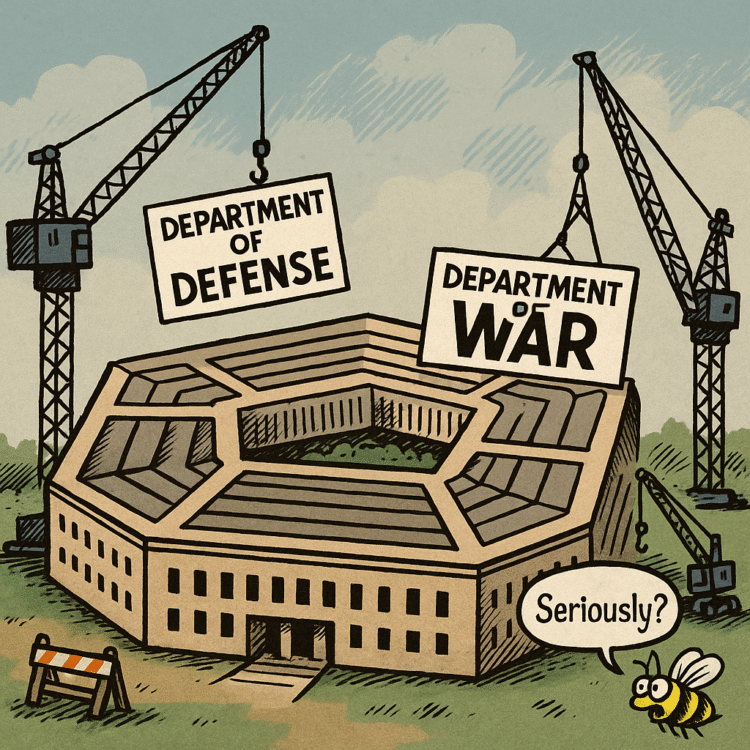
On September 5, 2025, President Donald J. Trump signed an executive order that rebranded the Department of Defense as the “Department of War.” It was the kind of move that sounds like a late-night Onion headline but instead became federal reality, complete with Pete Hegseth introducing himself on Fox & Friends the next morning as “Secretary of War.”
Never mind that a formal name change for an executive department likely requires congressional approval. Never mind that no Pentagon lawyer worth their JAG badge can explain whether contracts, FOIA requests, or NATO paperwork are valid under a name that hasn’t existed since 1947. The White House insisted the move was “truth in labeling.” Defense, they said, was too passive. War was more honest.
If you ever wondered what it looks like when the world’s largest bureaucracy spends billions to argue about letterhead, you’re about to find out.
A Million Small Headaches
Inside the Pentagon, current and former officials fumed. Not over the grand philosophical question of whether America should project power as War instead of Defense. No, the fury was over logistics.
Rebranding the Pentagon is not a matter of swapping a sign on the E-Ring. It means new seals, patches, websites, stationery, procurement templates, PowerPoint decks, FOIA headers, and base signage across hundreds of thousands of facilities in all 50 states and more than 40 countries.
It means troops overseas may soon salute flags emblazoned with the War seal. It means military families will have to apply for War housing, fill out War daycare forms, and attend War family briefings. It means the United States will present itself to NATO allies not as a partner in collective security but as the Department of War, please sign here.
One official summed it up with grim clarity: “It’s a million small headaches that will cost billions.”
Pete Hegseth, Secretary of War
Trump’s selection of Pete Hegseth as the newly christened “Secretary of War” is its own satire. Hegseth, a Fox News mainstay and culture warrior extraordinaire, now has a title once carried by Henry Stimson and James Forrestal.
He wasted no time making the rounds, puffing his chest and declaring that the renaming was a “signal to the world that America is on offense.” His performance landed somewhere between high school football coach and used-car salesman: loud, confident, utterly divorced from the realities of running a 2.9-million-person bureaucracy.
The Pentagon is less amused. The Joint Chiefs, already drowning in modernization challenges, now face the prospect of revising every training manual, procurement contract, and doctrine page that mentions “Defense.” That’s not warfighting. That’s wordsmithing.
Allies Alarmed, Enemies Amused
International reaction was swift. NATO partners privately fumed that the renaming projects needless belligerence, exactly the opposite of what’s needed to maintain fragile deterrence against Russia and China. “We already spend half our summits trying to convince Europeans we’re not itching for conflict,” one diplomat sighed. “Now we’ll show up literally branded as War.”
China and Russia, meanwhile, could hardly contain their glee. Kremlin spokespersons mocked the change as “finally honest.” Chinese state media plastered headlines about “American imperialists dropping the mask.” Propaganda writes itself when your adversary voluntarily names itself after your accusations.
The Department of Defense was at least an abstraction. The Department of War is a declaration.
The Congressional Logjam
Congressional reaction was predictable. Democrats called it “reckless branding theater.” Moderate Republicans muttered about distraction. Hardliners cheered the “return of American strength.” Legal experts pointed out the obvious: the name of an executive department is statutory. You can’t just Sharpie “Defense” into “War” without congressional authorization.
Which sets up the next farce: months of hearings, lawsuits, and budget turf wars over whether America’s war machine calls itself War machine. While ships rust, jets age, and families wait for pay raises, Washington will debate fonts.
The Bureaucracy of War
If there is one institution ill-suited for whimsical rebranding, it is the Pentagon. This is an organization that once spent seven years and $46 million trying to design a new camouflage pattern that blended with precisely no known terrain. This is the building where PowerPoint slides are classified and acronyms have acronyms.
Now imagine that machine attempting to convert every occurrence of “Department of Defense” into “Department of War.” Contracts will stall. Vendors will balk. Procurement pipelines will clog. Somewhere, right now, a colonel is sweating because his forms still say Defense while his general insists they say War.
The absurdity is not just symbolic. It’s operational. Bureaucracy runs on consistency. Upend the label, and you risk upending the system.
Truth in Labeling or Belligerence by Branding?
The White House insists this is about honesty. Defense sounds defensive. War is what America actually does. Why pretend otherwise?
There’s a logic there, albeit the nihilistic kind. After all, America has engaged in near-constant war footing for two decades. But honesty in branding is not cost-free. Words shape perception. Perception shapes policy. When you call yourself War, you project aggression even when you intend deterrence.
This is less truth in labeling and more belligerence by branding.
Domestic Distraction, International Consequences
Critics warn the rebrand distracts from real priorities: deterring adversaries, modernizing forces, caring for military families. The Pentagon already faces recruiting shortfalls, suicide crises, housing shortages, and technology gaps. Repainting base signs from Defense to War solves none of them.
Meanwhile, abroad, the optics are poison. American diplomats will now have to explain, with straight faces, why the Department of War is a force for peace. They will fail, because the words will already have done the damage.
The Satirical Core
The satire writes itself:
- A president renames the Department of Defense the Department of War with the stroke of a pen, as if changing a logo changes reality.
- A culture warrior with no administrative chops now carries the title of Secretary of War, once borne by statesmen navigating existential global conflicts.
- A bureaucracy that can barely manage a new camouflage pattern is now expected to rebrand every seal, sign, and contract across the globe.
- Allies are unnerved, enemies are entertained, and Congress is about to waste a year debating stationery.
This is governance as performance art. A government at war with fonts.
The Haunting Observation
On September 5, 2025, the United States didn’t just rename a department. It revealed its condition: a superpower so consumed by branding that it will spend billions to repaint signs rather than repair substance.
The haunting truth is this: empires rarely fall with a bang. They fall with absurdities. They fall when the world’s largest military machine devotes its autumn not to modernization or deterrence, but to whether “Defense” should be spelled “War.”
The name may change. The bureaucracy may stumble. The contracts may snarl. But the signal has already gone out: America is fighting wars of perception while losing wars of reality.
And the world is watching.