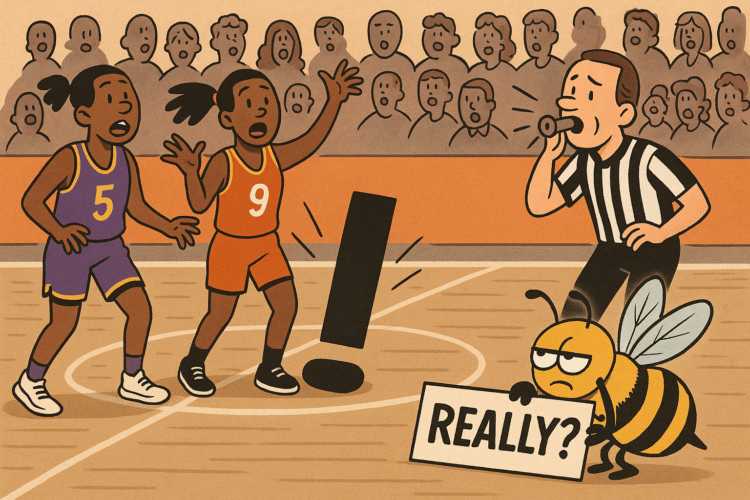
There are certain moments in sports history that get replayed for decades. Michael Jordan’s flu game. Brandi Chastain’s penalty kick. The time a sex toy took center court at a WNBA game.
Yes, you read that correctly. Somewhere between the jump ball and the final buzzer, an adult novelty item decided it was time for its professional sports debut — sailing through the air like an underfunded blimp and landing squarely in the middle of women’s basketball history.
Commissioner Cathy Engelbert, in what I can only imagine was the least comfortable press conference of her career, condemned the incident as “totally unacceptable.” Which is fair — there’s no line in the WNBA rulebook for “delay of game due to airborne phallus,” but there should be. And yet, the whole thing says less about the object in question and more about the cultural petri dish we’ve all been simmering in.
The Objectification Olympics
We’ve been talking for years about the need to respect women’s sports, to give female athletes the same funding, visibility, and broadcast time as their male counterparts. And progress has been made. But then some guy in the stands (and let’s be honest, it was a guy) decides the most valuable contribution he can make to the movement is throwing an adult toy into the game like it’s a bouquet at a bachelorette party.
This isn’t protest. This isn’t performance art. This is the frat boy version of a streaker — someone so desperate to be part of the moment that they bring their own prop. And in doing so, they confirm every lazy stereotype about women’s sports being “less serious” or “not real basketball.”
The fact that it happened in the WNBA, a league that has fought tooth and nail for legitimacy, makes it sting even more. No one’s lobbing marital aids onto the ice during NHL games — mostly because hockey fans understand that throwing objects on the playing surface can get you checked into the boards by security before you even hit your seat.
When the Joke Isn’t Funny
The thing about moments like this is that they’re meant to be funny. The thrower probably imagined a viral clip, a few snickers from the cheap seats, maybe even a meme or two. But here’s the joke: women’s sports don’t get the luxury of harmless pranks.
Every misstep, every disruption, every non-game-related headline gets tallied against the whole enterprise. “See?” the trolls say. “This is why we don’t watch.” As though NBA fans have never endured a beer-soaked fight in the stands, or NFL games haven’t been paused for twenty minutes because someone’s emotional support squirrel escaped onto the field.
In men’s sports, these interruptions become lore — “Remember the time the cat ran across the outfield?” In women’s sports, they become ammunition.
Sports as a Mirror
What happened at that WNBA game isn’t just a one-off act of juvenile stupidity; it’s part of a bigger pattern in sports fandom right now. We’re living in an era where being a “fan” often means treating games as interactive content — not something you watch, but something you star in.
The wave at baseball games used to be enough. Now it’s full-scale TikTok stunts, guerrilla brand promotions, and in this case, sexualized heckling disguised as “just a joke.” It’s the same mentality that fuels the courtside influencer culture: the idea that your presence at the game is just as important as the game itself.
The Gendered Double Standard
Imagine, for a moment, that this had happened at an NBA game. The coverage would be different. The toy would be called “an object,” the headlines would read “unidentified item thrown onto court,” and sports radio hosts would turn it into a debate about security staffing.
In the WNBA, the story becomes clickbait. The object isn’t just an object — it’s a punchline, a symbol, a chance to remind the audience that yes, women’s bodies are still considered fair game for public commentary. The act is both sexualized and infantilized: “Look at this silly, inappropriate thing” paired with “Oh, but lighten up, it’s just a gag.”
That’s the trap of being a woman in sports. You’re expected to be tough enough to compete professionally but gracious enough to laugh off humiliation. You’re supposed to be role models and entertainment, but never so commanding that you make people uncomfortable.
Commissioner Engelbert’s Tightrope
Cathy Engelbert’s “totally unacceptable” wasn’t just PR-speak — it was a line drawn in a sandpit that keeps getting kicked over. Her job is to grow the league, keep sponsors happy, and protect the athletes’ dignity, all while knowing that the slightest perception of humorlessness will be used against them.
Had she gone full scorched earth, she’d be accused of overreacting. Had she brushed it off, she’d be accused of condoning it. So she did what women in power have been forced to do for centuries: she kept her statement short, firm, and surgically polite.
Fan Behavior in the Age of Spectacle
Sports have always had unruly fans. But the balance has shifted — from fan as witness to fan as participant. And in women’s sports, that participation often comes with an undercurrent of control: We bought tickets, so we get to decide what kind of night this is.
That’s the cultural thread worth pulling here. The person who threw that object wasn’t just making a crude joke — they were inserting themselves into the game, physically altering the experience for players, officials, and fans. And they did it in a way that specifically targeted the players’ gender, a reminder that no matter how high you climb, someone still thinks they can yank you back down to the level of a punchline.
The Ripples Beyond the Court
It’s tempting to dismiss this as a small moment, not worth overanalyzing. But incidents like this don’t live in isolation — they feed into a wider narrative about how women in sports are treated, watched, and talked about.
Every time the WNBA trends for something other than the play itself, it reinforces the idea that women’s sports are still a novelty act in the eyes of too many. It’s not just disrespect; it’s a subtle kind of sabotage. You don’t need to dismantle a league if you can keep it from being taken seriously.
The Lasting Image
In ten years, the clip of that game might be a trivia answer, a meme buried in the archives. But for the players who had to stop mid-game and watch as staffers gingerly removed the object from the court, it’s another reminder of the uphill climb.
Because the real joke here isn’t that someone threw a sex toy. The real joke — the bitter, exhausting one — is that this kind of thing still happens at all, and that the same culture that demands women “stick to sports” won’t even let them do that without interruption.
Women’s sports have always been about more than the game. They’ve been about representation, equity, and the fight to be seen as legitimate. And on that night, all of that was paused — literally — for someone’s cheap laugh.