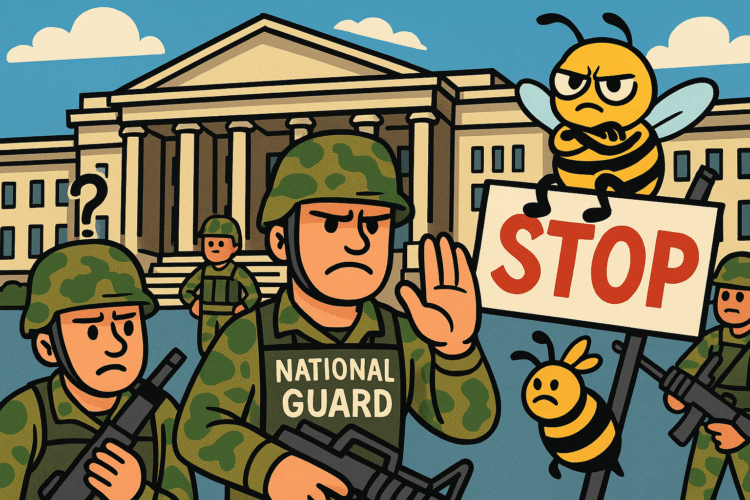
The 7th U.S. Circuit Court of Appeals didn’t throw a parade for Illinois, but it handed the Trump administration a powerful timeout. On October 11, 2025, the court largely upheld Judge April Perry’s emergency order blocking President Trump from deploying National Guard troops into Chicago and the rest of Illinois—but with a twist. Yes, the Guard can be federalized (that means technically under Washington’s command), but no, they can’t actually go anywhere or do anything without further judicial approval.
It’s the political equivalent of giving a teenager the car keys but draining the gas tank.
The Stakes: Guarding the Guard, Halting the March
The appeals court’s ruling is a rare moment when the judiciary basically said, “You can wear the uniform, but don’t move a muscle.”
What the Ruling Actually Did
- Trump can federalize Guard troops, meaning they report up the federal chain of command.
- But he can’t deploy them for “protection operations,” street patrols, or crowd control without more hearings.
- The court upheld the core injunction: boots can exist, but they can’t walk.
The ruling preserved Judge Perry’s main finding—that Washington’s declarations about “riots” and “uprisings” around Chicago’s Broadview ICE facility were, in her words, “not credible.” Perry had already called out a pattern of federal filings that confused “protest” with “riot.” That detail, repeated by the appeals court, is devastating.
The decision is not just legal—it’s moral accounting. The court didn’t buy that “Operation Midway Blitz,” the September immigration sweep that prompted all this, was anything other than a political stunt wrapped in camo.
Operation Midway Blitz: The Great Federal Overreaction
“Operation Midway Blitz” began as a high-visibility ICE operation in late September targeting undocumented residents in Chicago’s suburbs. What followed were chaotic raids, helicopters, and “protest zones” outside the Broadview ICE facility.
Federal officials claimed agents were under attack. But eyewitnesses, videos, and local reporting told a calmer story: peaceful protesters with signs, chants, and the occasional shouted insult—nothing resembling an insurrection.
Illinois Governor J.B. Pritzker and Chicago Mayor Brandon Johnson sued almost immediately. Their lawsuit accused Trump’s Department of Homeland Security and Department of Defense of fabricating chaos to justify federalizing Illinois’s Guard. Perry agreed, citing “a troubling lack of candor.”
In short: the White House cried “riot,” the courts said “reality check.”
A Patchwork of Pushback: Oregon and Beyond
Illinois isn’t alone in this constitutional tug-of-war. In Oregon, Judge Karin Immergut blocked Trump’s Guard deployment to Portland on October 4, calling the operation “a misuse of emergency authority.” Four days later, the 9th Circuit narrowed that injunction but still prohibited on-the-ground deployment.
So we now have a map of judicial contradictions: the executive can federalize troops, but can’t use them in cities that object—unless another court later disagrees. It’s like playing whack-a-mole with constitutional law.
The White House’s Argument (and Why It’s Leaking Confidence)
White House press secretary Abigail Jackson said the President “acted lawfully to protect federal personnel and property.”
That sounds neat in a press release but collapses under scrutiny.
- “Protection” ≠ “Occupation.” The law allows Guard support for defending federal sites, not indefinite patrols through neighborhoods.
- No credible threat. Courts found no solid evidence of violence beyond normal protest volatility.
- The optics are bad. The administration looks like it’s turning immigration enforcement into a military exercise.
It’s one thing to protect a courthouse. It’s another to march into a city that never asked for you.
The Federalism Tangle
At its heart, this case is about control: who commands the National Guard when Washington and a governor disagree?
- Under the Constitution, Guard units belong to the states unless federalized for war or rebellion.
- The Insurrection Act allows federal control during insurrections—but no one, not even the administration’s own filings, can point to an actual insurrection.
- Illinois argued, and the courts agreed, that Washington used “federal property protection” as a fig leaf to seize local authority.
When you strip the legalese away, it’s about trust. The federal government claims emergency power, but the states no longer trust how it’s wielded.
What Happens Next
- Justice Department Appeal: Trump’s team is already preparing an emergency petition to lift the injunction, possibly reaching the Supreme Court within weeks.
- En Banc Review: The 7th Circuit could take the case before its full bench to clarify scope and intent.
- DoD Logistics Headache: Commanders now oversee troops who are technically federal but barred from moving.
- Civil Rights Fallout: Immigrant rights and civil liberties groups are preparing fresh suits over arrests and surveillance tied to Operation Midway Blitz.
The legal clock is ticking, and the practical mess grows worse by the day. The Pentagon has troops sleeping in hangars, state officials fuming, and lawyers writing memos faster than soldiers can shave.
The Irony of Inertia
Trump can now say he “took control” of the National Guard, but he can’t use them for anything other than PowerPoint slides. The courts effectively turned his show of force into a paper tiger.
This might be the first time in modern history that troops are federalized but grounded. It’s not martial law—it’s bureaucratic purgatory.
Meanwhile, Illinois officials are quietly relieved. For them, the best troops are the ones still in their bunks.
The Broader Picture: Authoritarian Drift Meets Legal Friction
This isn’t just about Chicago or a single protest. It’s about whether a president can nationalize a state’s military to police dissent.
For months, Trump’s rhetoric has blurred the line between “immigration enforcement” and “civil unrest.” His defenders call it strength; his critics call it theater. The courts are calling it unconstitutional overreach.
It’s a delicate moment in American democracy: the tension between order and freedom, control and consent, force and law. Each new ruling redraws that line. And right now, it’s being drawn firmly against Washington’s boot.
Federalism in 2025: A Tale of Two Constitutions
There’s the Constitution as Trump imagines it—where the President can “federalize” anyone, anywhere, anytime, because “national security.” Then there’s the one courts actually read, where states still retain sovereignty unless Congress or chaos says otherwise.
This week’s ruling made one thing clear: federalism still has teeth. Illinois kept its Guard, Oregon kept its rights, and the executive branch got a reminder that “law and order” still requires, well, law.
The Cultural Undertone: Policing Dissent as Performance
Operation Midway Blitz wasn’t a strategy—it was a performance. The administration’s show of power wasn’t about security; it was about domination. Cameras, sound bites, viral clips—the language of fear disguised as authority.
When the courts intervened, they didn’t just stop a deployment. They interrupted a narrative.
Because this was never just about whether troops could patrol streets. It was about whether dissent could still look the government in the eye and say “No.”
Closing Reflection: When Power Marches, The Law Stands Still
So here we are, mid-October 2025: a shutdown government, a fragmented judiciary, troops in legal limbo, and a country arguing over whether the Constitution still means “no kings.”
Judge Perry and the 7th Circuit haven’t solved that question—but they’ve slowed its march. Their injunction isn’t glamorous. It won’t make campaign ads. But it is the sound of brakes screeching before something much worse.
The ruling doesn’t end the fight. It simply buys America time to remember what separation of powers actually feels like.
Final Section: THE LAW CLEARS ITS THROAT
You can federalize authority, but you can’t fabricate rebellion. You can wield power, but you can’t erase statehood. You can call soldiers patriots, but you can’t make them props.
For now, the National Guard stays where it is—ready but restrained, visible but still. And maybe that’s the most American image of all: a democracy holding its own line, one court order at a time.