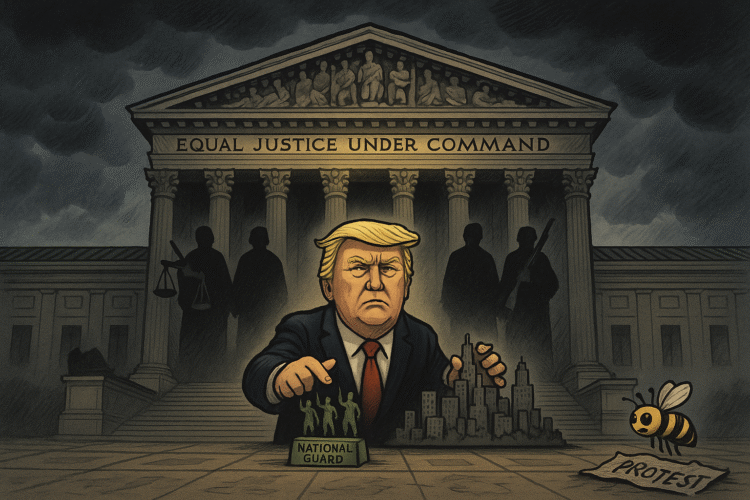
It’s a strange moment in the American experiment when the question before the Supreme Court is whether the President can send troops to Chicago because someone held up a sign too close to an ICE office. But here we are: Trump v. Illinois, a case that could turn the National Guard into the president’s personal crowd-control service, and the Constitution into a permission slip with fine print.
At its heart, the case is about one thing—how far a president can stretch “protecting federal property” before it starts sounding like “policing anyone who disagrees with me.” The answer could redraw the map of domestic power, not just for Trump but for every president who comes after him.
The Prologue: One Protest Too Many
The spark was small—modest protests outside an ICE facility in Chicago, the kind of weekend scene democracy usually shrugs at. Signs, chants, a few bullhorns. Illinois officials called for calm, and local police managed the crowd with all the drama of a snow parking ban.
Then the president announced he was federalizing the Illinois National Guard. Not to protect nuclear silos or repel insurrection, but to “defend federal property” from what he described as “an escalating rebellion.”
It was not an insurrection. It was a Saturday.
Illinois Governor J.B. Pritzker called it what it was: an overreach dressed as law and order. He refused to hand over control of the Guard. Trump sued.
The lower court blocked the order, noting with dry Midwestern restraint that “political opposition is not rebellion.” The Seventh Circuit upheld it, essentially telling the president to put his general’s hat back in the toy chest.
Now, the case sits before the Supreme Court, where constitutional history meets reality television.
The Government’s Argument: I Am the Law
The White House’s argument, distilled, is breathtakingly simple: under Section 12406 of Title 10, the president can federalize state National Guard units to “protect federal property,” and no one—not governors, not courts—has the authority to second-guess that decision.
It’s a legal philosophy best summarized as “trust me.”
The Justice Department’s brief reads like a bureaucratic remix of The Godfather: “If the President determines that conditions require intervention, such determinations are committed to executive discretion.”
Translation: once the president says it’s necessary, it’s necessary.
The challengers, led by Illinois and Chicago, call that theory what it is—a blank check for domestic militarization. They argue the president’s power to deploy troops inside the U.S. is narrowly limited by the Insurrection Act and the Posse Comitatus Act. You can’t just point at a building, yell “federal asset,” and turn the Guard into an urban SWAT team.
The Stakes: One-Man Army
The implications go far beyond one protest. If the Court sides with the president, the executive branch could effectively turn the National Guard into a permanent domestic force.
Imagine this precedent in action:
- A future president calls a voting center a “federal asset” because it uses federal grant money—then deploys troops “to secure the perimeter.”
- A protest outside a federal courthouse gets branded a “rebellion,” because the chants are loud and inconvenient.
- A city’s mayor resists a deportation raid, and soldiers arrive to “protect federal employees.”
The line between citizen and combatant would no longer be drawn by law, but by whim.
The Seventh Circuit’s Warning: Democracy Is Not a Threat
The Seventh Circuit’s ruling didn’t mince words. “Political opposition,” it wrote, “is not rebellion.” The court dismantled the government’s factual claims one by one—no evidence of widespread violence, no credible threat to federal employees, no justification for military intervention.
It was a judicial sigh—a reminder that not every protest is a crisis, and not every president is a commander on home soil.
That phrase—“political opposition is not rebellion”—is already being quoted in constitutional law classes, printed on protest banners, and probably whispered at dinner tables in the Justice Department cafeteria.
If the Supreme Court overturns it, the message will echo just as loudly, but with dread instead of relief.
The Supreme Court’s Crossroads
The justices now face four key questions:
- Nonreviewability: Can courts even review a president’s decision to deploy troops under Section 12406? Or is it a royal decree by another name?
- Scope: Does “protecting federal property” mean guarding buildings, or does it extend to policing entire city blocks in the name of “security”?
- Threshold: What counts as “rebellion” or “insurrection”? A mob? A march? A trending hashtag?
- Evidence: Does the president need to prove a threat exists, or just say one does?
Each answer carves the shape of American democracy’s next decade.
The Chilling Possibility: The Federal Guard
The fear isn’t abstract. The past few years have seen a steady creep toward executive muscle-flexing under the banner of “federal security.”
The AP cataloged similar skirmishes in Portland and California, where troops and federal agents were deployed around protests, nominally to protect courthouses and DHS offices but effectively to intimidate dissent. Governors and mayors argued the federal government was “laundering” immigration enforcement and protest suppression through the military.
Now, with the Supreme Court holding the scalpel, the risk is that temporary excess becomes permanent law.
If the president wins, we get a standing domestic army—one that answers to politics, not law.
The Administration’s Retreat (For Now)
Sensing political and legal headwinds, the administration has taken a half-step back, agreeing to extend the temporary restraining order as the case proceeds. It’s a classic tactical retreat—buy time, project moderation, and hope the Court delivers the real victory later.
The talking point is “responsibility.” The reality is strategy.
This isn’t about the Chicago protests anymore; it’s about setting a precedent that outlives the facts.
When a president argues that his power to deploy troops is “nonreviewable,” he’s not just trying to win this case—he’s trying to redefine accountability as a matter of personal discretion.
The Constitutional Shell Game
To the untrained ear, “Section 12406” sounds obscure. But hidden inside that statute is the key to a modern imperial presidency. It allows the president to call up state Guard units “to enforce federal laws, suppress insurrection, or repel invasion.”
Historically, that meant emergencies—Civil War uprisings, Little Rock’s desegregation crisis, natural disasters. The law presupposes chaos, not criticism.
Trump’s theory shreds that distinction. By rebranding peaceful protests as “threats to federal property,” he collapses the moral distance between rebellion and dissent.
The Insurrection Act and Posse Comitatus Act, which restrict military involvement in civilian law enforcement, were designed to prevent this exact overreach.
But laws are only as strong as the courts willing to enforce them.
A Nation Watching for the Catch
The case’s quiet terror lies in its technicality. Legal scholars call it “the nonreviewability trap.” If the Court agrees that such decisions are beyond judicial scrutiny, no amount of factual abuse can be challenged later.
The president could deploy troops on Election Day, claim they’re “securing federal voting infrastructure,” and the courts would shrug.
It’s the oldest authoritarian trick in the book—replace law with procedure, then call the result “order.”
The Chicago Template
Illinois’s evidentiary win—the finding that the administration’s threat assessment was exaggerated—has become a playbook for other cities. Chicago’s lawyers didn’t just fight the order; they dissected its math. They showed how vague “federal threat” memos inflated minor scuffles into “national emergencies.”
If the Court lets that record stand, it offers a model of resistance: facts as defense, not just law.
But if it reverses, those same facts become irrelevant. Reality itself becomes optional—an inconvenience subordinated to presidential narrative.
The Soundtrack of a Constitutional Drift
You can already hear the spin.
Administration spokespeople call the case a “clarification of authority.” Supporters frame it as “ensuring public safety.” The base hears “taking back the streets.”
Meanwhile, the rest of the country hears the undertone: that “order” can now be declared by proclamation, enforced by troops, and insulated from review.
The legal term is “nonreviewable discretion.” The historical term is “abuse of power.”
The Philosophical Core: Fear of the Citizen
At bottom, Trump v. Illinois isn’t about troops or protests or even property. It’s about whether the federal government still trusts its citizens to be messy, loud, and inconvenient without seeing them as enemies.
The founders assumed rebellion was the exception, not the reflex. The Constitution’s checks and balances are built on the premise that dissent is patriotic until proven otherwise.
If the Supreme Court rules otherwise, it will mark the formal inversion of that principle: dissent as rebellion, obedience as freedom.
The Shadow of Precedent
Every president watches this case. Every governor does too. The decision will determine who commands the National Guard in crises yet to come—hurricanes, elections, protests, border standoffs.
If the Court enshrines one-man discretion, future presidents won’t need facts, consent, or Congress. They’ll just need a narrative and a camera.
The National Guard, once a symbol of federal-state partnership, could become the most politicized force in the republic—a uniformed audience for every crisis theater.
The “Law and Order” Show, Renewed for Another Season
Picture the next headline: “President Deploys Guard to Secure Voting Facilities.” Or “Troops Activated to Protect Federal Courthouse Amid Demonstrations.”
The visuals will be tidy. The sound bites will be patriotic. The message will be unmistakable: power doesn’t just protect itself—it performs it.
And when the cameras fade, the precedent will remain, waiting for the next president who thinks governance is best done with soldiers and slogans.
Closing Section: The Line in the Pavement
The Supreme Court’s decision will draw more than legal lines—it will draw the moral perimeter of modern democracy.
If Illinois wins, the system retains one last pressure valve: local consent, judicial review, civilian supremacy. If it loses, the Guard becomes a roving emblem of political will—domestic deployment by executive feeling.
The Constitution’s most fragile principle isn’t separation of powers. It’s restraint—the idea that the powerful can look at a street protest and see citizens, not insurgents.
When the Court rules, remember what’s really on trial. It isn’t just Section 12406. It’s whether America still believes the right to assemble is stronger than one man’s right to disperse.