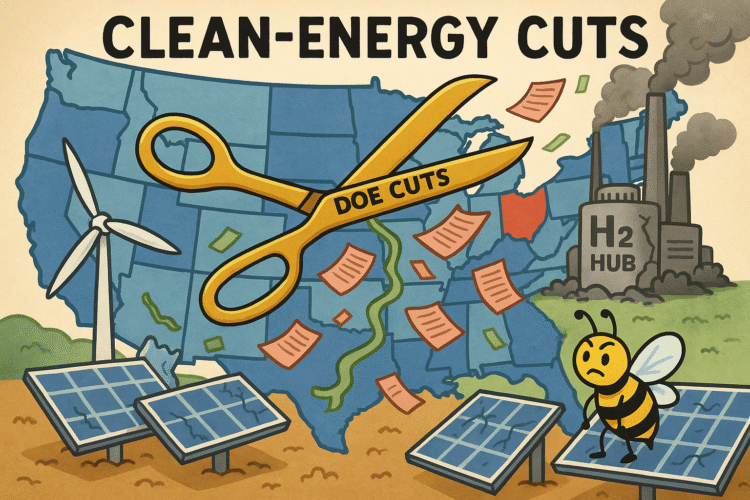
Once upon a shutdown, the Department of Energy quietly became an executioner. In the first two days of October, with government stalled and Congress gridlocked, the Trump administration canceled roughly $7.56 billion in clean-energy funding—snatching away support from 223 projects across 16 Democratic-leaning states. Projects included caliber hydrogen hubs in California and the Pacific Northwest, grid resilience upgrades, battery storage pilots, and more. The cuts weren’t random austerity. They bore the stamp of political vengeance.
To understand it is to see how power casts shadows across futures, especially in a crisis where the executive rules by absence. This purge is the ghostwriter of what remains of American climate ambition.
The Swift Guillotine: Titles, Timelines, Targets
On October 2, DOE announced it would terminate 321 financial awards supporting 223 projects, “saving” about $7.56 billion in federal outlays. Politico+3The Department of Energy’s Energy.gov+3Reuters+3 The official line claimed that the projects “did not adequately advance the nation’s energy needs,” were not “economically viable,” or were misaligned with the administration’s energy priorities. Axios+3The Department of Energy’s Energy.gov+3Reuters+3
Among the casualties: up to $1.2 billion destined for California’s ARCHES hydrogen hub, and up to $1 billion for the Pacific Northwest hydrogen hub. Politico Pro+5The Washington Post+5Reuters+5 The archipelago of canceled projects also included battery plants, grid upgrades, industrial decarbonization pilots, and equity-driven energy efforts in tribal and low-income communities. Politico Pro+4Utility Dive+4The Washington Post+4
These were awards made under prior administrations—many via Biden-era programs like the Office of Clean Energy Demonstrations, EERE, ARPA-E, Grid Deployment Office, Manufacturing & Energy Supply Chains, and fossil-energy partners. Reuters+3The Department of Energy’s Energy.gov+3Utility Dive+3 The DOE gave recipients 30 days to appeal the termination. Utility Dive+3The Washington Post+3Reuters+3
While these cancellations hit Democratic states hardest, some Republican districts also got collateral damage. GOP lawmakers in affected states scrambled to figure out whether their constituents would feel the blow. Politico+1
In California, Governor Gavin Newsom erupted. He demanded that the executive honor prior commitments and warned that the deletions would cost 200,000 projected jobs in clean energy. The Daily Beast+4Arches H2+4Governor of California+4 The leadership of ARCHES, led by CEO Angela Galiteva, responded that withdrawing funding ignores the promise of 220,000 jobs and punishes resilience pipelines built over years. Arches H2 Meanwhile, in Oregon and Washington, state officials condemned the funding dagger in the back of their regional hub. Utility Dive+3opb+3Politico+3
Why This Moment Matters More Than It Looks
This purge is not just a cut. It is a reengineering of climate ambition in the crust of a political storm.
First: timing amplifies damage. The shutdown already slow-walks permitting, halts grant processing, delays federal matching funds. By canceling projects midstream, the administration kills momentum, freezes supply chains, and makes reactivation harder if (when) the money is restored.
Second: targeted geography. Every cut lists states that voted against Trump in 2024. The selective logic is unmistakable: dismantle clean programs where political opposition resides, while sparing (or reprioritizing) hubs in states governed by political allies. The Texas hub, for instance, is left untouched. The Washington Post+2Politico+2
Third: private capital stranding. Companies that co-invested based on federal confidence now see projects vanish mid-contract. Workforce planning stops cold. Factories and supply chains in limbo. If your battery plant was banking on DOE grant money, now you may be betting on a bailout or bankruptcy.
Fourth: international competitiveness at risk. While Europe and Asia court hydrogen engineers, U.S. states decimate domestic hubs. Nations with coherent industrial policies will outbid us for talent and investment. The reliability premium we once boasted is now a liability.
Fifth: political blowback in “safe” districts. Some Republican-held House districts contain canceled projects. Voters may not care about the ideology—they care about jobs and local factories. What happens when your “blue-state purge” bleeds into red counties?
Legal Arteries and Likely Fights
DOE’s public announcement claims it is “saving over $7.56 billion” and delivers on fiscal responsibility. The Department of Energy’s Energy.gov But it cannot legally kill grants Congress already authorized—or strip awarded money without violating appropriation statutes and contract obligations. Unobjected judicial orders may stop part of this.
Project appeals will likely land in federal court—injunctions freezing terminations, arguments for breach of contract, or misuse of executive “review” authority. Allied states may file suit, claiming inequitable enforcement, discrimination, or constitutional overreach.
Given the shutdown, courts may claw back some terminations, but not before damage is done. Receipts, matching funds, grid works—all may be derailed ahead of judicial reversal.
Metropolis Case Studies: Where the Cuts Land Hard
In California, the ARCHES hydrogen hub was a cornerstone of the state’s next generation economy. The removal of $1.2 billion threatens more than clean energy—it risks the trades, supply chains, labs, manufacturing. Reuters+5Hydrogen Insight+5Arches H2+5 ARCHES leadership notes they had already anticipated 220,000 jobs tied to the ecosystem. Arches H2
In the Pacific Northwest hub, six nodes across Oregon, Washington, and Idaho were suspended—undermining regional ambitions for clean hydrogen, grid resilience, and energy exports. opb+1
In Colorado, more than $608 million in DOE funding was canceled across at least 34 projects—methane capture, grid upgrades, industry pilots. Colorado Public Radio Even some of those were in swing or Republican-adjacent districts, creating distress among local stakeholders.
These cuts echo through municipal budgets, local utilities revising integrated resource plans (IRPs), and coalitions of universities, unions, and firms suddenly scrambling to fill gaps—if possible, with state funds or private capital. Some will mothball initiatives, redirect them, or abandon them altogether.
The Narrative Pivot: From Bipartisan Promise to Partisan Sabotage
Just a year ago, hydrogen hub competition was modeled as bipartisan infrastructure. States lined up. Industry responded. DOE’s selection process matched federal grants with local pledges. Clean energy was an economic frontier, not a political weapon.
Now, that frontier is being erased. The same projects once hailed are now recast as waste, misaligned, or partisan liabilities. The pivot suits the shutdown playbook: use a crisis to rebrand infrastructure as privilege, equity funding as agenda, and control over subsidies as power.
What States Can Try to Do
Some states won’t surrender quietly. They may:
- Gap-fund with state dollars: allocate emergency funds to keep core projects running until federal appeals resolve.
- Rescope projects: narrow phases, scale back deliverables, modularize components that survive cancelation.
- Seek alternate financing: private-lender bridge loans, bond measures, public–private partnerships to weather the clawback.
- File emergency legal suits: injunctions to stop terminations, prevent fund clawbacks, restore immediate operating capital.
- Crowdfund and rebrand narratives: position canceled jobs as federal warfare on state economies, rally public support, pressure members of Congress.
But even these measures may only slow the bleed. The damage is structural: supply chains fractured, investors wary, workforce migration stunted.
The Final Reckoning
What we see now is not messy policy. It is deliberate sabotage. Blue-state hydrogen hubs gutted, climate investments erased, grid upgrades halted—all as leverage in a shutdown that claims to be about “fiscal restraint.” If power is the ability to veto projects in opposition territory, this is raw power.
And the worst part: the ideological line is now drawn over infrastructure, not taxes. The war is not about what you can afford—it’s about who gets to build. In the lab, the factory, the city. In the clean future, the machines, the engineers, the pipelines.
This purge is more than cuts. It is a carte blanche rewrite of how federal energy and climate policy gets made—or unmade. And that rewrite happens in a week when the cameras are off, Congress is locked out, and the executive acts with its greatest leverage.
If this moment becomes the baseline, we don’t get back those hydrogen corridors, that battery plant in a heartland district, that utility-ready grid expansion. We get a successive truncation of climate ambition in the name of political revenge.
That is the future they are trying to build. And if they succeed, the silence of dismantled projects will echo louder than any speech.