There is a special kind of civic panic that arrives when hope polls above forty percent. It hums like a subway third rail, invisible until someone grounded enough dares to touch it. That, apparently, is the mood of New York City on the eve of its mayoral election, where Zohran Mamdani, a 32-year-old socialist assemblyman from Queens, stands one headline away from making optimism look electable. The headlines, however, have other plans.
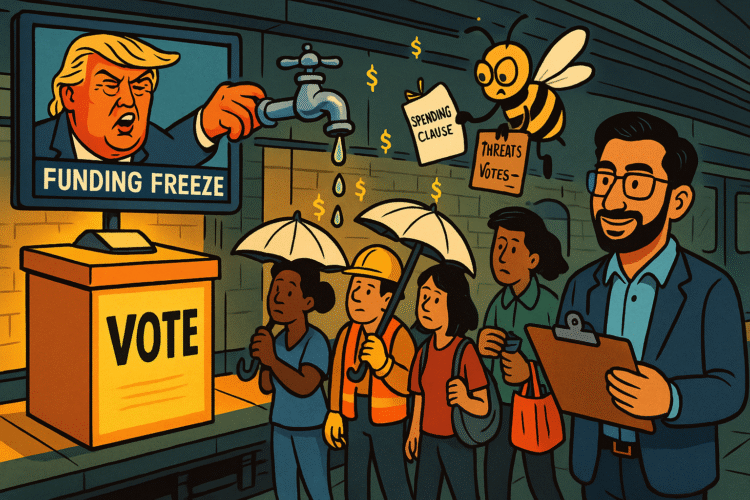
On Truth Social, Donald Trump has decided that New York’s next mayor is a matter of federal security. He has warned that if Mamdani wins, he will personally ensure the city “doesn’t see a penny” of certain funds, because “we’re not paying terrorists.” The comment was later clarified to mean “radical communists,” which was then clarified again to mean “whatever you think is worse.” He went on to endorse, or not endorse, Andrew Cuomo, depending on which clip plays first on cable. Meanwhile, Curtis Sliwa, wearing his trademark red beret and existential confusion, continues to be technically the Republican candidate but has been sidelined by the former president’s sudden affection for Democratic nostalgia.
The Mamdani campaign itself feels like something America forgot it could produce: a joyful, defiant, literate movement. Volunteers describe it as “a block party that accidentally turned into democracy.” There are kids handing out halal doughnuts next to union organizers quoting Baldwin, climate activists canvassing alongside retirees who just want the trains to work, and a candidate who can talk about zoning policy with the same moral force most politicians reserve for national tragedies. When reporters ask about being a Muslim in politics, Mamdani answers like a person who has already spent his lifetime proving he’s not the headline others wish he’d fit.
Trump, however, sees headlines as weapons. Over the weekend he told Fox Business that “New York needs to learn respect” and claimed to have “already frozen big money” destined for the city. By “big money” he appeared to mean a tranche of infrastructure funding tied to the Hudson River Tunnel project, a multibillion-dollar engineering epic that happens to require federal apportionment schedules to continue on time. The Office of Management and Budget, when asked, declined to confirm any freeze, which is bureaucratic for “we’re currently deciding how to word the denial.”
The threat itself is not new. Presidents have occasionally tried to use the federal purse as leverage, but the Constitution’s Spending Clause and a few centuries of separation of powers generally frown on executive blackmail. Congress allocates funds, agencies administer them, and presidents sign or veto. Anything else tends to end up in court. The last time Trump tried this play was during his first term, when he attempted to withhold counterterror grants from sanctuary cities. The courts, from district to appellate, blocked him. They cited the same doctrine every first-year law student memorizes between panic attacks: Congress spends, presidents execute. You can condition grants, but not coerce recipients. And certainly not to punish voters for choosing someone you dislike.
Still, the optics work in his favor. Trump knows that threatening blue cities is cheaper than funding red ones, and that grievance outperforms governance. His latest performance turns New York’s mayoral race into a loyalty test for the federal spigot. It also allows him to audition for a future in which every budget line is a political endorsement.
The Mamdani team, for their part, has chosen not to perform outrage. They’ve responded with policy briefings and a sense of humor that reads like civic hygiene. “We’re running to fix housing and transit,” Mamdani told reporters. “If the president wants to take that personally, he’s welcome to sue himself.” The remark ricocheted across social media as both clapback and civics lesson, the kind of sentence that restores faith in syntax.
Meanwhile, Andrew Cuomo, whose comeback arc appears to be powered entirely by Trump’s confusion, released a statement clarifying that he did not solicit the endorsement and does not believe in cutting federal funds to influence elections. Translation: thank you, but please stop helping.
Within hours, national outlets began describing the spectacle as “unprecedented,” which is journalism’s polite synonym for “unlawful but we need a second source.” Constitutional scholars were less circumspect. The Spending Clause, they noted, allows Congress to attach conditions to grants if those conditions relate to the program’s purpose, but coercion crosses the line when funding is used to compel unrelated behavior. Threatening to defund New York’s transit, housing, or counterterror budgets over a mayoral choice would almost certainly qualify.
The Office of Management and Budget, meanwhile, operates the apportionment machinery that translates congressional appropriations into usable agency dollars. A “freeze” would require formal guidance, a reprogramming notice, or a letter of credit suspension. Each step would generate a paper trail visible to oversight committees, inspectors general, and, eventually, judges. In short, the mechanics of intimidation are traceable, even when the intent is plausible deniability.
What makes this episode remarkable is not the novelty of executive overreach, but its theatrical candor. Trump is not hiding the threat; he is bragging about it. He has turned the art of the deal into the art of the shakedown, livestreamed and merchandised. The federal government, in this view, is a private trust managed for friends and suspended for enemies. The irony is that the very communities he targets—immigrants, transit riders, public servants—are the ones who keep the federal apparatus functioning at the street level.
By Monday morning, polls showed Mamdani maintaining a slim lead. His volunteers were still canvassing with playlists and clipboards, while the opposition’s message had distilled into “he’s too happy to be trusted.” The contrast was striking: a movement defined by joy facing a coalition fueled by threat. Hope is rarely organized; this one is.
In Queens, where Mamdani grew up, shopkeepers talk about him the way small towns talk about teachers who changed their lives. There’s a communal pride that feels both local and subversive: the idea that someone who takes the subway might one day fix it. That sense of intimacy terrifies professional consultants, who rely on distance to justify their fees.
Across talk shows, Trump continued to insist that he alone could “save” New York from Mamdani’s socialism. On Newsmax he described the candidate as “dangerous,” then corrected himself to “maybe just misguided,” then pivoted to a story about pigeons in Central Park. It was not entirely clear whether he understood that mayoral powers do not include nationalizing Wall Street. But clarity has never been his genre.
In the background, OMB lawyers are likely drafting memos reminding agencies that apportionments must follow congressional intent and that coercive freezes invite lawsuits. These memos will leak, be parsed, and then ignored by those who benefit from chaos. The Justice Department, still reeling from previous rounds of separation-of-powers litigation, will probably prepare an advisory that says nothing while hinting everything. The machinery of governance will grind forward, slower than the outrage cycle but sturdier.
For those who still believe elections are civic rituals rather than hostage negotiations, the Mamdani campaign feels like a cultural exhale. It is a reminder that progress is not the opposite of tradition; it is what happens when tradition admits failure and tries again. His rallies are smaller than Trump’s, but denser with humanity. There are no hats, no merch tables, just conversations that spill into block parties. It is, for lack of a better word, hopeful.
The juxtaposition could not be sharper: a Muslim socialist preaching community over fear while a former president invokes the Treasury as a cudgel. America has seen this pattern before, from Birmingham to Berkeley, where power mistakes empathy for weakness. What unnerves authoritarians is not radicalism but joy—especially joy that votes.
Cable producers, naturally, prefer the drama. They have turned the race into a narrative of “faith versus fear,” as if democracy were a genre series with predictable arcs. The networks replay Trump’s threats like weather reports, noting the latest gusts of outrage without explaining that the climate is man-made. Legal analysts outline potential injunctions in the same tone meteorologists use for hurricanes. “The courts will likely intervene,” one said, “but damage will occur first.”
Meanwhile, everyday New Yorkers continue to ride subways built with federal grants, cross bridges maintained by appropriations, and work in hospitals funded by Medicaid and FEMA reimbursements. They are, in real time, the hostages of a metaphor. The question is whether they will recognize the irony when voting booths open.
Mamdani’s supporters have begun calling the threats “a confession.” They argue that a president trying to defund a city over an election is not asserting strength but admitting fear—fear that joy might be contagious. Cuomo’s camp, predictably, blames “political theater,” which is accurate except for the part where people still have to live in the stage set.
The legal scholars have started dusting off case law: South Dakota v. Dole, NFIB v. Sebelius, City of San Francisco v. Trump. Each established limits on conditional funding and coercion. The pattern is clear: when presidents play accountant with appropriations, the judiciary plays referee. What is less clear is whether the public still recognizes the foul.
If the White House attempts to formalize the freeze, expect a lawsuit within hours. The city could claim violation of the Spending Clause, coercion beyond the permissible scope of grant conditions, and abuse of administrative discretion. The courts would issue a temporary injunction, Congress would posture about oversight, and the agencies would quietly continue issuing letters of credit until told otherwise. Democracy, like plumbing, leaks until repaired.
Yet amid the legal theater, something subtler is happening: a moral referendum disguised as a mayoral race. The question is not whether Mamdani can run New York; it is whether America can tolerate someone who believes governance is an act of care. The candidate’s Muslim faith, routinely weaponized by opponents, has become an accidental symbol of pluralism at work. When asked about extremism, Mamdani tends to quote policy, not scripture. His calm has become its own argument.
The contrast exposes a national pathology: we expect Muslim politicians to apologize for the fringe of their faith while forgiving Christian nationalists their entire platform. We demand humility from the marginalized and loyalty from the powerful. Mamdani’s refusal to play that script reads less like defiance than sanity.
Trump’s calculation is simpler: pick a fight, dominate the airtime, redefine the stakes. By inserting himself into a local race, he transforms municipal politics into a federal morality play. The message is clear: dissent will cost you. The subtext, however, is accidental honesty—he is confessing that he still fears cities, because cities remember him.
By Tuesday night, polls will close. Ballots will be counted between cable segments, lawyers will prepare emergency filings, and someone at OMB will quietly update a spreadsheet that determines whether a tunnel gets bored or paused. In the spaces between those bureaucratic keystrokes, democracy will either flinch or not.
The Mamdani campaign is betting on not. It has raised small-dollar donations from every borough, mobilized communities usually treated as focus groups, and rebuilt faith in the word “movement.” It feels, in the most unfashionable way, like citizenship.
Critics call it naïve, which might be the highest compliment available in a cynical age. Because cynicism is not intelligence; it is self-preservation dressed as analysis. Hope, by contrast, requires work. It demands the endurance to act without guarantee, to show up when power insists you stay home. In that sense, Mamdani’s optimism is revolutionary: it trusts voters more than fear.
When historians revisit this week, they may treat Trump’s threats as a constitutional crisis or a campaign stunt. But the real story will be simpler: a city decided to take the civics test it was told no longer mattered, and it refused to cheat.
Coda for a City
Democracy rarely collapses; it erodes under the weight of its own jokes. A president calls a mayor a communist, a budget becomes a threat, and a city learns how much of its courage was procedural. If New York sues, it will not just be defending funds; it will be defending the idea that elections are not auditions for obedience.
The next few days will reveal how power interprets embarrassment. If agencies issue freezes, the courts will intervene. If Congress pretends surprise, the precedent will stand. But somewhere in Queens, a campaign office will still be humming with music, volunteers refreshing precinct numbers between dance breaks. They will remember that intimidation only works when it feels like news.
Tomorrow, the voters will answer a question that should never have been asked: can joy govern? The city, in all its flawed magnificence, is about to reply.