Not a Conspiracy Theorist, Just a Smell Test Enthusiast
I don’t wear tin foil hats. I don’t subscribe to newsletters about the Denver Airport being a Masonic portal to lizard people. I am not a conspiracy theorist. I follow the facts wherever they lead, even if they lead me to deeply inconvenient places like “Charlie Kirk’s opinions exist” or “Elon Musk still has Wi-Fi.”
But there are times when the official story arrives pre-packaged with such on-brand neatness that you can’t help but raise an eyebrow. Times when the details line up so perfectly with preexisting talking points that it smells less like truth and more like a Fox News producer’s dream board.
Enter the assassination of Charlie Kirk.
The accused? A 22-year-old from a conservative Christian family, allegedly “radicalized” into killing after living with a transgender roommate. The motive? We’re told it was Kirk’s anti-trans rhetoric, because apparently nothing screams believability like a narrative that checks every culture-war box before investigators even figure out what brand of rifle casings they picked up off the Utah pavement.
Too Convenient by Half
Maybe it’s true. Maybe Tyler Robinson really was driven from Bible verses to bullet casings because of exposure to queer life. Maybe his roommate was patient zero in some cosmic clash between faith and gender politics. But isn’t it a little convenient that the story fits the culture-war outline this cleanly?
The timeline itself wobbles. Authorities were still processing the scene when leaks suggested it was about trans rights. They hadn’t identified the suspect, hadn’t traced the weapon, hadn’t finished cataloging shell casings—and already, trans identity was headline material.
It’s the oldest playbook in the book: name the culture-war culprit first, fill in the evidence later.
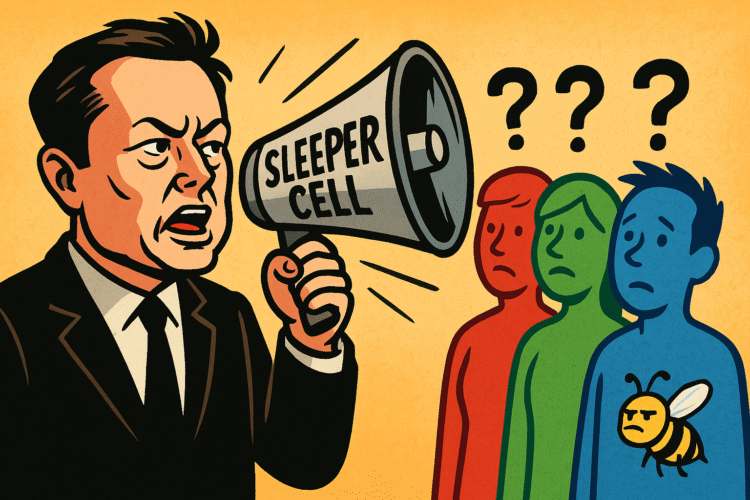
Musk and the Imaginary Sleeper Cell
And then Elon Musk entered the chat.
Within hours, the man who built his career on reusable rockets and unending lawsuits was on X (formerly Twitter, currently Hell) warning about “transgender sleeper cells.” As if queer people are some covert special ops force activated by rainbow-colored dog whistles.
The logic is grotesque. Treating gender identity as a religion, as something you “join,” as if there’s a gay seminary somewhere cranking out assassins. “Welcome to Queer Camp, here’s your syllabus: Advanced Pronouns 101, Weaponized Glitter, and How to Bring Down the Republic by Existing.”
It’s not just lazy—it’s deeply homophobic. Blue eyes aren’t a cult. Queerness isn’t a denomination. There is no LGBTQ sleeper cell because identity is not ideology. It’s who you are, not something you’re conscripted into. Musk treating it otherwise is less analysis, more fever dream with a $200 billion valuation.
We Are Not a Monolith
Here’s the thing nobody on the right seems capable of grasping: queer people aren’t a single hive mind. There’s no rainbow-colored Borg cube sending out kill orders.
Not all LGBTQ folks are progressive. Not all are Democrats. Not all have politics at all. Many don’t even know who Charlie Kirk is, and those who do mostly regard him as background noise. There are gay MAGA voters, trans libertarians, Black conservatives, and bisexuals who just want to file their taxes and binge Netflix without being turned into an avatar of national decline.
But in the right’s culture-war narrative, one queer person’s actions indict the whole community. Straight white men can commit mass shootings weekly without it being a referendum on straightness or whiteness. But one trans roommate of a suspect? Suddenly every queer person is an accessory.
The Fox News Special of It All
This is what makes the whole story smell like reheated Fox News leftovers. The neatness of the plotline. The way the talking points wrote themselves before the affidavits were even dry. Conservative martyr shot by someone linked—however tenuously—to queer life. Within hours, the chyron is typed: “Trans Radicalization Strikes Again.”
It’s not that I believe the event was staged or that Robinson didn’t pull the trigger. It’s that I’ve seen this movie too many times. The urge to stuff every tragedy into the culture-war narrative, no matter how messy or premature, robs me of trust.
I don’t think I’m paranoid for noticing when the news sounds less like messy human reality and more like the third act of a Fox News melodrama.
The Erosion of Trust
That’s the real problem here: trust. It’s not just about Charlie Kirk, or his widow, or his killer. It’s about whether the institutions delivering this story are telling us what they know or what they want us to believe.
When the motive is framed before the investigation concludes, when the narrative is handed down like scripture, when cultural scapegoats are named before suspects are processed—it chips away at credibility. You don’t have to be a conspiracy theorist to smell opportunism. You just have to be awake.
Gasoline on the Fire
And this opportunism isn’t neutral—it’s gasoline on the fire. Because once Musk shouts about “sleeper cells,” once influencers scream about the “trans agenda,” once the narrative calcifies, it doesn’t matter what investigators find. It doesn’t matter if Robinson acted for personal reasons, if his politics were muddled, if his motives were contradictory. The damage is done.
The culture war gets a fresh sacrificial lamb. Queer people get painted as villains. And violence, instead of being confronted, gets metabolized into propaganda.
The Endless Projection
The irony is rich. Conservatives howl about not being blamed collectively when one of their own commits violence—January 6 was just “a few bad apples,” mass shootings are just “mental health.” But when a killer once lived with a trans roommate, suddenly every queer person in America is implicated.
This isn’t analysis. It’s projection. They know their rhetoric fosters violence, so they scramble to pin that same charge on the communities they target. It’s a shield built out of hypocrisy.
Is It Bad to Doubt?
So is it bad that I doubt? Is it bad that my trust in institutions has eroded to the point where I side-eye official stories that sound too perfectly engineered for primetime?
Maybe. But doubt isn’t conspiracy. Doubt is self-defense. Doubt is what you develop after watching decades of narratives crafted to scapegoat the vulnerable while protecting the powerful.
I’m not saying Robinson didn’t act alone. I’m not saying the FBI fabricated anything. I’m saying it doesn’t quite pass the smell test that within hours of Kirk’s assassination, before evidence was fully gathered, the storyline was already written in bright neon letters: trans adjacency equals motive.
That’s not journalism. That’s choreography.
Shut the Fuck Up
Which brings me back to Elon Musk. Shut the fuck up.
There is no transgender sleeper cell. There is no rainbow militia hiding in your basements. There is no queer collective plotting your downfall. What there is: a community of individuals, as messy and contradictory as any other, trying to live.
Treating identity as ideology, as conspiracy, as religion, is not just wrong—it’s dangerous. It creates the very atmosphere of menace that makes tragedies more likely. And every time someone like Musk opens his mouth, the gasoline spreads further.
We are not a monolith. We are not your villains. We are not your cult. Stop dragging us into your chaos.
Summary: Smelling the Spin
I am not a conspiracy theorist. I follow facts. But the story of Charlie Kirk’s assassination feels too neatly packaged: a conservative youth from a Christian family, allegedly radicalized by living with a trans roommate, driven to kill by anti-trans rhetoric. The narrative was stamped before investigators had evidence, before motives were confirmed, before the public knew the shooter’s name. Elon Musk shouting about “transgender sleeper cells” only adds insult—identity isn’t a religion, orientation isn’t a cult, and queer people are not a monolith. Individuals commit violence for messy reasons. Exploiting that violence to scapegoat entire communities erodes trust, fuels culture wars, and treats grief as branding. The facts may prove the official story true, but the convenience of the framing—and the speed with which it was weaponized—reeks of spin.