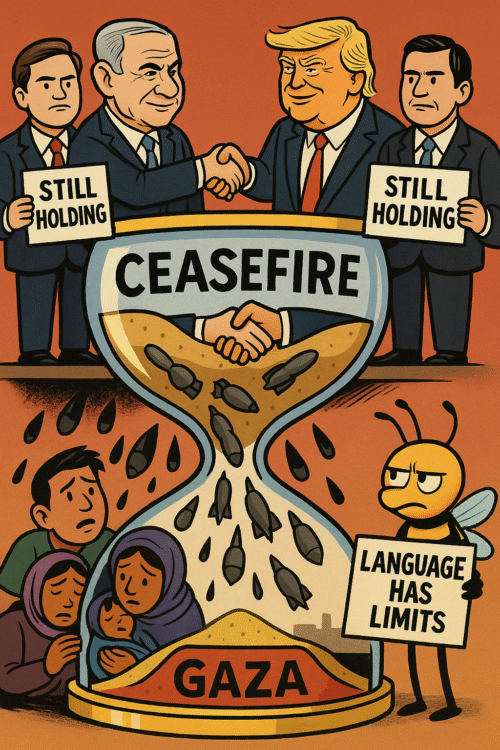
There are moments in history when language becomes so thoroughly mangled that it folds in on itself. This week, that word is ceasefire. Once a term for stopping violence, it now means “repositioning artillery for improved optics.”
The latest headlines read like a tragic parody: Israel launched new strikes across Gaza after Prime Minister Benjamin Netanyahu ordered a “forceful response” to alleged Hamas violations of the U.S.-brokered truce. Nine people were killed in Gaza City and Khan Younis before breakfast. Other tallies climbed above twenty by afternoon.
The trigger? A supposed sniper or RPG attack on Israeli troops in the south—and the contentious return of hostage remains that Israel says had already been partly recovered. Hamas denied involvement, saying it remained committed to the ceasefire while postponing a planned handover of remains. In other words: everyone’s still technically agreeing not to fight, except for the part where they keep killing each other.
Welcome to 2025’s peace with features.
The Trump-Vance-Rubio Doctrine: Ceasefire as Customer Service
This was supposed to be the great diplomatic reboot. The Trump administration, fresh off rebranding the Department of State as “Trump International Diplomacy,” had negotiated what it called “a durable cessation of hostilities framework”—or, as the rest of the world dubbed it, a pause button that keeps unpausing itself.
The U.S.-brokered ceasefire came with a coordination cell in southern Israel run by U.S. Central Command officers, who now find themselves performing the impossible: refereeing a fight where both sides claim the whistle belongs to them.
Vice President JD Vance, doing his best impression of a policy hawk trapped in a Hallmark Channel remake of Dr. Strangelove, told reporters that “the truce is still holding.” He said this as footage of Israeli tanks rolling into Khan Younis aired behind him. Secretary of State Marco Rubio—America’s most enthusiastic graduate of the John Bolton School of Eternal Conflict—declared that Israel had “the right to respond to imminent threats.”
The logic is elegant in its circularity: if peace is violated, bomb harder until peace feels safe again.
The Timeline: How to Break a Truce Without Saying You Did
Let’s trace the slow-motion unravelling.
Early October: The ceasefire begins, framed as a historic pause in a war that has already left tens of thousands of Palestinians dead or missing since 2023. Israel keeps drones in the air “for surveillance only.” Hamas keeps digging tunnels “for infrastructure.” Everyone congratulates each other for restraint while quietly preparing for the next round.
October 10–18: Reports surface of “low-intensity” Israeli strikes in “limited zones.” That’s bureaucratic shorthand for “we’re bombing, but politely.” Netanyahu insists that these aren’t violations; they’re “protective calibrations.” Meanwhile, the U.S. monitoring cell starts sounding like a customer support line. “Your ceasefire is important to us,” CENTCOM might as well say. “Please remain calm while we process your airstrike.”
October 19: The retaliation order lands. Israeli officials claim Hamas violated the truce with an attack on troops and by mishandling the remains of hostages. Hamas denies it, saying Israel staged a provocation to justify escalation. Somewhere between these narratives lies the truth, buried under rubble.
October 22: Air raids resume. Gaza’s health ministry counts the bodies. Israel’s defense minister Israel Katz declares that Hamas will “pay dearly.” Turkish officials call the strikes a “betrayal of international law.” Mediators in Qatar and Egypt start preparing condolence statements disguised as diplomacy.
By Tuesday night, the ceasefire isn’t so much broken as it is “structurally challenged.”
The Semantics of Fire
Modern war has become an exercise in euphemism. Bombing is “precision engagement.” Civilian deaths are “collateral metrics.” A ceasefire is “paused deterrence.”
Israel calls its actions “retaliatory responses.” The U.S. calls them “proportionate measures.” Gaza calls them “another night.”
It’s a macabre ritual: declare peace, violate peace, accuse the other side of violating peace, bomb in defense of peace, repeat. Everyone is fluent in the grammar of denial.
The ceasefire exists as both fiction and fig leaf—a rhetorical convenience that lets governments talk about “stability” while maintaining the option to incinerate it.
The Ceasefire Economy
Let’s not forget that every truce has a supply chain. Arms manufacturers love ceasefires because they’re recurring contracts disguised as compassion. The markets prefer predictability, and few things are more predictable than a “temporary truce” collapsing on schedule.
In this ecosystem, humanitarian aid becomes an accounting line item. Hospitals like al Shifa scramble for diesel fuel and bandages while donor nations argue about border logistics. Aid groups issue their standard statements—“gravely concerned,” “deeply troubled,” “calling for restraint”—phrases that have lost meaning through repetition.
The death toll isn’t shocking anymore. It’s a data point.
The Optics of Outrage
The U.S. press dutifully performs its outrage rotation. The same anchors who once called Gaza “a complex issue” now describe it as “a developing situation.” Twitter’s armchair generals draw battle maps between brunch and blame. Cable news treats every bomb as breaking news and every corpse as context.
The administration, meanwhile, does the diplomatic two-step: condemn violence while financing it. The Pentagon reassures the public that “U.S. munitions were not directly involved in this specific strike,” as though morality can be outsourced.
Vice President Vance’s claim that the truce “remains intact” is like declaring a house unburned because the chimney’s still standing.
Netanyahu’s Political Theater
Netanyahu, ever the political survivor, has turned perpetual crisis into brand strategy. Facing domestic backlash, corruption trials, and coalition fractures, he’s found his footing in the chaos he perpetuates.
His new refrain—“Hamas will pay dearly”—isn’t about deterrence. It’s about deflection. Each bombing run doubles as a press release to his base, a reminder that he remains the indispensable man of war.
The planned $300 million White House ballroom might have been Trump’s vanity project; Netanyahu’s is the eternal state of emergency. It keeps the cameras on, the critics at bay, and the right-wing coalition intact.
The American Chorus of Selective Sympathy
The U.S. response is a study in calibrated apathy. Rubio speaks of “Israel’s right to defend itself.” Vance speaks of “our commitment to peace through strength.” Biden’s absence from the sentence is the only silence louder than the bombs.
Humanitarian groups beg for corridors to reopen. Hospitals beg for morphine. And the administration releases statements about “monitoring the situation closely,” as if surveillance were compassion.
The ceasefire’s monitoring cell now functions less like a control room and more like a guilt management system.
The Mirage of Balance
Mainstream diplomacy loves the word “balance.” It’s the perfect anesthetic—ethical neutrality wrapped in bureaucratic poise. When officials say “both sides must show restraint,” what they mean is “we refuse to assign accountability.”
But balance in an asymmetrical war is moral absurdity. When one side controls the airspace, the borders, and the blockade, while the other side buries its dead under apartment rubble, neutrality is complicity in slow motion.
Still, balance photographs well. It fills press releases. It keeps donor conferences civil.
The Collapse of Credibility
When everything becomes a headline, nothing becomes history. The public’s attention drifts like dust. The numbers blur: ten thousand dead, twenty thousand, now forty. The arithmetic of atrocity numbs the conscience.
What remains is the language of deflection. “Regrettable.” “Tragic.” “Unavoidable.” These are the adjectives of absolution. They let leaders mourn publicly while calculating privately.
The ceasefire was never about peace—it was about pacing. About managing outrage before the next wave.
Turkey Condemns, Qatar Mediates, the UN Drafts Statements
International response follows its familiar choreography. Turkey condemns “in the strongest possible terms.” Qatar offers to mediate. The UN Security Council drafts another resolution destined to die under a veto.
Meanwhile, U.S. diplomats talk about “phased processes” and “confidence-building measures.” It’s the same lexicon that has powered fifty years of failure. The words change, the result doesn’t.
The only confidence built is in the consistency of collapse.
Hospitals, Rubble, and the Politics of Waiting
On the ground, aid organizations move like ghosts between craters. Al Shifa Hospital, already operating on fumes, prepares to relocate patients for the third time this month. The Red Crescent reports that ambulances are being targeted.
Every aid worker knows the cruel rhythm: airstrikes, pause, negotiation, another airstrike. Every ceasefire becomes a countdown.
Children now grow up knowing that “truce” means “rest period before the next explosion.”
The New Normal: Ceasefire as PR
We’ve entered the era of performative restraint. Governments treat truces like press releases. The goal isn’t peace; it’s perception.
The Trump administration touts the deal as proof of “unprecedented diplomacy.” Israeli officials frame it as “measured strength.” Hamas frames it as “resistance within limits.” Each faction markets its version of virtue.
Even as the rubble rises, everyone insists they’re adhering to the framework.
It’s not peace—it’s plausible deniability.
The Numbers That No One Owns
According to Gaza’s health ministry, at least nine people died in the latest wave, with other tallies surpassing twenty. Israel claims every strike is “precisely targeted.” The Pentagon releases thermal images to prove moral precision.
But bodies don’t lie. Neither do the empty hospital beds, the funerals broadcast live, the streets where “reconstruction” means removing bones.
The total Palestinian death toll since 2023 stands in the tens of thousands. That phrase—tens of thousands—has become so repetitive it barely registers anymore. But each digit hides a name, a family, a world that once existed.
And still, officials insist the ceasefire is “holding.”
The Fragile Architecture of Pretend
What’s next? Netanyahu plans to visit the U.S.-led monitoring center in southern Israel—an act of theater more than oversight. The UN may hold another emergency session that achieves the diplomatic equivalent of shrugging.
Hostage body returns may continue in what officials call “Phase 2,” because bureaucracies must have phases even for grief.
And somewhere in Washington, someone will declare that “the process continues,” because acknowledging collapse would require conscience.
The Ceasefire as Mirror
This ceasefire isn’t just a geopolitical failure—it’s a moral mirror. It reflects a world that prefers managed violence to uncomfortable peace.
It shows how empathy has been subcontracted to NGOs while governments perfect the art of selective outrage. It reveals the futility of language when every word has been stripped of its weight.
We call it “de-escalation.” What it really is, is maintenance. Maintenance of hierarchy, of armament, of illusion.
The Theology of Deterrence
War, like religion, has its liturgies. Every side prays to the god of security, invokes divine right, and recites scripture about “never again.” But deterrence has replaced deliverance as the modern sacrament.
In that theology, suffering is collateral holiness. Every bomb is a sermon about strength. Every ceasefire is a resurrection that lasts just long enough to sell the next arms shipment.
And the faithful—governments, donors, spectators—bow their heads and call it order.
The World’s Longest Loop
If the twentieth century was defined by wars that ended, the twenty-first is defined by wars that refresh. Each round resets the narrative: aggression, retaliation, ceasefire, breach, repeat.
The actors change, the pattern doesn’t. The language of diplomacy has become the script of addiction. We keep using “peace” like a sedative, just enough to dull the conscience before the next relapse.
Closing Section: The Architecture of Ashes
In the end, this isn’t a story about Hamas or Israel or even Trump’s traveling circus of ceasefire architects. It’s a story about what happens when the world stops believing in the possibility of peace and starts settling for choreography.
When “ceasefire” becomes code for “intermission.”
When “monitoring” becomes code for “witnessing without intervening.”
When “resilience” becomes code for “surviving what should never have happened.”
Somewhere in Gaza, a child learns to tell time by the sound of drones. Somewhere in Tel Aviv, a mother counts the minutes between sirens. Somewhere in Washington, a spokesperson says “we urge restraint” into a camera, and the world mistakes it for mercy.
The truth is simpler and crueler: the ceasefire never held because it was never meant to. It was an illusion of control in a world addicted to fire.
And the only thing holding is the silence that follows every explosion, waiting patiently for the next one.