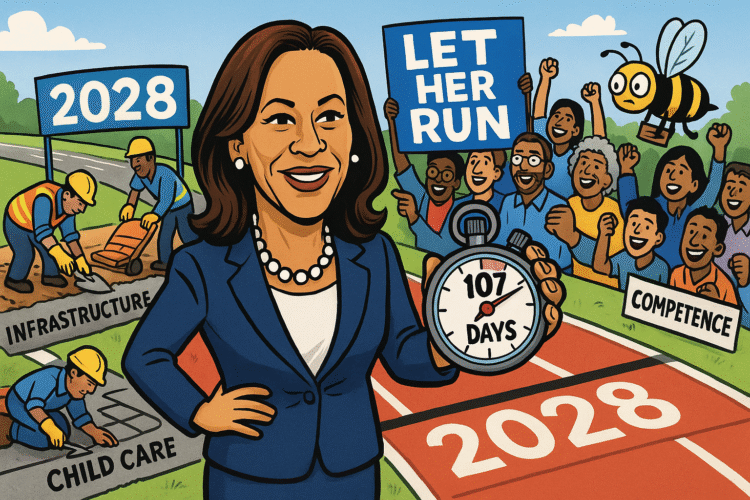
This piece is part of my ongoing series where I make the affirmative case for every potential 2028 Democratic presidential candidate—their virtues, their pitfalls, their receipts. Each of them gets the same treatment: no mythmaking, no memes, no mercy.
Today’s subject is the one who had the least time but left the deepest mark.
Kamala Harris didn’t just inherit a race; she inherited a countdown clock. When Joe Biden stepped aside in July 2024, she had 107 days to introduce herself as the new nominee, rebuild the Democratic Party’s campaign infrastructure, fundraise, define her message, and hold together a coalition stretched to its breaking point.
She lost that election. But she won something larger: credibility, competence, and the kind of scars that precede greatness.
This isn’t a eulogy for her 2024 campaign—it’s a roadmap for why she deserves the real race she was never given.
Exhibit A: The 107-Day Trial
Imagine taking over a national campaign when the money’s drying up, the polling’s tanking, and half the press corps thinks you’re a placeholder. That was Kamala Harris’s starting line.
In those 107 days, she did the impossible. She rebuilt a fractured campaign operation, reenergized disillusioned voters, and managed to put the word “hope” back in headlines that had been written as obituaries.
She drew crowds that surprised even her skeptics. She turned “freedom” into a unifying Democratic theme that didn’t sound like a bumper sticker but like a moral argument. She reframed reproductive rights, voting rights, and economic security as one fight—freedom from control, suppression, and corporate greed.
She went from inheriting a machine to running it with precision. Every week was triage and transformation. The result was a campaign that didn’t feel like survival—it felt like revival.
But America measures its leaders by outcome, not trajectory. And time ran out before the arc could complete. She lost, yes. But what she proved in 107 days is that she could do what few politicians can: get better, sharper, and more authentic under maximum pressure.
Exhibit B: The Foundation—A Career Built on Work, Not Optics
Before she was a vice president with a stopwatch, Kamala Harris was a prosecutor with a purpose.
As San Francisco District Attorney, she built Back on Track, a reentry program that cut recidivism in half. She cracked down on human trafficking before the issue became politically convenient, and she began experimenting with restorative justice models that treated rehabilitation as crime prevention.
Her critics, especially on the left, love to reduce her to the truancy program. The truth is more complicated. The intent was to keep kids in school and families connected to services long before school-to-prison pipeline reform became mainstream. She was testing theories the rest of the country is only now catching up to.
As California Attorney General, she stared down Wall Street when no one else would. The 2012 mortgage crisis was crushing homeowners, and the federal settlement being pushed through was a fraction of what victims were owed. Harris refused to sign it. She walked away, held her ground, and came back with a $20 billion relief package—more than triple California’s original offer.
That single act redefined her reputation: fearless, disciplined, and impossible to buy off.
She also launched OpenJustice, California’s first transparency portal for police data, publishing officer-involved shootings and racial bias metrics for the public to see. She created the first state-level privacy enforcement division, foreshadowing the tech accountability debates that would dominate the next decade.
This wasn’t glamour governance. It was methodical, painstaking, structural reform—the kind that rarely trends but always matters.
As U.S. Senator, she turned Senate hearings into masterclasses in prosecutorial questioning. She cut through bluster with surgical precision. When she grilled Jeff Sessions until he “couldn’t recall,” she reminded America what oversight was supposed to sound like. When she pressed Brett Kavanaugh, she wasn’t performing outrage—she was documenting it for history.
And as Vice President, she became the fixer. When the administration needed calm in the chaos, she stepped up: reproductive freedom, voting rights, infrastructure rollouts, supply chain coordination, and broadband expansion. She handled the details while others handled the headlines.
Her 2024 campaign proved that this background—law, structure, and systems—wasn’t a liability. It was a governing education.
Exhibit C: The 2024 Campaign That Shouldn’t Have Worked But Did
When Biden dropped out, the political establishment went into panic mode. Donors froze. Analysts pronounced the race over before it began. Republicans were gleeful.
And yet, Harris took the wheel.
She rebuilt fundraising operations in record time. She assembled a coalition that spanned labor unions, Gen Z activists, suburban moderates, and reproductive rights organizers. She gave the Democratic Party something it hadn’t had in years: an emotional core.
Her rallies were packed with energy, her speeches carried conviction, and her messaging finally cut through. She wasn’t trying to sound like anyone else—she was finally speaking like herself.
She didn’t win the presidency, but she did something equally important: she reintroduced the concept of competence to American politics.
She showed that you could run a disciplined, ethical campaign that focused on governing, not grievance.
And while the pundit class obsessed over whether she was “likable,” millions of women, immigrants, and first-generation Americans saw themselves reflected in power.
Exhibit D: The Flaws, Fairly Tried
Yes, her early campaigns had growing pains. Staff turnover and messaging confusion fed the caricature that she lacked direction. But look closer—those weren’t moral failings, they were managerial adjustments. Every leader who transitions from courtroom command to campaign chaos faces that gap.
Yes, she struggled to define herself in 2020. She toggled between bold progressive and pragmatic centrist, never quite finding the throughline. That’s not inconsistency—it’s calibration in a fractured party allergic to consensus.
And yes, her border assignment became an opposition talking point. The reality is that she was given an impossible brief: fix migration without funding or jurisdiction. She did the thankless diplomacy anyway, focusing on root causes, rebuilding regional cooperation, and being blamed for a system that predates her by decades.
The lesson? She learned to stop chasing optics and start controlling narrative. The 107 days were her thesis defense in public: define yourself or be defined.
Exhibit E: The 2028 Opportunity—A Real Campaign for a Real Candidate
Kamala Harris doesn’t need to rebrand. She needs to rerun—with time.
This time, there will be no sudden handoff, no fractured donor class, no emergency messaging huddles. The 2028 race could be her first real test under fair conditions.
She has what Democrats desperately need:
- A prosecutorial temperament in an era of disinformation.
- A coalition builder’s map that connects labor halls in Detroit to tech hubs in Austin.
- A reformer’s record that turns abstractions into statutes.
She is fluent in both the idealism of civil rights and the pragmatism of city budgets. She knows that the fight for democracy happens as much in zoning boards as in courts.
Her platform for 2028 practically writes itself:
- Abortion rights as freedom.
- Voting rights as infrastructure.
- Housing and transit as economic justice.
- Antitrust and consumer protection as cost-of-living relief.
- Climate jobs as industrial policy.
It’s not revolutionary in tone—but it’s transformative in effect.
Because what Harris offers isn’t spectacle. It’s function. The grown-up table version of progress.
Exhibit F: Coalition Arithmetic and Cultural Gravity
The 2024 coalition didn’t dissolve—it’s dormant.
Harris’s 107-day sprint reactivated core constituencies Democrats often take for granted: Black women, working-class Latinos, suburban women, and younger voters motivated by abortion rights and climate urgency. She built bridges between groups that rarely share language but share stakes.
She can expand that coalition with time to plan—by rebuilding state parties, empowering local organizers, and framing freedom as an economic as well as social promise.
And there’s something deeper: cultural gravity.
An openly gay man in the Cabinet and an openly Black and South Asian woman at the top of the ticket changed what political leadership looks like. Representation isn’t cosmetic—it’s kinetic. It expands the map of possibility.
A full Harris campaign wouldn’t just chase votes. It would cement generational permission.
Exhibit G: Media and Misunderstanding
The press doesn’t quite know how to write about Kamala Harris. They toggle between extremes—fawning or dismissive, never contextual.
In 2024, she faced the same lazy tropes: “word salads,” “awkward laughs,” “unrelatable.” What got missed was the reality that she was doing what women, especially women of color, have always had to do—be twice as prepared and half as forgiven.
Her composure wasn’t stiffness. It was survival.
If the media has any institutional memory left, 2028 will test whether they’ve learned to cover competence as newsworthy.
Exhibit H: Lessons from the 107 Days
Those 107 days were more than a sprint—they were a revelation.
Harris learned how to campaign as herself, not as an adjunct. She learned how to lead the conversation rather than react to it. And she learned that her power doesn’t come from charisma—it comes from clarity.
The 2028 campaign will let her deploy those lessons with the one thing she never had before: time to breathe.
She can build the ground game. Define her economic narrative. Show up in rural counties before anyone else does. Run as the executive she already is, not the emergency candidate she had to become.
Exhibit I: Competence Is the New Radical
The Kamala Harris case isn’t about identity—it’s about efficacy. She knows how to govern. She reads the briefings. She respects institutions. And she delivers results that hold up in court.
That shouldn’t be radical, but in this era, it is.
The country has survived two decades of performative politics—outrage as oxygen, grievance as gospel. Harris offers the antidote: disciplined governance.
The 2024 race showed she could hold her own against chaos. The 2028 race could show that competence can still inspire.
Exhibit J: The Closing Argument
Kamala Harris got 107 days to prove what kind of president she could be.
She didn’t get the normal luxuries: months of narrative-building, endless donor retreats, an army of surrogates. What she got was a crisis. And she handled it.
Now, she deserves the full campaign—the runway to make her case without the countdown clock ticking like a doomsday timer.
The next Democratic nominee must be someone who can govern, not just campaign. Someone who can bridge moral urgency with procedural mastery. Someone who can fix what’s broken without setting it on fire.
Kamala Harris already did that—in fragments. 2028 is her chance to do it whole.
Because in the end, America doesn’t need a savior. It needs a professional. And after the chaos, the conspiracies, and the collapse of seriousness, competence is the most radical platform there is.
She lost the 2024 election, but she won the argument for why she should lead the next one.
Maybe this time give her more than 107 days. Give her the race she earned.