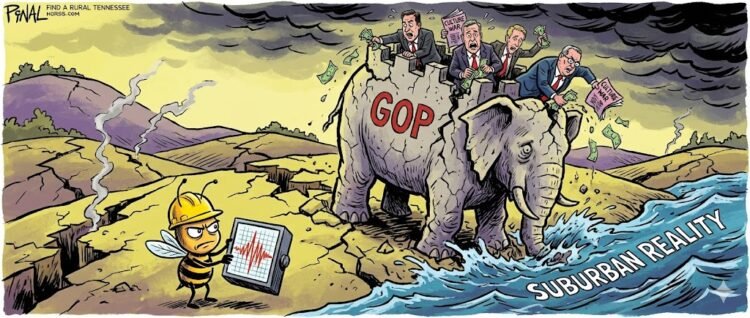
When a twenty-two point lead shrinks to single digits, you don’t pop champagne; you check the foundation for termites.
In the grandiose, self-mythologizing atlas of the Republican Party, Tennessee’s 7th Congressional District is supposed to be a fortress. It is drawn with the kind of jagged, protective geometry that ensures a generic conservative can sleepwalk to victory while speaking in tongues. This is deep-red soil, the kind of place where Donald Trump won by a staggering twenty-two points just last year, a margin that suggests not just a political preference but a theological one. By every law of political gravity, the special election here should have been a routine administrative procedure, a stamping of papers to install the next loyal foot soldier, Matt Van Epps, into the machine. It should have been boring. It should have been invisible.
Instead, it was a crime scene. While Van Epps technically won the seat, the margin was a disaster that is currently causing ulcers in consultant class dining rooms from Nashville to Washington. The Democratic challenger, state legislator Aftyn Behn, closed the gap to within eight points. She took a district that was supposed to be a conservative panic room and turned it into a competitive battleground. In the binary world of winning and losing, the GOP held the chair. But in the terrifying, nuanced world of trend lines and momentum, they just watched their structural advantage evaporate.
This result is not a local fluke or a quirk of the weather. It is a siren. It signals a dangerous national trend for the GOP as they stare down the barrel of the 2026 midterms. The comfortable arithmetic that has allowed them to govern by grievance and ignore the economic reality of their constituents is fraying. The massive swing toward the Democrats in a district that should be immune to such things suggests that the electorate is not as calcified as the maps suggest. It suggests that inflamed Democratic enthusiasm is not just a coastal phenomenon but a force capable of breaching the red wall.
The mechanics of this near-death experience for the GOP are worth unpacking, if only to understand the depth of their problem. Special elections are usually low-turnout affairs where organization beats enthusiasm. But here, we saw a surge in early voting that defied the usual lethargy of an off-year contest. The cold weather, which political folklore usually claims favors the disciplined Republican base, did nothing to dampen the Democratic fire. In fact, it seems the only thing keeping the Democrats warm was a burning, incandescent rage.
Behn’s campaign did not run on the caricature of progressivism that Fox News likes to beat like a piñata. She ran on affordability. She ran on the cost of housing, the price of groceries, and the fact that the people in charge seem more interested in policing library books than fixing the economy. This message of pocketbook pain cut across the usual strata. It resonated with the suburban voters who are slowly, quietly divorcing the GOP. It resonated with rural voters who are realizing that culture war red meat does not put food on the table.
The suburban erosion is the most terrifying part of this data set for Republican strategists. These are the voters who used to be the bedrock of the party, the fiscal conservatives who wanted lower taxes and stable neighborhoods. Now, repulsed by the chaos and the performative cruelty of the national brand, they are drifting away. They are not becoming radical leftists. They are simply becoming exhausted. And an exhausted voter is a dangerous variable in a system that relies on tribal loyalty.
We must also talk about the weakness of the “cultural wedge” messaging. For years, the GOP playbook has been simple: find a marginalized group, demonize them, and ride the resulting wave of fear to victory. It worked for a while. It worked when the economy was stable and people had the luxury of worrying about what was in a textbook. But when the rent is overdue and the eggs cost a fortune, the fear-mongering loses its potency. Van Epps tried to play the hits, talking about the usual litany of social grievances. The voters looked at their bank accounts and shrugged.
The ripple effects of this result will be felt long before the next ballot is cast. Fundraising flows are about to be recalibrated with violent speed. Donors, those skittish creatures who view politics as an investment strategy, do not like to pour money into a sinking ship. If a safe seat in Tennessee requires a massive cash infusion just to hold the line, then there is no such thing as a cheap win. Every district becomes expensive. Every race becomes a drain. The war chest that was supposed to be used to expand the map will now be burned defending the castle keep.
Candidate recruitment is another casualty of this “victory.” If you are a rising Republican star, looking at the political landscape, do you want to run in 2026? Do you want to tie your fortune to a brand that is struggling to hold onto a Trump +22 district? The smart money stays on the sidelines. The ambitious talent waits for a better cycle. What you are left with are the true believers and the grifters, the people who either don’t understand the data or don’t care. And that is how you end up with a caucus of clowns.
The media narratives, always hungry for a “dems in disarray” story, will have to pivot. It is hard to sell the idea that the Democratic brand is toxic when they are overperforming in the heart of MAGA country. The narrative shifts to one of Republican vulnerability. It shifts to the competence crisis within the GOP. It asks the uncomfortable question: if they can’t dominate here, where can they dominate? The aura of invincibility is a fragile thing, and once it cracks, it is impossible to repair.
We are watching a stress test of the modern Republican coalition, and the metal is screaming. The party has built its entire strategy on the assumption that the base is immovable and the map is secure. They have gerrymandered their way into a false sense of security. But maps cannot save you from a mood shift. Boundaries cannot protect you from a populace that feels ignored. The “routine safe seat” is a relic of a bygone era. In the current volatile climate, every seat is a referendum on the sanity of the ruling class.
Consider the panic that this instills in the high-profile surrogates who flocked to Tennessee to drag Van Epps across the finish line. These are the heavy hitters, the names that are supposed to move markets. They came, they spoke, they waved the flag. And they barely made a dent. It exposes the limits of celebrity politics. It shows that endorsements are not magic spells. You cannot transplant enthusiasm from a rally stage to a voting booth if the product you are selling is defective.
The GOP is now forced to poll and pivot on messaging, a chaotic process that usually results in a muddled, incoherent platform. They have to figure out how to talk about the economy without admitting that their policies are unpopular. They have to figure out how to energize the base without alienating the suburbs. They are trapped in a strategic cul-de-sac of their own making. They cannot move left without losing the MAGA core, and they cannot move right without losing the middle. So they spin in circles, getting dizzier and more desperate.
On the other side, this result strengthens the Democratic belief in a 2026 map expansion. It validates the strategy of competing everywhere, of refusing to cede ground just because the pundits say it is hopeless. It tells the DCCC that there are pickup opportunities in places they hadn’t even considered. It energizes the volunteers who make the phone calls and knock on the doors. Belief is a powerful fuel in politics. If the Democrats believe they can win in Tennessee, they will fight harder in Ohio and Pennsylvania and Arizona.
The long-term signal is undeniable. The safe-red arithmetic is brittle. It is built on low turnout and high apathy. When those variables change, the equation collapses. When voters start judging politicians based on pocketbook pain and elite dysfunction rather than tribal identity, the GOP loses its structural advantage. They have nothing to offer a voter who wants solutions rather than scapegoats.
This is the danger of governing by performance art. You can entertain the base for a long time, but eventually, the lights come up and people realize the theater is falling apart. The GOP has spent years prioritizing the spectacle over the substance. They have treated governance as a subset of cable news. Now, faced with a specialized election that functioned as a reality check, they are finding that the ratings are slipping.
The narrow victory for Van Epps will be spun as a triumph of conservative values. They will claim that they held the line against the radical left. They will ignore the margin. They will ignore the trend lines. But behind the closed doors, in the strategy sessions and the donor calls, there will be no celebration. There will only be the cold, creeping realization that the ground is shifting beneath their feet.
In the theater of modern American politics, losing narrowly in a supposedly safe seat sometimes functions as a political Rorschach test. The partisans see what they want to see. The Republicans see a win is a win. The Democrats see a moral victory. But the objective observer sees something else entirely. They see a tremor. They see a crack in the facade. It is not the chair that matters so much as the vibration it sends through the palace.
The tremor tells us that the old rules are dead. It tells us that no one is safe. It tells us that the anger in the electorate is not contained to one party or one demographic. It is a free-floating radicalism, looking for a target. And right now, the target is the incumbent power structure. The GOP, comfortable in their gerrymandered fortresses, thought they were immune. They thought they could ride out the storm behind their red walls. But the water is rising, and the walls are leaking.
We are entering a cycle of extreme volatility. The 2026 midterms will not be a traditional contest between two stable parties. It will be a brawl in a burning building. The Tennessee result is the spark. It shows that the fire is already spreading. The GOP can try to ignore it. They can try to spin it. But they cannot put it out.
The “elite dysfunction” mentioned earlier is key. The voters in the 7th District looked at Washington and saw a circus. They saw a House majority that cannot pass a budget, cannot pick a speaker, and cannot govern. They saw a party consumed by internal feuds and performative investigations. And they decided, by a terrifyingly large margin, that they had had enough. Even in deep red Tennessee, competence is starting to look like a desirable trait.
This is the nightmare scenario for the Republican leadership. They can deal with an ideological opponent. They can fight a battle of ideas, however dishonest that battle may be. But they cannot fight a battle against their own incompetence. They cannot campaign against the reality that they have no plan to fix the country. The “routine walk” in Tennessee became a forced march because the voters refused to play their assigned role.
The high off-year turnout is the metric that should keep them up at night. It suggests that the electorate is engaged, attentive, and angry. The apathy that usually protects incumbents is gone. Every vote is a struggle. Every district is a battlefield. The GOP does not have the resources or the message to fight a war on every front. They relied on the map to do the work for them. Now, they have to actually do the work.
And let’s be honest, work has never been their strong suit. They prefer the grift. They prefer the easy money of the outrage cycle. But the outrage machine is broken. It is making noise, but it is not producing votes. The Tennessee special election proved that you cannot scare people into voting for you when they are terrified of their grocery bill.
So, let them have their “victory.” Let them swear in Van Epps and pretend that everything is fine. Let them ignore the alarms ringing in the basement. The rest of us can see the smoke. We know what it means when a canary coughs up blood. It means the air is toxic. It means the mine is collapsing. It means it is time to get out.
The tremor has passed through the palace. The king is still on the throne, but the crown is crooked, and the courtiers are whispering. They know that a storm is coming. And they know, deep down, that their fortress is built on sand.
Receipt Time
The invoice for a decade of neglecting the working class has finally arrived, and the late fees are punitive. The GOP thought they could pay the bill with culture war coupons and IOUs written on the back of Heritage Foundation napkins. The voters in Tennessee just rejected the payment. They want cash. They want results. They want a government that functions. The narrow margin in the 7th District is the collections agency knocking on the door. You can hide behind the curtains and pretend you aren’t home, but they aren’t going away. The political debt is real, and the interest rate is variable. The bankruptcy of the modern Republican Party is no longer a theoretical concept; it is a mathematical certainty, playing out in real-time, one “safe” seat at a time.