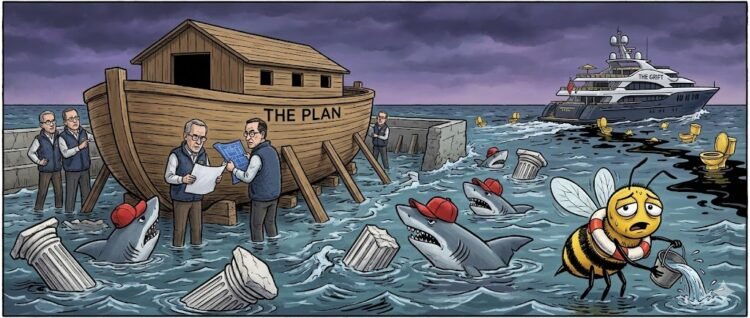
When the sensible conservatives start sounding like doomsday preppers, it is time to check the expiration date on the canned goods.
There is a specific frequency of alarm that only emits from the offices of The Bulwark. It is not the shrill, glass-shattering panic of liberal Twitter, nor is it the guttural, blood-and-soil roar of the MAGA swamp. It is the steady, high-pitched whine of a smoke detector in an empty house that is slowly filling with carbon monoxide. On December 5, Jonathan V. Last, the newsletter’s editor and designated captain of the Titanic’s band, published an essay that reads less like a political strategy and more like a final will and testament for the concept of Western civilization.
The piece is framed around an “all-hands” meeting, a corporate ritual usually reserved for announcing quarterly losses or new HR policies regarding microwave fish. But in JVL’s world, the agenda item was the potential extinction of the liberal order. He argues that the moment calls for “institutional sobriety” and “clearer moral imagination,” which is a very polite way of saying that everyone needs to stop doom-scrolling and start building an ark.
The central thesis is that we need a “bigger ship.” This is a metaphor for a broader, more robust coalition capable of weathering the storm of a second Trump term. It is a noble sentiment. It brings to mind images of sturdy oak planks and disciplined rowing. But one cannot help but notice that while JVL is measuring the timber for this new vessel, the water is already up to our necks. We are debating naval architecture while the sharks are circling the life rafts.
The Culture War is the Only War
Last’s diagnosis of the MAGA movement is surgically precise and terrifyingly accurate. He argues that this is not an economic project. It never was. The price of eggs is just a pretext. The price of gas is just a prop. The real driver, the engine that powers the red hats, is a perceived loss of cultural dominance. It is a status anxiety attack weaponized into a political movement.
This is the “cultural project” of the new right. It is not about policy. It is about feelings. Specifically, the feeling that they used to run the show, and now they have to press “1” for English or see a Pride flag at Target. JVL correctly identifies that you cannot solve this with a tax cut or an infrastructure bill. You cannot bribe a man out of his racism. You cannot subsidize away the fear of replacement.
The satire writes itself here. We are the wealthiest, most powerful nation in history, yet our politics are being driven by a collective tantrum over who gets to use which bathroom. We have turned governance into a therapy session for people who are traumatized by the existence of diversity. And The Bulwark, God bless them, is trying to counter this with “moral imagination.” It is like bringing a sonnet to a knife fight.
NATO is Dead (Long Live the Memory)
The darkest part of the essay, the part that should make every diplomat in Brussels start day-drinking, is the declaration that “NATO is over.” This isn’t hyperbole. Last cites reports that Pentagon officials are already telling their European counterparts to assume greater conventional responsibility because the U.S. might be withdrawing from coordination mechanisms.
“Coordination mechanisms” is a boring phrase for a terrifying reality. It means the United States is taking its ball and going home. It means the security umbrella that has kept Europe from exploding for eighty years is being folded up and put in the attic.
The irony is that the “America First” crowd thinks this is a victory. They think they are saving money. In reality, they are creating a vacuum that will be filled by chaos. JVL sees this. He knows that a world without NATO is a world where might makes right, where borders are suggestions, and where the United States finds itself alone in a hostile neighborhood.
But the “bigger ship” he proposes seems ill-equipped to handle this geopolitical tsunami. Project 2028, the proposed counter-movement, sounds like a thoughtful, well-reasoned policy framework. It sounds like a seminar at the Brookings Institution. The problem is that the other side is not holding seminars. They are holding rallies where they cheer for war crimes. They are not interested in the “rhetorical terms of contestation.” They are interested in winning by any means necessary.
The Anti-Corruption Pivot
One of the concrete strategies Last proposes is a relentless anti-corruption campaign. He wants to tie “elite looting” to policy failures. He wants to show the working-class MAGA voter that their heroes are actually grifters who are stealing the copper wiring out of the walls of the republic.
It is a sound strategy on paper. It appeals to the cynical realist in all of us. The Trump administration is, after all, a kleptocracy with a spray tan. The conflicts of interest are so glaring they can be seen from space. The self-dealing is not a bug; it is the operating system.
But there is a flaw in this plan. It assumes that the MAGA voter cares about corruption. It assumes that they view the looting as a bad thing. But what if they view it as a perk? What if they see the grift as proof of genius? “He’s smart,” they say. “He’s getting his.” In a culture of impunity, the successful thief is not a villain; he is a role model.
Trying to shame this administration for corruption is like trying to shame a shark for eating a seal. It is not a moral failing; it is just what they do. And the audience, trained by years of reality TV and cynical politics, has lost the capacity for outrage. They expect the looting. They just want to make sure they are on the side of the looters.
The Moral Imperative vs. The Algorithm
Last also warns against treating audiences as commodities or mobs. He wants The Bulwark to be a bastion of institutional sobriety, a place that respects the intelligence of its readers. This is a direct shot at the engagement-farming model of modern media, where outrage is the only currency and nuance is a liability.
It is a noble goal. It is also a lonely one. We live in an attention economy that rewards the loudest, stupidest voice in the room. Trying to build a “bigger ship” based on sobriety and morality is like trying to open a library in a nightclub. You might attract a few quiet souls who want to read, but the vast majority of people are there for the thumping bass and the cheap shots.
The “moral framing” that treats anti-MAGA as an ethical imperative is necessary, yes. But it is also preaching to the choir. The people who read The Bulwark already agree. The people who need to hear it are watching Fox News and scrolling Truth Social, where the moral imperative is to “own the libs” at all costs.
Project 2028: The Waiting Game
The concept of “Project 2028” implies that we just need to survive for four years. We need to hold the line, build the coalition, and prepare for the next election. It suggests that this is a temporary aberration, a fever that will break.
But what if it isn’t a fever? What if it is a chronic condition? What if the institutions we are trying to save are already too rotted to support the weight of the “bigger ship”?
The danger of this mindset is that it encourages a kind of passive resistance. It encourages us to wait for the pendulum to swing back. But pendulums don’t swing in a vacuum. They are pushed. And right now, the people pushing the pendulum are the ones who want to dismantle the clock entirely.
JVL’s essay is a cry for help from the bridge of a sinking ship. He is trying to organize the lifeboats. He is trying to keep the passengers calm. He is trying to chart a course to safety.
But looking at the horizon, at the storm clouds gathering over Europe, at the corruption rotting the foundation of Washington, at the cultural war consuming the heartland, one has to wonder if the ship is big enough. One has to wonder if there is anywhere left to sail.
The Sobriety Test
Ultimately, the call for “institutional sobriety” is the most radical part of the essay. In a time of drunkenness—drunk on power, drunk on rage, drunk on nostalgia—sobriety is a revolutionary act. To look at the world as it is, not as we wish it to be, requires a kind of courage that is in short supply.
Last is asking us to stare into the abyss without blinking. He is asking us to recognize that the liberal order is fragile, that democracy is not guaranteed, and that the forces arrayed against it are formidable.
He is right, of course. He is usually right. That is what makes reading him so depressing.
But there is a sliver of dark humor in it all. Here we are, the heirs to the Enlightenment, the citizens of the superpower, reducing our grand strategy to “please don’t let the bad guys steal everything.” We are negotiating the terms of our own survival with people who think the Constitution is a suggestion.
The “bigger ship” might never leave the dry dock. The “Project 2028” might just be a file on a hard drive that gets seized by the new Department of Justice. But at least someone is writing it down. At least someone is trying to keep the minutes of the meeting while the building burns.
Receipt Time
The invoice for this reality check is steep. It requires us to acknowledge that the NATO alliance, the bedrock of global security for decades, is effectively being liquidated by a real estate developer with a grudge. It requires us to admit that a significant portion of our fellow citizens care more about cultural dominance than economic survival. It requires us to accept that “anti-corruption” is a niche interest group rather than a universal value. JVL has tallied the costs, and the total is grim. We are purchasing a survival strategy for a world that may no longer exist by the time the credit card clears. The “bigger ship” is a nice idea, but right now, we are all just treading water, waiting to see if the sharks are hungry.