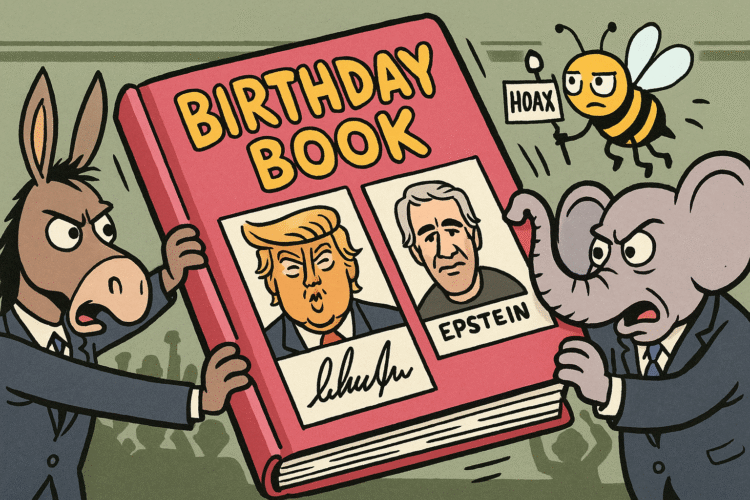
America has always had a gift for taking the grotesque and wrapping it in party favors. We can turn a banking collapse into a Netflix documentary, a constitutional crisis into a coffee-table book, and now, Jeffrey Epstein’s rolodex into a “birthday book.” Imagine the scrapbooking aisle of Michael’s, but curated by Ghislaine Maxwell.
This week, Democrats released a 238-page compendium from 2003: Epstein’s “birthday book.” Among the guest lists, doodles, and notes allegedly sits a sexually suggestive drawing signed by none other than Donald Trump. The White House immediately screamed “forgery,” which is their default setting whenever handwriting, morality, or reality itself intrudes. Press Secretary Karoline Leavitt cited unnamed “handwriting experts,” a phrase that here means “a cousin with a magnifying glass.” Trump himself waved it away, declaring the whole thing a “dead issue”—a bold claim for a man who can’t stop suing people for defamation about it.
Scrapbooking with the Stars
The absurdity of the “birthday book” cannot be overstated. This is not Watergate’s missing tapes or the Pentagon Papers. This is an oversized yearbook full of powerful men who thought their reputations could survive the company of Jeffrey Epstein. It’s the celebrity autograph book from hell, and every new page feels like opening a middle-school time capsule only to find the Declaration of Independence inside.
Ghislaine Maxwell, the socialite turned convicted sex trafficker, compiled the book herself. Think of her as Martha Stewart but for felonies. The project was apparently meant to commemorate Epstein’s 50th birthday, which in hindsight should have been marked with an indictment cake and a cellblock serenade.
The Trump Signature Problem
At the center of the storm is a drawing with Trump’s alleged signature and some sexually suggestive flourishes. The White House insists it’s fake, a hoax, a deepfake-on-paper. But here’s the thing: Trump has spent years autographing anything thrust in front of him, from MAGA hats to Bibles to actual human arms. The man signs more than a notary public at a Vegas wedding chapel.
Handwriting experts—real ones, not the unnamed variety—could probably pick his Sharpie scrawl out of a lineup. It’s not exactly subtle. His signature looks like an EKG gone wrong. To suggest it’s a forgery is to suggest someone out there can replicate chaos in pen form with forensic precision. Possible, yes. Likely, no.
The White House Defense: Deny, Sue, Repeat
Trump’s strategy here is familiar: declare it fake, sue anyone who disagrees, and hope the news cycle moves on. He’s already filed a $10 billion defamation lawsuit against The Wall Street Journal for its earlier Epstein coverage. Ten billion. With a “b.” That’s not a lawsuit; that’s a pitch for a Marvel sequel.
The White House, meanwhile, insists this is just another “Democrat hoax.” This is their term for everything inconvenient: election results, climate change, pandemic death tolls, criminal indictments, birthdays. If you don’t like reality, call it a hoax. If reality persists, sue it for defamation.
Democrats Smell Blood (and Dust)
House Democrats, never ones to pass up a messy headline, are demanding full disclosure of all Epstein files. They see the “birthday book” as Exhibit A in a long-delayed trial of public morality. At minimum, it’s another opportunity to remind Americans that powerful men treated Epstein’s orbit as a networking mixer.
But here lies the rub: every new disclosure risks implicating people across the political spectrum. Epstein’s Rolodex was not partisan. It was bipartisan sleaze, a Who’s Who of compromise. Democrats calling for transparency must know they may also be lighting the fuse on their own reputations. Transparency sounds noble until it drops you into a scandal next to an old boarding-pass stub.
The Maxwell Transcripts: A Strange Defense
Just weeks ago, the Justice Department released transcripts of Ghislaine Maxwell’s interviews. In them, she claimed Trump was “never inappropriate.” For the White House, this was manna from heaven: the convicted trafficker vouched for the president’s decency. It’s like being endorsed by a Yelp reviewer who specializes in arson.
The defense collapses under its own weight. If Maxwell’s word is trustworthy, then so is her “birthday book.” If she’s a liar, then her defense of Trump is meaningless. The White House cannot have it both ways, though it will certainly try.
The Pandora’s Box of Extrajudicial Scrapbooks
The bigger danger here isn’t just reputational damage. It’s the precedent. If presidents can shrug off suggestive notes in the ledgers of predators as “forgeries” without investigation, then every authoritarian abroad has a new alibi. What happens when another head of state claims the right to kill or conceal evidence by labeling it “fake”?
Worse, what if the book is authentic? Then the U.S. president’s signature is literally part of Epstein’s scrapbook of influence, a relic in the museum of complicity. Either way, the optics rot.
Congress in the Theater Business
As hearings loom, Congress has found its new Broadway show. Lawmakers will line up to wave photocopies of Epstein’s doodles like they’re holding the Magna Carta. Republicans will denounce the book as a distraction. Democrats will insist the book is a smoking gun. C-SPAN will trend for the first time in years.
The tragedy, of course, is that amid all the theatrics, survivors of Epstein’s crimes will once again be background actors in a play about powerful men. Their voices drowned by the sound of political opportunism clinking like champagne glasses at Mar-a-Lago.
The Irony of Trump’s “Dead Issue”
Trump called the whole matter a “dead issue.” But if history has taught us anything, it’s that the president’s definition of “dead” is unusually flexible. Birtherism? Dead, until it wasn’t. The 2020 election? Dead, until it became a lifestyle brand. Lawsuits? Dead, until the filing fees clear.
In truth, nothing is ever dead in Trumpworld. Issues are zombies—shambling forward, feasting on credibility, refusing to stay buried. The “birthday book” will be no different.
The Aftertaste
The truth is bleak and simple: America is trapped in a loop where the grotesque becomes ordinary. Epstein’s crimes were monstrous, but the fallout has been reduced to culture-war fodder. A scrapbook becomes a scandal becomes a punchline.
Whether the signature is authentic or forged, whether the book is revelatory or banal, the fact remains: power protected Epstein for decades, and power continues to protect itself through denial, distraction, and deflection.
The aftertaste we’re left with is bitter: the realization that transparency may never come, accountability may never arrive, and the names in Epstein’s orbit may forever be shielded by politics.
And so, once again, we are asked to move on. To accept that the grotesque is normal, that the scrapbook is closed, that the issue is “dead.” But like every zombie in American politics, it isn’t dead. It’s just waiting for the next news cycle to shuffle back into view.