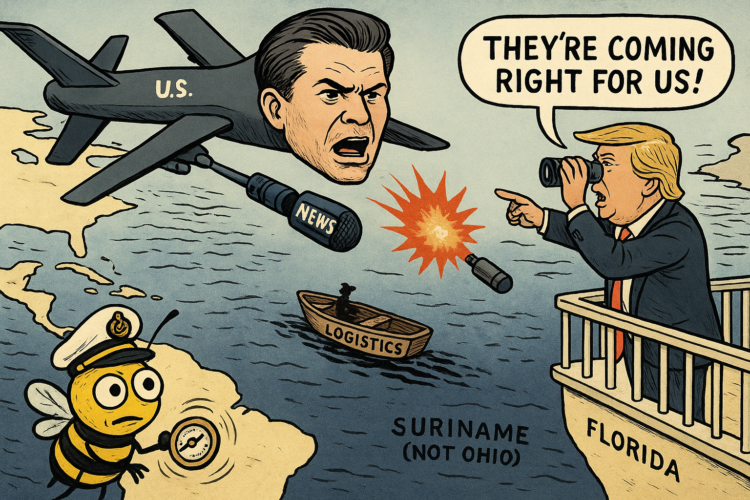
The White House promised us they were stopping a direct threat to the homeland, but it turns out they were just interdicting a shipment for the Amsterdam party scene with a Hellfire missile.
Geography has never been a strong suit of the American empire. We have a long and storied history of confusing one desert for another, misplacing entire countries on the map, and bombing the wrong village because the coordinates were written on a cocktail napkin. But this week, the Trump administration achieved a new milestone in cartographic incompetence. In a congressional briefing that sucked the oxygen out of the room, Navy Admiral Frank “Mitch” Bradley walked lawmakers through the reality of a September boat strike that President Trump and Defense Secretary Pete Hegseth have been touting as a heroic defense of the American homeland.
The narrative, as sold to the public on cable news and Truth Social, was simple. A “go-fast” boat, laden with the poison of the cartels, was barreling toward the United States. It was an imminent threat. It was a missile wrapped in fiberglass. It was coming for your children. It was coming for your suburbs. And so, in a display of righteous, kinetic fury, the United States Navy blew it out of the water. They didn’t just stop the boat; they erased it. And when survivors were spotted clinging to the wreckage, waving for help? Well, according to reports and the grim logic of the “double tap,” they erased them too.
It was a perfect story for the “America First” era. Tough. Decisive. Brutal.
There was just one small problem. The boat wasn’t going to America.
According to Admiral Bradley, who presumably possesses a map and a working compass, the vessel was on a rendezvous course to transfer narcotics to a larger ship bound for Suriname. For those of you who haven’t looked at a globe recently, Suriname is on the northeastern coast of South America. It is not Florida. It is not Texas. It is not even close. In fact, if you are in a boat off Venezuela and you head toward Suriname, you are driving away from the United States. You are driving toward the Atlantic Ocean and the route to Europe.
The revelation landed with the dull thud of a lie collapsing under its own weight. The boat wasn’t coming to poison American cities. It was part of a logistics chain likely funneling product toward the nightclubs of Berlin or the coffee shops of Amsterdam. We didn’t save Ohio. We didn’t save Miami. We executed a dozen people to protect the purity of the European drug supply chain. We acted as the world’s most violent bouncer for a party we weren’t even invited to.
The Fog of War (Room)
The disconnect between the Admiral’s briefing and the Secretary’s rhetoric is the kind of thing that usually signals a regime in crisis. Hegseth, the cable-news warrior turned Pentagon chief, has staked his tenure on the idea that the military should be unleashed. He treats the rules of engagement like suggestion cards in a suggestion box that he has already set on fire. To him, every boat in the Caribbean is a potential invasion force. Every smuggler is a terrorist. Every coordinate is a target.
But Admiral Bradley is a man who deals in vectors and knots. When he stood before Congress, he didn’t offer a sermon on the wickedness of the drug trade. He offered data. He showed the briefing materials. He showed the strike footage. And the data told a story of a localized smuggling operation that had absolutely zero nexus to the immediate safety of the United States.
The implication is devastating. It means that the “imminent threat” framing was a fabrication. It was a lie invented to justify a massacre. It means that the decision to launch missiles wasn’t based on tactical necessity; it was based on political expediency. They wanted a win. They wanted footage of an explosion to play on the evening news. They wanted to show the base that they were “doing something” about the border, even if the border in question was thousands of miles away and the “invaders” were driving in the wrong direction.
This is the danger of putting a propagandist in charge of the war machine. Hegseth doesn’t see the world as it is; he sees it as a series of segments. He sees the B-roll before he sees the intelligence. And when the intelligence contradicts the B-roll, he ignores the intelligence. The result is a foreign policy that functions like a reality show, where the plot twists are manufactured and the body count is real.
The Suriname Defense
One has to appreciate the absurdity of the specific geography involved here. Suriname. A former Dutch colony. A small, diverse nation with a rich culture and a lot of rainforest. It is not exactly a hotbed of anti-American terrorism. The idea that a boat heading there posed a “direct threat” to the U.S. requires a level of magical thinking that borders on psychosis.
Did the administration think the boat was going to take the long way around? Did they think it was going to circle the globe and sneak up on us from the other side? Or did they just assume that nobody in the American electorate knows where Suriname is?
The latter is the safe bet. The Trump doctrine relies heavily on the geographic illiteracy of the public. If you say “South America,” the base hears “Mexico.” If you say “drug boat,” the base hears “fentanyl in my backyard.” The specifics don’t matter. The vibes matter. And the vibe they are selling is that the entire hemisphere is a war zone and only Pete Hegseth can save you.
But the Admiral didn’t play along. By clarifying the destination, he stripped the operation of its “self-defense” justification. If the boat wasn’t coming here, then the strike wasn’t interdiction; it was assassination. It was the United States military acting as a global vigilante, killing people for crimes they hadn’t committed yet, in a jurisdiction we don’t own, to stop a shipment that wasn’t destined for our shores.
The “Double Tap” Doctrine
This brings us to the darkest part of the story: the kill count. The strike didn’t just disable the boat. It killed 11 people. And according to reports that have sparked bipartisan outrage, some of those people were alive after the first blast. They were in the water. They were waving. They were signaling for help.
And then the second strike came.
In the sterilized language of the military, this is a “follow-on strike.” In the language of human rights, it is a war crime. Attacking shipwrecked survivors—hors de combat, out of the fight—is a violation of the Geneva Conventions. It is the kind of thing we used to prosecute other countries for doing. But under the “narco-terrorist” framework that the administration has adopted, these weren’t sailors or even criminals; they were targets.
The “narco-terrorist” label is the ultimate permission slip. It allows the government to bypass the messy business of arrests and trials. You don’t read rights to a terrorist. You don’t offer a lawyer to a terrorist. You vaporize them. By slapping this label on smugglers, the administration has granted itself the authority to turn the Caribbean into a free-fire zone.
But if the boat was heading to Suriname, the “terrorist” label falls apart. Terrorists attack political targets. They attack civilians. These men were moving product. They were criminals, certainly. But were they an existential threat to the American way of life? Was the guy treading water, waving his arms, a danger to the republic?
The “double tap” suggests that the goal wasn’t just to stop the drugs. It was to leave no witnesses. It was to send a message. It was a display of cruelty for cruelty’s sake, a way of saying that American power is absolute and unconstrained by mercy or law.
Bipartisan Horror
The reaction from Congress has been a rare moment of clarity in a polarized town. Democrats like Rep. Jim Himes and Rep. Adam Smith are demanding the release of unedited video. They want to see what the drone saw. They want to know if the pilots reported the survivors. They want to know who gave the order to fire the second missile.
But even Republicans are shifting in their seats. It is one thing to be tough on drugs. It is another thing to sanction the summary execution of 11 people on a boat headed to South America. The “administration allies” who are defending the action are doing so with the frantic energy of people who know they are defending the indefensible. They are shouting about “narco-terrorists” and “poison” because if they stop shouting, they might have to hear the screams from the water.
The congressional oversight checkpoints are multiplying. There are demands for footage. There are whispers of a DoD Inspector General inquiry. There is the looming specter of a Justice Department investigation, though one wonders if a DOJ run by this administration would investigate its own shadow.
The diplomatic strain with Venezuela is also real, though perhaps the least of our worries. We bombed a boat in their backyard. We killed people who may have been their citizens. We acted with total impunity. It is the kind of behavior that turns neighbors into enemies, but the administration seems to view diplomatic friction as a badge of honor.
The Intelligence Failure (or Success?)
The question that hangs over all of this is: Was it an intelligence failure, or was it an intelligence success?
If the goal was to stop a threat to the U.S., it was a failure. The intel was wrong. The boat was going the wrong way. The threat was nonexistent.
But if the goal was to create a spectacle, it was a success. They found a boat. They blew it up. They claimed victory. The fact that the details were wrong is irrelevant to the political project. The project is fear. The project is violence. The project is showing the world that the United States is a mad dog that will bite anything that moves.
Admiral Bradley’s briefing suggests that the military knows the difference. The professionals know that coordinates matter. They know that you can’t just bomb random boats because they fit a profile. They know that precision is the difference between warfare and murder.
But the professionals are not in charge. The pundits are in charge. And to a pundit, a boat is just a prop.
The Europe Connection
Let’s return to the absurdity of the destination. Suriname. The gateway to Europe.
European drug enforcement officials are likely looking at this with a mixture of horror and confusion. On one hand, less cocaine in Rotterdam is a good thing for them. On the other hand, having the U.S. Navy start World War III in the Atlantic to stop it is probably not the interdiction strategy they would have chosen.
We are essentially subsidizing European border control with American missiles. We are the violent unpaid intern of global counternarcotics. We are doing the dirty work, taking the moral hit, and killing the people, all to stop a shipment that wasn’t even our problem.
It is a profound strategic confusion. We are overextended. We are broke. We are dealing with crises in Ukraine, in the Middle East, in Asia. And yet we are expending precision munitions to blow up a wooden boat heading to a former Dutch colony.
It speaks to a lack of prioritization that is terrifying. If everything is a threat, nothing is a threat. If every boat is a target, you run out of missiles very quickly.
The Erosion of Standards
The episode has renewed the debate over the policy and legal standards that allow lethal force in counter-narcotics operations. For decades, the rule was simple: law enforcement handles drugs, the military handles war. The lines have blurred since the 1980s, but they have never been erased quite like this.
Under Trump and Hegseth, the distinction is gone. Drugs are war. Smugglers are combatants. The ocean is a battlefield.
This shift has profound consequences. It militarizes a problem that is fundamentally economic and social. You cannot bomb your way out of an addiction crisis. You cannot missile-strike the law of supply and demand.
But it is easier to bomb a boat than it is to build a treatment center. It is easier to kill a smuggler than it is to address the poverty that drives him to smuggle. It is the lazy man’s solution to a complex problem.
And it is a dangerous precedent. If we can kill drug smugglers in international waters, who else can we kill? Can we drone strike a poppy farmer in Afghanistan? Can we assassinate a pharmaceutical executive who pushes opioids? Where does the logic end?
It ends nowhere. It is a logic of infinite violence.
The Cost of the Lie
The political consequences for Hegseth are near-term and severe. He lied. He stood up and told the American people that this boat was a threat. He framed it as a victory for homeland security.
Now, the Admiral has exposed the lie. Hegseth looks either incompetent or dishonest. Either he didn’t know where the boat was going (incompetence), or he knew and lied about it (dishonesty). Neither is a great look for a Secretary of Defense.
But in this administration, shame is a deprecated feature. Hegseth will likely double down. He will attack the Admiral. He will attack the “Deep State” for leaking the truth. He will claim that Suriname is actually a secret base for the invasion of Texas.
The truth doesn’t matter to them. But it matters to the families of the 11 people who died. It matters to the sailors who had to pull the trigger. It matters to the citizens who want to believe their government isn’t a gang of murderers.
Conclusion: The Empty Sea
We are left with a haunting image. A boat burning on the water. Men waving for help. A drone watching from above. And a missile streaking down to finish the job.
All for a shipment of drugs heading to a country most Americans couldn’t find on a map.
It is a tragedy of errors. It is a moral stain. But more than anything, it is a revelation. It shows us exactly who is running the show. We are being led by men who view the world as a map of targets, who view the truth as an inconvenience, and who view human life as a rounding error.
They told us they were saving us. They were just killing time. And people.
The ocean is big. It hides a lot of secrets. But it couldn’t hide this one. The bodies may be gone, but the truth floated to the surface. And it stinks.
Receipt Time
The invoice for this operation is a grim tally. It includes the cost of the Hellfire missiles, surely tens of thousands of dollars each, spent to destroy a wooden boat. It includes the cost of the fuel for the jets and the drones. But the real cost is listed in the moral ledger. We paid for this “victory” with our humanity. We paid for it with the credibility of our armed forces. We paid for it with the lives of 11 men who, whatever their crimes, did not deserve to be hunted like animals and executed while begging for mercy. The administration tried to sell us safety, but they delivered a massacre. And the receipt shows that the destination was never the United States; the destination was always the bottom of the ocean.