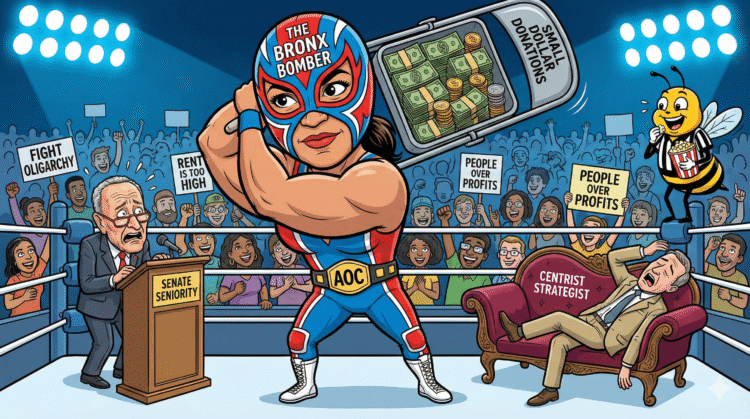
It has been seven years since a twenty-eight-year-old bartender from the Bronx looked at the decaying edifice of the Queens Democratic machine, ordered a seltzer, and then proceeded to bulldoze the entire building. We all remember the shock of 2018. We remember the “AOC phenomenon,” a phrase used by consultants to describe something they hoped was a fever dream. But here we are in late 2025, and the fever hasn’t broken. It has calcified into a political machine that is currently filling arenas in Salt Lake City and making K Street lobbyists consider early retirement.
Let’s be honest: I would absolutely love to see Alexandria Ocasio-Cortez go after the Senate seat. Not just because she would make an amazing senator—though the CSPAN clips of her dissecting private equity ghouls would be appointment television—but because the sheer panic it would induce in the Democratic establishment would be enough to power the Eastern Seaboard for a decade.
The “AOC phenomenon” is no longer a vibe; it is an infrastructure. While the pundits were busy tweeting about her tweets, she was busy building a fundraising apparatus that makes the DCCC look like a bake sale. She is currently on the “Fighting Oligarchy” tour with Bernie Sanders, a roadshow that is selling out venues usually reserved for pop stars or monster truck rallies. They are drawing crowds in Montana. If you can get ten thousand people to cheer for “structural economic reform” in Missoula, you aren’t just a politician; you are a movement.
This is where the panic sets in for the “Brooklyn brownstone to K Street” corridor. For years, the strategy was to pat her on the head, give her a committee assignment, and wait for her to burn out. Instead, she evolved. The “Twitter flamethrower” has quietly become an inside player with a staff more disciplined than a Prussian regiment. She has forged relationships with President Biden (who likely views her as a terrifying but necessary bridge to the youth vote) and Hakeem Jeffries. She endorsed Abigail Spanberger, a centrist former CIA officer, for Virginia governor, a move that caused heads to explode on both the far left and the center right.
It was a flex. It was a signal that she understands the long game better than the people who claim to invented it.
Now, the question hanging over every cocktail party in D.C. is simple: What does she want? Does she want Chuck Schumer’s perch in 2028, turning the Senate Majority Leader race into a generational cage match? Or does she want the big chair? The prospect of a democratic socialist from the Bronx at the top of the ticket is the kind of “fork in the road” that makes moderate strategists reach for the Xanax.
The polling is the delicious cherry on top of this chaotic sundae. National polls still show more voters view her unfavorably than favorably—a statistic her detractors cling to like a life raft. But here’s the thing about polarization: it works both ways. In a party reeling from Trump’s return, “unfavorable to the establishment” is a feature, not a bug. She faces deep suspicion from centrists who are still traumatized by the “defund the police” slogan, and she gets plenty of eye-rolling from internet leftists who think she’s compromised too much by hugging zionists or voting for budgets.
But that’s the sweet spot. If you are pissing off the New York Post and the World Socialist Web Site simultaneously, you are probably doing something effective.
The strategists are gaming it out. If she runs for Senate, she likely clears the field of any progressive challengers and forces Schumer into the fight of his life—or a graceful retirement. If she runs for President, she fractures the primary in a way that makes 2020 look like a tea party. She is leading massive rallies, co-sponsoring shutdown town halls, and pushing Gaza cease-fire resolutions with a relentless energy that makes the rest of the party leadership look like they are napping in a sensory deprivation tank.
So yes, let her run. Let her bring the “Fighting Oligarchy” energy to the Senate floor. Let her force the party to decide if it wants to be the party of the donor class or the party of the people filling arenas to hear about wealth taxes. The Democratic Party is at a crossroads, and frankly, it’s time to let the bartender drive.