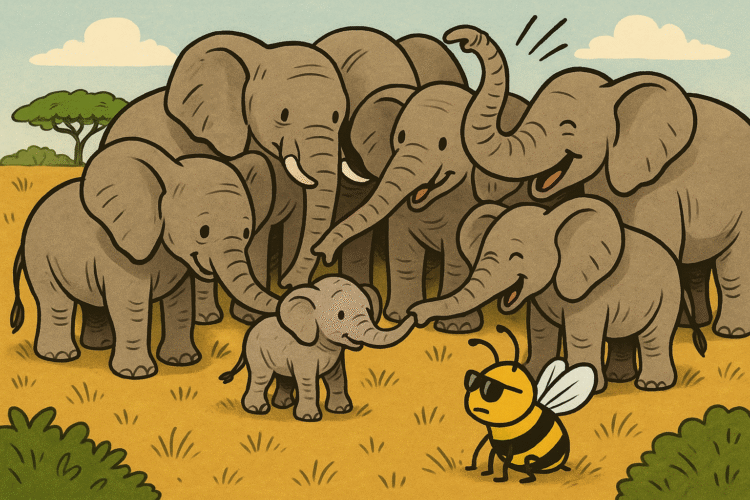
Out on the African savanna this week, an elephant gave birth.
No livestream.
No gender reveal explosion.
No toxic balloons released into the upper atmosphere to signal the biological inevitability of a mammal.
Just a herd. Present. Unapologetically together.
The newborn calf, somewhere between 200 and 260 pounds—about the weight of two campaign managers or one American family’s weekly Costco run—arrived into the world under open sky, surrounded by a semi-circle of gray giants who immediately responded by doing what humans no longer know how to do: showing up, staying close, and not posting about it.
No One Had to Text “Let Me Know If You Need Anything”
When the baby arrived, there was no fumbling for phone cameras. No polite delay. No Instagram carousel scheduled for 3 p.m. peak engagement. The herd didn’t check in later with vague platitudes and emotionally distant memes about “tribe” and “light.”
They encircled the newborn. Physically. Immediately. Intentionally.
They reached out—not with empty words, but with trunks. Trunks that touched gently, trumpeted loudly, and announced without translation: You’re here. We’re here. Let’s live.
One elephant stood near the calf’s flank. Another positioned herself near the mother’s head. A third kept her back to the scene entirely, scanning for predators. No one had to assign roles. No one had to debate boundaries. They moved in unison, without permission, because community isn’t something you RSVP for—it’s something you are.
Group Chat, But Functional
The celebratory trumpeting wasn’t for show. It was communication. Announcement. Alarm system and lullaby all at once. It meant: Something important just happened. This matters. Adjust accordingly.
Meanwhile, in our species, someone gives birth and half their friends vanish into “I didn’t want to intrude” silence, while the other half demand swaddled photos and postpartum positivity content like grief never happened in the same room.
Elephants don’t need a baby name poll.
They need each other.
That’s it. That’s the whole ecosystem.
260 Pounds of Collective Trust
This calf, still wobbling on legs like half-cooked spaghetti, entered a landscape filled with predators. Lions. Hyenas. Opportunists with teeth. And the only thing that ensures its survival is not how strong it is—but how tightly the herd closes ranks.
The baby doesn’t stand a chance alone.
But it was never meant to.
Because in the wild, safety isn’t an individual pursuit. It’s a formation.
And formation isn’t built by accident. It’s muscle memory. It’s who watched your mother give birth. It’s who knew your grandmother’s limp. It’s who slept near your shoulder when the storm came. Not once. Every time.
We like to believe we’ve evolved past this. We haven’t. We’ve just replaced it with ring lights and parenting books written by people with nannies.
The Elephant in Our Room
There was a time when human communities operated like herds—before capitalism rebranded exhaustion as independence. Before we mistook “boundaries” for “isolation.” Before we built houses with garages that sealed behind us like drawbridges.
Now, a baby arrives and people send DoorDash credit.
Elephants show up with their bodies.
They make a wall.
Not a metaphorical one. A literal one. Bone, muscle, and tusk all saying: No harm comes to this child unless it comes through me first.
Compare that to your HOA group thread where Carol still hasn’t returned the stroller she borrowed in April.
Final Thought
We like to call ourselves the dominant species. Superior. Evolved. But an elephant gave birth in the open air, and her sisters formed a living fortress before her placenta hit the ground.
That’s not primitive. That’s the blueprint.
Because survival isn’t about how loud you are.
It’s about who comes running when you cry out.
And that newborn didn’t need to prove it was worthy of protection.
It only had to exist.
And the herd said: Good enough.