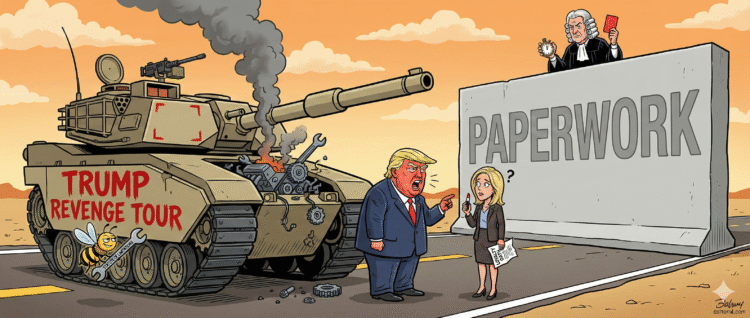
The most defining characteristic of the second Trump administration is not its malevolence, nor its incompetence, but its profound and unending awkwardness. We are constantly forced to watch the political equivalent of a man trying to high-five someone who is actively tying their shoe. This dynamic reached a crescendo of cringe this week when the White House prepared to unveil a grand, televised “fix” for the looming healthcare cliff, only to cancel the event, burn the press release, and send the press secretary out to tell the American public that we were all hallucinating.
The phantom event was supposed to be Donald Trump’s triumphant pivot. After spending forty-three days shutting down the government under the screaming banner of “no free Obamacare for illegals,” the President realized that come December 31, roughly twenty-two million actual voters are going to face a premium spike that will make the price of eggs look like a rounding error. He needed a patch. He needed a win. He needed to look like the “dealmaker” who could solve the affordability crisis that his own party has spent the last decade exacerbating.
So, his team cooked up a proposal. It was a classic Trumpian Frankenstein monster, a legislative creature stitched together from the rotting parts of old GOP talking points and the survival instincts of a desperate incumbent. According to detailed reporting from CNN, Politico, and the Associated Press, the plan was to extend the enhanced Affordable Care Act subsidies—the very ones Joe Biden passed—for roughly two more years. But to make it palatable to the Freedom Caucus, they slapped a MAGA hat on it.
The proposal reportedly included new income caps around seven hundred percent of the federal poverty level, a ceiling designed to look “fiscally responsible” while actually just adding more paperwork. It featured a mandatory minimum premium payment to kill “zero-dollar plans,” ensuring that the poorest Americans would have to pay something, anything, just to prove they have “skin in the game,” because apparently being too poor to afford a copay isn’t enough skin for the Republican soul. And, of course, it was sweetened with the usual conservative candy: expanded Health Savings Accounts (tax shelters for people who already have money) and rigorous “anti-fraud rules” (bureaucratic hurdles designed to kick people off the rolls).
It was perfect. It was cynical. It was a way to keep the subsidies flowing just long enough to get through the midterms while pretending to be tough on “welfare.” CNN had the graphics ready. The Centers for Medicare and Medicaid Services chief, Dr. Mehmet Oz—the man who turned the relentless pursuit of snake oil into a federal appointment—was scheduled to stand by the President’s side and nod sagely about “market-based solutions.”
And then, the Republicans saw it.
The implosion happened not on the podium, but in the cloakrooms. Congressional Republicans, who were apparently blindsided by a White House plan they had not vetted, erupted with the specific fury of a group that feels betrayed by their own leader’s sudden lucid moment of self-preservation. They were furious. They were confused. They were insulted.
You have to understand the psychology of the modern GOP to appreciate the irony here. Just months ago, these same lawmakers voted for the “One Big Beautiful Bill,” a piece of legislation that jacked up Medicaid work requirements and put millions of people at risk of losing coverage. They have spent their entire careers campaigning on the repeal of the Affordable Care Act. They have sworn blood oaths to destroy it. And now, here was Donald Trump, the avatar of their rage, asking them to vote for a bill that would technically extend Obamacare subsidies?
The cognitive dissonance was too much. The hardliners, the true believers who would rather see the healthcare system collapse than admit the government should help pay for insulin, demanded a fresh “repeal-style” mega bill through reconciliation. They didn’t want a patch; they wanted a demolition. They viewed the subsidies not as a lifeline for their constituents, but as a surrender to socialism.
Meanwhile, the swing-district Republicans—the poor souls representing suburbs where people actually like having health insurance—were terrified. They know that if the subsidies expire on December 31, their voters are going to open their bills in January and see premiums double or triple. They know this is political suicide. But they also know that if they vote for anything that looks like “shoring up Obamacare,” they will get primaried from the right by someone screaming about abortion and deficits.
Speaking of abortion, the “Hyde Amendment” paranoia kicked in immediately. Members privately fumed that any extension of subsidies would open up a new front in the abortion wars. They worried that if they attached Hyde-style restrictions to the subsidies, the Democrats would walk, and they would be blamed for the collapse. They worried that if they didn’t attach restrictions, the pro-life groups would primary them. They were trapped in a maze of their own making, and Trump had just dropped a minotaur in the center.
The result was a legislative abort sequence initiated at mach speed. The White House sensed the revolt. They realized that putting Dr. Oz on television to sell a plan that the Speaker of the House wouldn’t touch was a recipe for a news cycle disaster. So, they pulled the plug.
Enter Karoline Leavitt, the White House Press Secretary whose job description increasingly involves looking into a camera and denying the existence of physical objects. She was sent out to dismiss the detailed, sourced reporting about the plan as “mere speculation.” She insisted no event had ever been scheduled. It was a “Jedi mind trick” performed by someone who flunked out of the Academy. We saw the schedule. The reporters were in the briefing room. The chyron was written.
But in Trump’s Washington, reality is negotiable. If the plan failed, the plan never existed.
This fiasco is not just a story about a canceled press conference. It is a perfect microcosm of the broader paralysis gripping the American government in 2025. Trump is stuck. He has painted himself into a corner with his rhetoric. He spent forty-three days shutting down the government to prove he was tough on “illegals” getting healthcare, a straw man argument that collapsed under the weight of its own irrelevance. Now, he needs a short-term subsidy patch to prevent election-year rate shock. He needs the very thing he demonized.
But his party is too ideologically invested in hating the ACA to embrace a band-aid. They have spent fifteen years radicalizing their base against the concept of federal healthcare subsidies. They cannot turn around and vote for them just because the math says they should. They are prisoners of their own propaganda.
So we are left with this surreal dynamic. The White House is floating half-baked frameworks that die in the sunlight. Republicans are sniping over whether to stuff these ideas into another giant “reconciliation monster” bill that has zero chance of passing. Democrats are split between cautiously engaging—because they actually want people to have healthcare—and blasting the outline as a rebrand of failed GOP ideas.
The “mandatory minimum premium” idea is particularly revealing. It exposes the cruelty at the heart of the conservative healthcare vision. The obsession with killing “zero-dollar plans” is not about economics; it is about morality. They believe that if a poor person gets healthcare for free, it is a moral failing. They believe that forcing someone who makes $15,000 a year to pay a monthly premium is necessary to build character. It doesn’t matter that the administrative cost of collecting those premiums often exceeds the revenue generated. It doesn’t matter that it will cause thousands of people to drop coverage because they simply can’t navigate the billing system. The cruelty is the point.
And the Health Savings Account expansion? That is the cherry on top of the insult. HSAs are great if you have disposable income to save. They are useless if you are living paycheck to paycheck. Expanding them is not a solution for the working class; it is a tax cut for the upper middle class disguised as healthcare reform. It is a way to funnel more money into the financial markets while pretending to help the sick.
The collapse of this “fix” leaves us staring down the barrel of December 31. The clock is ticking. The insurers are nervous. The state exchanges are trying to figure out what rates to publish. And the people in charge are arguing about optics.
This is the tragedy of the moment. The American healthcare system is a broken, leaking, expensive mess. It is crushing families. It is bankrupting seniors. It is a national embarrassment. And the only people who have the power to fix it are currently locked in a room, screaming at each other about “fingerprints.”
The Republicans don’t want their fingerprints on a fix because they hate the law. Trump doesn’t want his fingerprints on a failure because he hates losing. So they do nothing. They cancel the speech. They delete the draft. They pretend the problem doesn’t exist.
Meanwhile, somewhere in a swing district, a family is looking at their renewal notice and wondering how they are going to pay for their daughter’s asthma medication next year. They don’t care about the Hyde Amendment. They don’t care about “skin in the game.” They don’t care about the internal politics of the Freedom Caucus. They just want to know if the doctor will still see them in January.
The answer from Washington is a resounding “maybe.” The answer from the White House is “mere speculation.” The answer from the GOP is “we’re working on a concept of a plan.”
We are watching the same crew that broke the health system argue over whether they can stomach temporarily fixing the one part that keeps premiums from exploding. They are the arsonists who are debating whether it is ideologically consistent to use a fire extinguisher. And while they debate, the sparks are falling on the roof.
Dr. Oz may have been scrubbed from the schedule, but the snake oil salesmanship remains. The administration is trying to sell us the idea that they are competent stewards of the public health, while simultaneously proving they cannot even organize a press conference to announce a policy their own party hates. It is a farce. It is a tragedy. And come January 1, it is going to be a bill that every single one of us has to pay.
Receipt Time: The Cost of Incompetence
Let’s be clear about what “mere speculation” actually looks like when it hits your bank account. If the enhanced subsidies expire, the Department of Health and Human Services—the agency Dr. Oz supposedly runs—estimates that premiums will effectively double for millions of enrollees. We are talking about an average annual increase of hundreds, sometimes thousands, of dollars for families who are already being crushed by the cost of living. This isn’t abstract. This is rent money. This is grocery money.
The “One Big Beautiful Bill” that Republicans already voted for set the stage for this. By pushing for Medicaid work requirements, they have already signaled that they view coverage as a privilege to be earned, not a right to be protected. The proposed “fix” was just an extension of that philosophy: help, but only if we can make it painful. Help, but only if we can punish you a little bit for needing it.
The fact that they couldn’t even agree on that—the fact that a plan designed to be cruel wasn’t cruel enough for the hardliners and was too scary for the moderates—tells you everything you need to know about the state of the governing party. They are paralyzed by their own hatred of the safety net. They have spent so long convincing their voters that Obamacare is the devil that they cannot bring themselves to save it, even when their own political survival depends on it.
So, the podium stays empty. The press secretary lies. And the deadline gets closer. The “art of the deal” has become the art of the denial. And the only thing “beautiful” about this situation is the perfect, crystalline clarity with which it reveals the absolute moral bankruptcy of the people in charge.