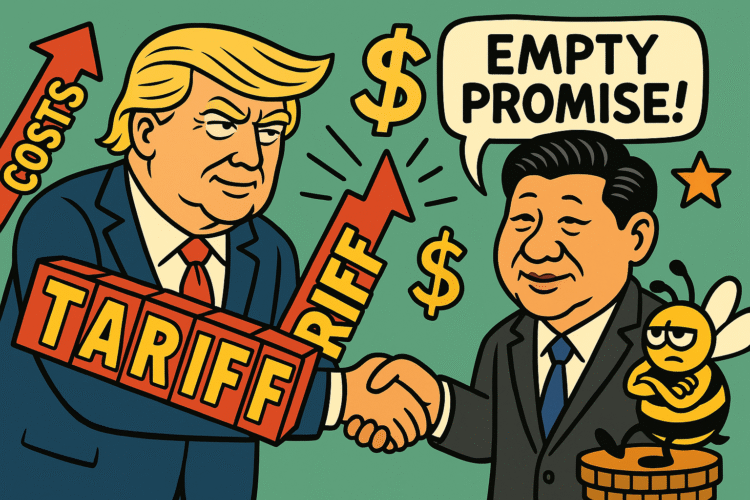
It takes a special kind of genius to spend ten months lighting the economy on fire only to celebrate putting out one match. President Donald Trump has done it again, staging a “historic tariff breakthrough” that cuts the fentanyl import duty from 20 percent to 10 percent and lowers the overall average tariff rate from 57 percent to about 47 percent after his summit with Xi Jinping in Busan.
The deal, announced in front of flags, cameras, and a very confused interpreter, trades real tariff relief for verbal promises that Beijing will “work very hard” to curb the export of fentanyl precursors. China, in return, delays its rare earth export restrictions for a year and throws in a few soybean purchases. The result is textbook Trumponomics: a self-inflicted crisis dressed up as a win, where the scoreboard reads “China 1, America 0, Trump +50 retweets.”
The Tariff Odyssey
Back in January, Trump’s second-term trade team rolled out an aggressive tariff schedule that raised average duties on Chinese imports to nearly 57 percent. The official line was “strategic decoupling.” The actual effect was Walmart panic, farmer despair, and every electronics manufacturer calculating how many times they could say “Made in Mexico” before the auditors noticed.
China responded predictably: retaliation on U.S. agricultural exports, new tech alliances with Southeast Asia, and a formal complaint to the World Trade Organization alleging the U.S. duties undermined joint work on fentanyl control. In simpler terms, Beijing told Washington, “You can’t lecture us about drugs while you’re taxing the antidote.”
By spring, fentanyl precursor shipments from China slowed—not because of enforcement, but because of paperwork gridlock caused by the tariffs themselves. Pharmacies saw shortages in basic medical supplies. Customs warehouses filled with confiscated containers marked “chemicals of concern.” The irony was visible from orbit.
Summer: The Brinkmanship Gets Dumber
As the trade war stretched into summer, Trump’s economic team split into camps. Treasury wanted a partial rollback to ease inflation. USTR wanted new conditions on AI hardware. Trump wanted whatever would make a better chyron on Fox News.
The markets played along. Every tariff threat sparked selloffs. Every rumor of a “breakthrough” produced a sugar high. By August, consumer prices were still climbing, farm bankruptcies ticked up, and the political slogan “America First” had quietly evolved into “America, Please Hold.”
Enter the fall summit season, where Trump planned to meet Xi in South Korea. His advisers pitched it as an opportunity to “reset the tone.” What they didn’t mention was that the tone had already shifted from negotiation to hostage video.
Busan: The Handshake Heard Around Wall Street
The meeting lasted ninety minutes, which is either a diplomatic milestone or the length of a mediocre golf round. Cameras captured the handshake, the flags, and Trump declaring that “China has promised to work very hard to stop the flow of fentanyl.”
In exchange, he cut the fentanyl tariff in half.
The problem is that fentanyl production isn’t about import duties. It’s about chemical enforcement, border control, and supply chain transparency. Tariffs don’t stop precursors. They just make them more expensive to track.
Beijing’s promise to “work very hard” is not a binding legal commitment. There’s no measurable target, no enforcement mechanism, and no defined timeline. What there is, however, is a clear economic outcome: Chinese exporters get a rate cut, American importers get relief from the mess Washington created, and the White House gets to call it a victory.
The Political Theater of “Toughness”
Trump’s trade policy has always been less about outcomes and more about optics. To the base, “tough on China” polls better than “competent with numbers.” So tariffs serve as stagecraft—a way to conjure enemies, assign blame, and promise redemption through transaction.
The problem is that tariffs are taxes by another name. When you raise them, prices rise. When you cut them, prices take months to adjust because corporations don’t pass savings along instantly. The net result after ten months of volatility is inflation that still bites and industries that have learned to live with chaos.
This latest reversal lowers the average tariff rate to around 47 percent, which sounds like progress until you remember it started at 25 percent before Trump’s trade war 2.0 began. We’re cheering a partial climbdown from a mountain we built ourselves.
The Economic Body Count
Here’s the thing about market “wins.” They only count if you measure something real.
In manufacturing, factory orders dropped by 9 percent between March and September as companies paused imports and shifted sourcing. Agricultural exports to China fell nearly 15 percent as Beijing targeted soybeans and corn. Supply chains rewired themselves through Vietnam and Mexico, where firms found creative ways to slap new origin labels on the same Chinese components.
Meanwhile, consumer electronics prices rose an average of 8 percent, contributing to inflation that wiped out any wage gains for most households.
Now, after nearly a year of this, the administration is bragging about tariff relief that restores conditions closer to what they were when this mess started.
If you set your own house on fire, you don’t get credit for putting it out.
The Legal and Bureaucratic Maze
Even the rollback isn’t straightforward. For any tariff change to take effect, it must appear in the Federal Register and be implemented by U.S. Customs and Border Protection (CBP). That means forms, guidance, and review periods.
As of this writing, no official document specifies when the new rates will apply. Importers don’t know whether the 10 percent fentanyl tariff starts immediately or after a bureaucratic lag. Exporters don’t know if the soybean concessions include volume guarantees or token shipments.
And the so-called Memorandum of Understanding (MOU) between Washington and Beijing? Not public. If it exists at all, it’s likely a set of talking points dressed as policy.
In the meantime, Trump gets to stand at a podium and announce victory while the government accountants quietly calculate how much revenue just evaporated.
The Real Winner: China
The genius of Beijing’s playbook is patience. China didn’t concede anything measurable. The promise to “work very hard” on fentanyl enforcement costs nothing. The delay on rare earth export curbs buys them goodwill without sacrificing leverage. The soybean purchases are symbolic gestures meant to soothe Midwest voters, not to rebalance trade.
In practical terms, China pocketed tariff relief, avoided escalation, and preserved its strategic options. America, by contrast, spent a year paying higher import costs, hemorrhaging goodwill with allies, and walking away with a deal that reads like a memo from an improv class.
If this were a chess game, Trump just traded a queen for a compliment.
The Security Context: The World Watches, Amused
Global markets watched the Busan handshake with a mix of amusement and dread. European leaders privately mocked the spectacle as “tariff theater.” Japan and South Korea, whose economies also hinge on trade with China, quietly adjusted their supply chain hedges.
Meanwhile, Russia expanded its own energy and rare earth export channels, stepping into any gap left by U.S.-China friction.
The world learned an old lesson in a new way: when America plays checkers, everyone else plays for the long game.
The Human Consequence of “Economic Patriotism”
Beneath the geopolitics lies the simple reality that tariff wars hurt workers first.
Truckers, dockworkers, warehouse staff, and small business owners have spent ten months navigating fluctuating costs. Every time the administration changed a rate, they changed their invoices. Every time a shipment stalled, someone lost a paycheck.
Now, as tariffs roll back, these same people won’t see a refund. Their year of instability becomes a rounding error in a press release.
The next time someone says tariffs make America strong, ask them how strong your wallet feels at the grocery store.
The Accountability Mirage
The administration insists the tariff cuts are “proof that the President’s tough stance works.” That’s the same logic a doctor might use after giving you food poisoning and then selling you the antidote.
There’s no independent oversight, no published enforcement mechanism, no measurable outcomes. We’re left waiting for five key signals to see whether anything real happens:
- Whether the Federal Register posts binding guidance with effective dates and product categories.
- Whether CBP and USTR publish a verifiable MOU outlining fentanyl reduction targets.
- Whether fentanyl precursor seizures decline in measurable ways.
- Whether rare earth exports stay unrestricted beyond one year.
- Whether consumer prices actually fall.
Until then, all we have is a handshake and a headline.
The Political Spin Cycle
On conservative media, the announcement became instant gospel. Pundits hailed “a victory for American workers” even as those workers continue paying inflated prices. Progressive outlets mocked the spectacle but risked underplaying the systemic damage of ten months of policy whiplash.
Moderate economists sighed, as they always do, and pointed to the spreadsheet: a year of reduced competitiveness, higher consumer costs, and lost credibility in trade governance.
But for Trump’s political machinery, none of that matters. What matters is the optics—a president “fixing” the mess he made. It’s governance as performance art, where applause counts more than arithmetic.
The Illusion of Control
Tariff policy has become America’s favorite placebo. It gives the illusion of control over forces far larger than any one administration. Supply chains, global demand, automation, and corporate greed are not subject to executive order. Yet we keep pretending they are.
The Busan summit was not a victory. It was a receipt. It showed how much we paid for a year of economic theater and how cheaply we sold the encore.
If the goal was to look strong, mission accomplished. If the goal was to achieve something measurable, check again next fiscal year.
Section Title: The Receipt at the End of the Show
A nation’s economic policy should not read like the world’s most expensive punchline.
We spent ten months paying higher prices, watching supply chains buckle, and pretending tariffs were weapons instead of taxes. Then we declared victory for undoing a fraction of the damage.
China got leverage. Trump got a headline. America got the bill.
And in the final act, the only thing more inflated than the tariffs themselves is the ego that called this a win.